
•
Hey everyone, and welcome back to the On-Chain Mind Newsletter.
Today we’re diving into 10 great questions submitted by you about on-chain metrics, market cycles, MSTR, forex and the upcoming new platform!
There’s a lot of great questions again, so let’s dive straight in!
1. How Confident Are You in the 4-Year Cycle?
Question: I saw on X that you were leaning away from 4-year cycles. Can you elaborate, considering how Ben Cowen explains that the S&P 500 typically dips every 4 years?
My Thoughts: Ultimately, I believe we have to lean away from rigid 4-year cycles. One challenge is that everyone measures them differently. Some count from the previous bear market bottom, others from the cycle top, and others from the halving. The “number of days” since a certain price doesn’t hold up as a robust theory in my mind, so I don’t base decisions on it.
Early Bitcoin cycles were materially affected by the halvings, but today global liquidity and macro factors exert a far more dominant impact on price action. Markets move in peaks and troughs as central banks adjust policy, and both the S&P 500 and now Bitcoin reflect those broader cycles. Sticking to a fixed 4-year number rather than letting the underlying data guide your decisions will likely get you burnt or holding the bag. It’s far more reliable to focus on observable trends than arbitrary calendar points.
2. Global M2 Growth and Bitcoin Price
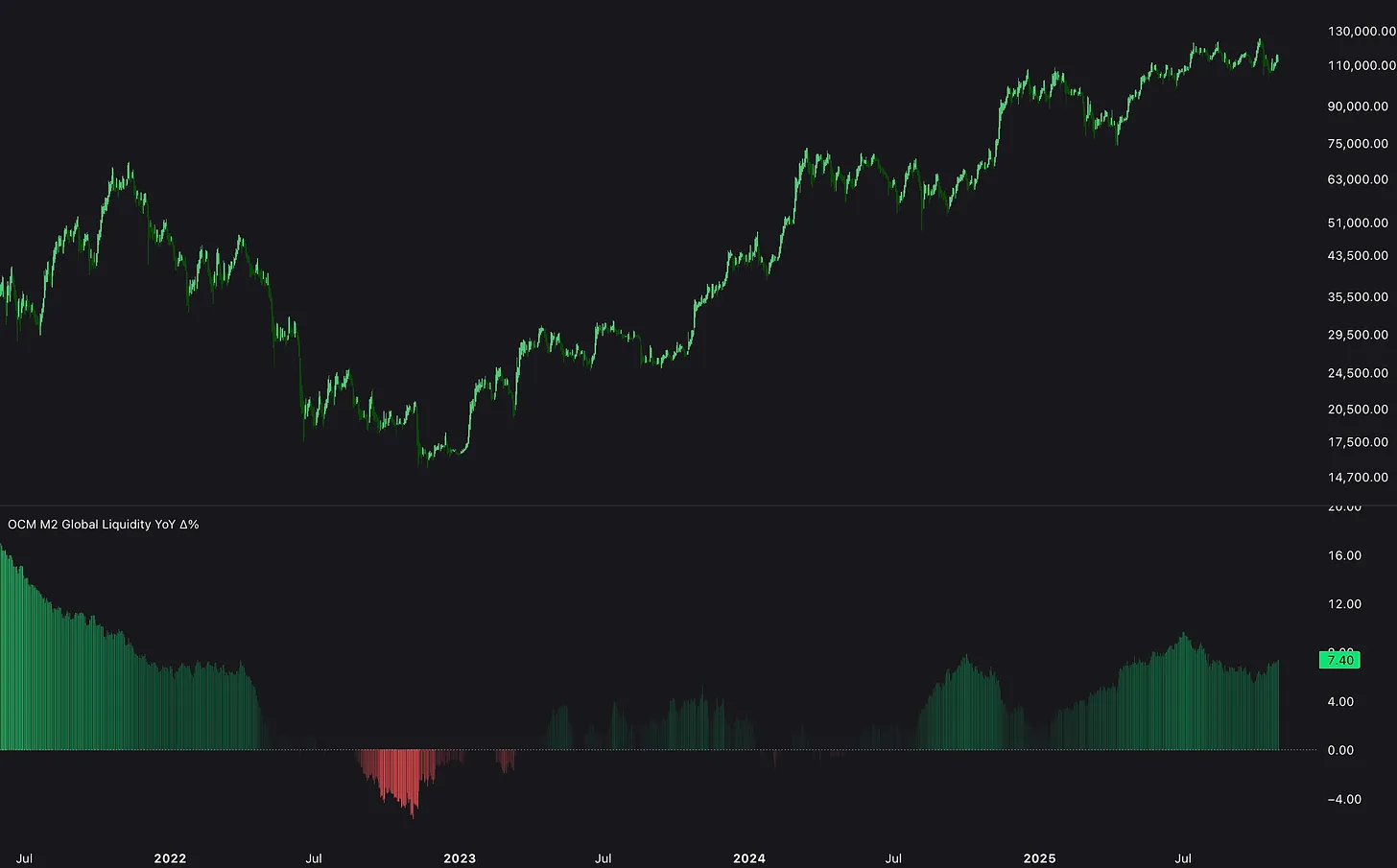
Question: Does YoY M2 growth with a 90–120 day lag really influence Bitcoin? Could BTC reflect this trend early next year?
My Thoughts: I’m a strong believer that overall liquidity expansion or contraction correlates very closely with Bitcoin price over macro timeframes. You can match up M2 growth to BTC price with a lag of roughly 90–120 days, but obsessing over the exact number of days is less useful than understanding the trend. Currently, M2 YoY is expanding at 7.3%, and Bitcoin’s price is reflecting that trend. Focus on the macro trajectory rather than precise timing. If the trend continues, Bitcoin is likely to mirror it, though the exact timing will always have some variance.
3. How Likely Is BTC to Wick Down to $101k Again?
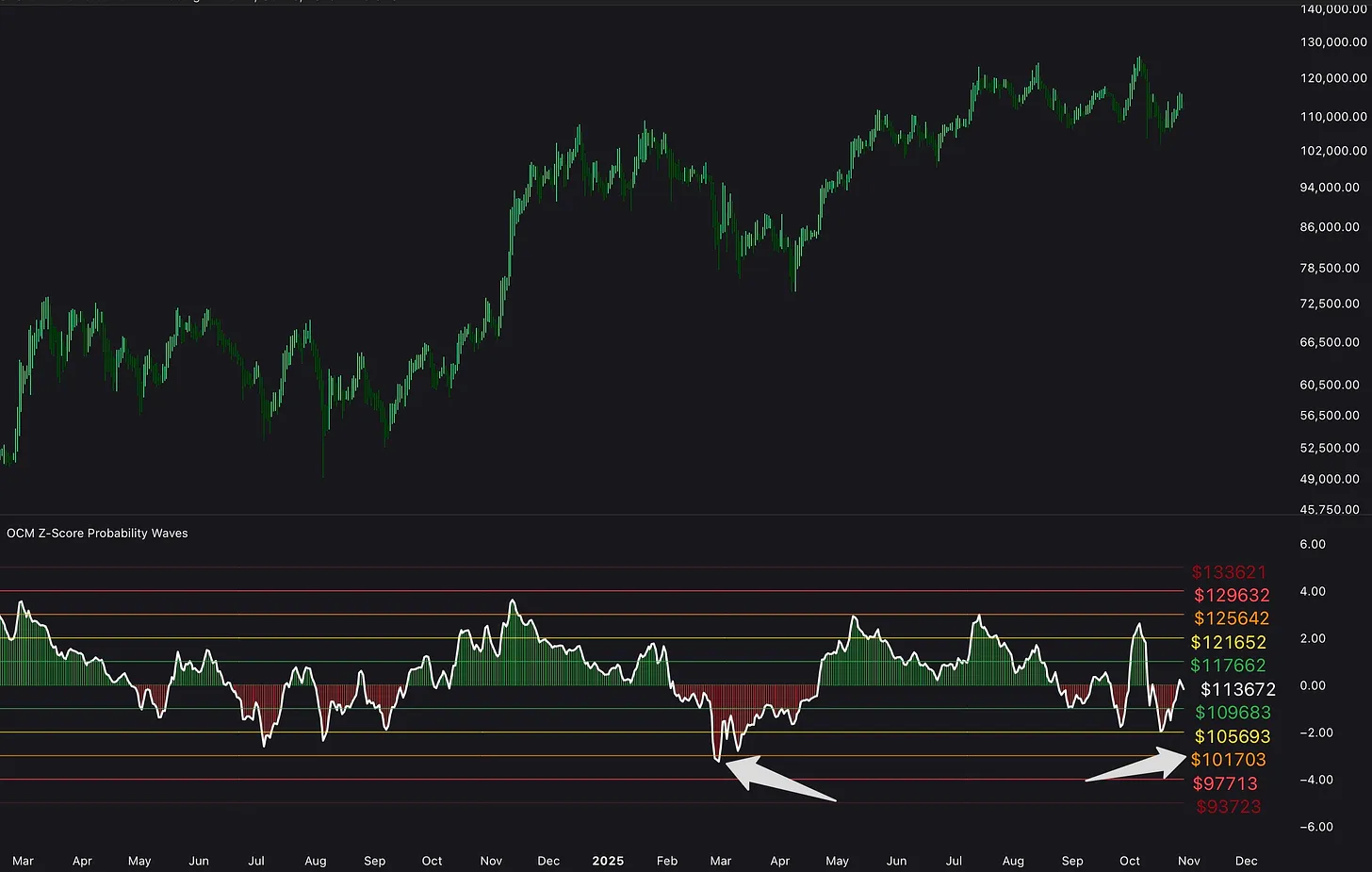
Question: Could Bitcoin revisit $101k?
My Thoughts: According to the Z-Score Probability Waves, my favourite statistical tool, $101k is a -3 standard deviation event. Statistically, it’s quite unlikely, but not impossible. As we saw in February 2025, we experienced a -3 SD event when the market wicked down to $80k before bouncing back. So, while it could happen, the probability is much lower than the market moving higher from here. It’s a rare tail event, not a baseline scenario, but always something to be aware of.
5. Upcoming Website and Premium Access
Question: You mentioned a website coming. What will be included, and will premium subscribers have access?
My Thoughts: The website is going to be a massive improvement over the current setup. It will host my existing TradingView indicator suite plus a completely new range of on-chain, derivatives, and other market data that TradingView simply cannot accommodate. The aim is to create a one-stop hub for every type of Bitcoin data you could possibly want. Premium subscribers will keep their current subscription price and receive full access to the new site. Once fully built, prices will probably rise, and the target launch date is the end of 2025. You guys will be the first to know about it. Exciting times ahead!
6. Thoughts on Forex Trading
Question: What’s your view on forex?
My Thoughts: Personally, I don’t trade forex anymore. Early in my investing/trading journey, I used it to learn technical analysis, and it’s a solid training ground. But when it comes to generating alpha, crypto is far superior, especially with on-chain analysis. In forex, everyone has access to similar tools, and many rely on highly optimised algorithms. In crypto, a well-built on-chain toolkit provides a distinct edge that I simply cannot recreate in the forex market.
7. Cycle Indicators for the S&P
Question: Will you create cycle top/bottom indicators for the S&P, or is Z-Score Probability Waves sufficient?
My Thoughts: The Z-Score Probability Waves works really well for equities, allowing me to time rotations in and out of specific stocks and indices like the S&P effectively. Cycle top/bottom indicators are purely on-chain, so they only function for assets like Bitcoin. That said, many of the Trend & Momentum tools in the suite are also excellent for equities, so check them out if you’re looking for medium-term trend timing.
8. MSTR’s Influence on On-Chain Signals
Question: How do you model MSTR’s leveraged, programmatic buying? Could it distort on-chain metrics?
My Thoughts: MSTR’s programmatic accumulation acts as a quasi-algorithmic bidder, injecting demand irrespective of spot price (although it does tend to buy more as price is rallying). As an on-chain analyst, you can isolate its impact by tracking labelled inflows/outflows tied to MSTR’s OTC desks (via Arkham Intelligence entity tags). This filters “inorganic” supply from organic HODLer behaviour. Although, I’m not sure how much you would gain from it.
Does it distort core signals? Moderately. Long-Term Holder (LTH) Supply includes MSTR’s coins once aged >155 days, inflating apparent HODLer conviction. Coin Dormancy rises artificially from their low-velocity stacking. To correct, you could subtract known corporate treasuries in adjusted metrics, revealing “true”retail/institutional sentiment beneath. But overall, treasuries and the ETFs don’t distort on-chain signal, it’s still rich as ever.
9. Using On-Chain Metrics for Shorter Timeframes
Question: Can on-chain metrics be used for short-term entries?
My Thoughts: On-chain data is inherently a mid- to macro-level tool. It’s excellent for spotting broader trends and cycle-defining points but less useful for minute-to-minute timing. For medium-term trades, I combine on-chain insights with lower-timeframe technical analysis to optimise entries. The “Trend & Momentum” and “Probabilities & Statistics” sections of the suite are perfect compliments for this. Essentially, on-chain gives the directional thesis, while technical analysis pinpoints the execution.
10. How Big Could the Next Drawdown Be?
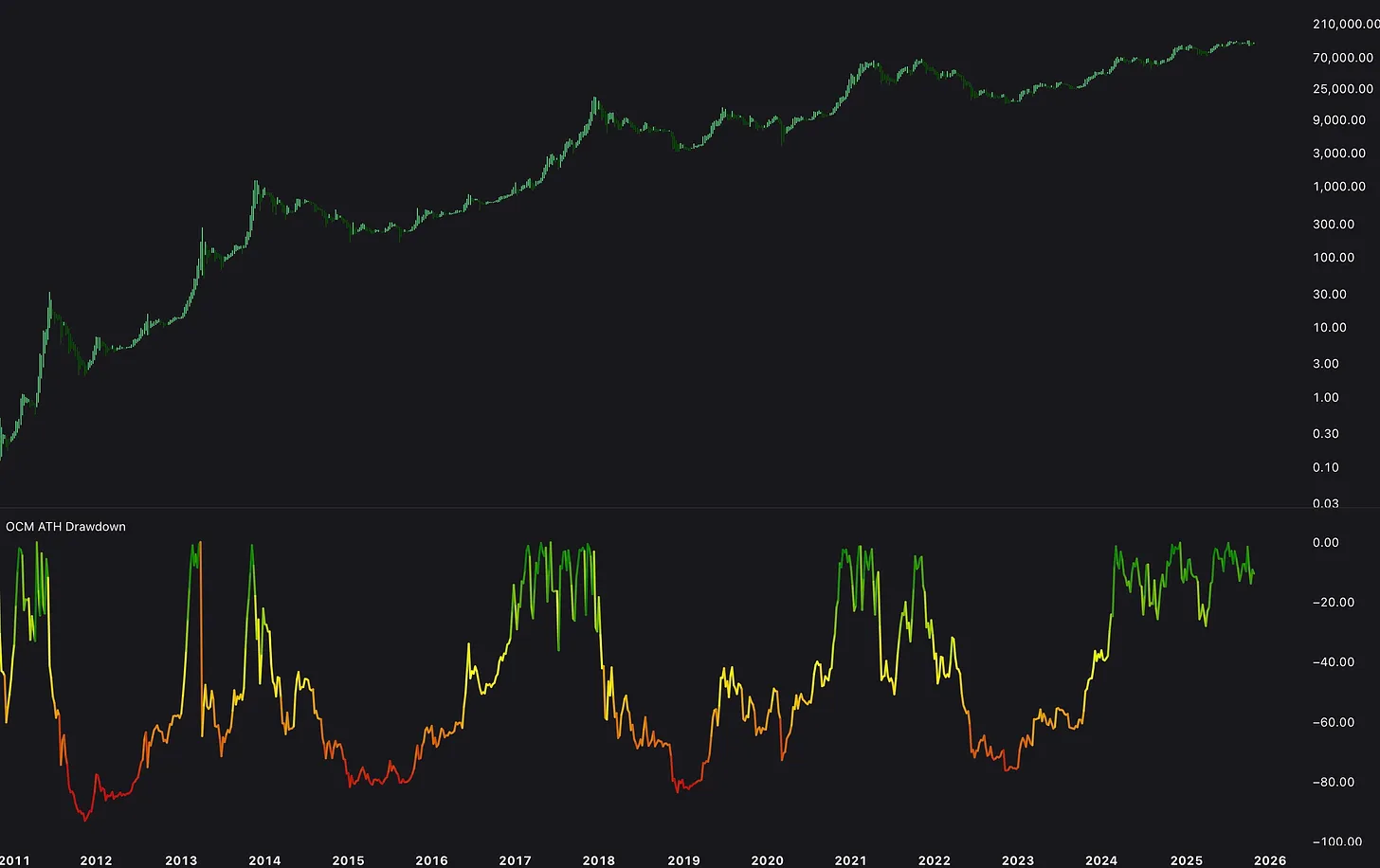
Question: What’s your expectation for the next drawdown?
My Thoughts: Every single cycle so far has experienced 70%+ drawdowns from the all-time high, following the final parabolic rally. The principle is simple: the harder the rally, the harder the fall. This cycle has been more measured, but we should still prepare for a minimum 50% drawdown. How far it eventually falls depends on how the cycle concludes, but history shows that even steady rallies can see sharp retracements in Bitcoin. My educated guess is a minimum 50% correction remains probable, but I’ll be monitoring any parabolic acceleration as a leading indicator of deeper pain.
I’ll catch you in the next one.
Cheers,