
Spotting the Local Bottom in a Liquidation Cascade
Recently, the Bitcoin market saw a dramatic event: over $10 billion in futures positions evaporated in just 24 hours. Some are calling it the “final capitulation” before the next bear market, but from my perspective, it actually looks like a classic structural reset.
In this article, we’ll break down how the flush unfolded, why it likely doesn’t signal the end of the bull market, and how you can interpret the key on-chain and derivative metrics to navigate this accumulation opportunity.
Let’s get into it.
A Forced Deleveraging: Open Interest fell 22% in a day, far outpacing Bitcoin’s 13% price drop. This indicates liquidations, not mass spot-market selling.
Liquidation Spikes Signals Structural Lows: The 3rd largest long liquidation in 3 years has marked a potential turning point.
On-Chain Support Holds: Bitcoin remains above the short-term holder cost basis (~$113,000), maintaining my bullish framework.
Risk Metric Reset: The Short-Term Risk Score dropped from 47% to 38%, creating accumulation-friendly conditions.
A Flush, Not a Freefall
The recent collapse in Bitcoin futures open interest was staggering. From roughly $45 billion to $35 billion in a single day — a 22% contraction. Meanwhile, Bitcoin’s price fell from around $124,000 to $107,000 — a 13% decline.
That difference is crucial. Open interest fell nearly 62% more sharply than price, a clear sign that derivatives markets (not spot holders) were driving the move. Margin calls, cascading liquidations, and forced deleveraging swept through both long and short positions, leaving spot investors largely intact.
This is a classic market detox. In bull cycles, open interest naturally inflates as traders pile in with leverage. Volatility spikes trigger violent unwind events, which are painful in the moment, but healthy in the long run. Once the smoke clears, the market is left with cleaner positioning, fewer over-leveraged traders, and a healthier structural foundation.
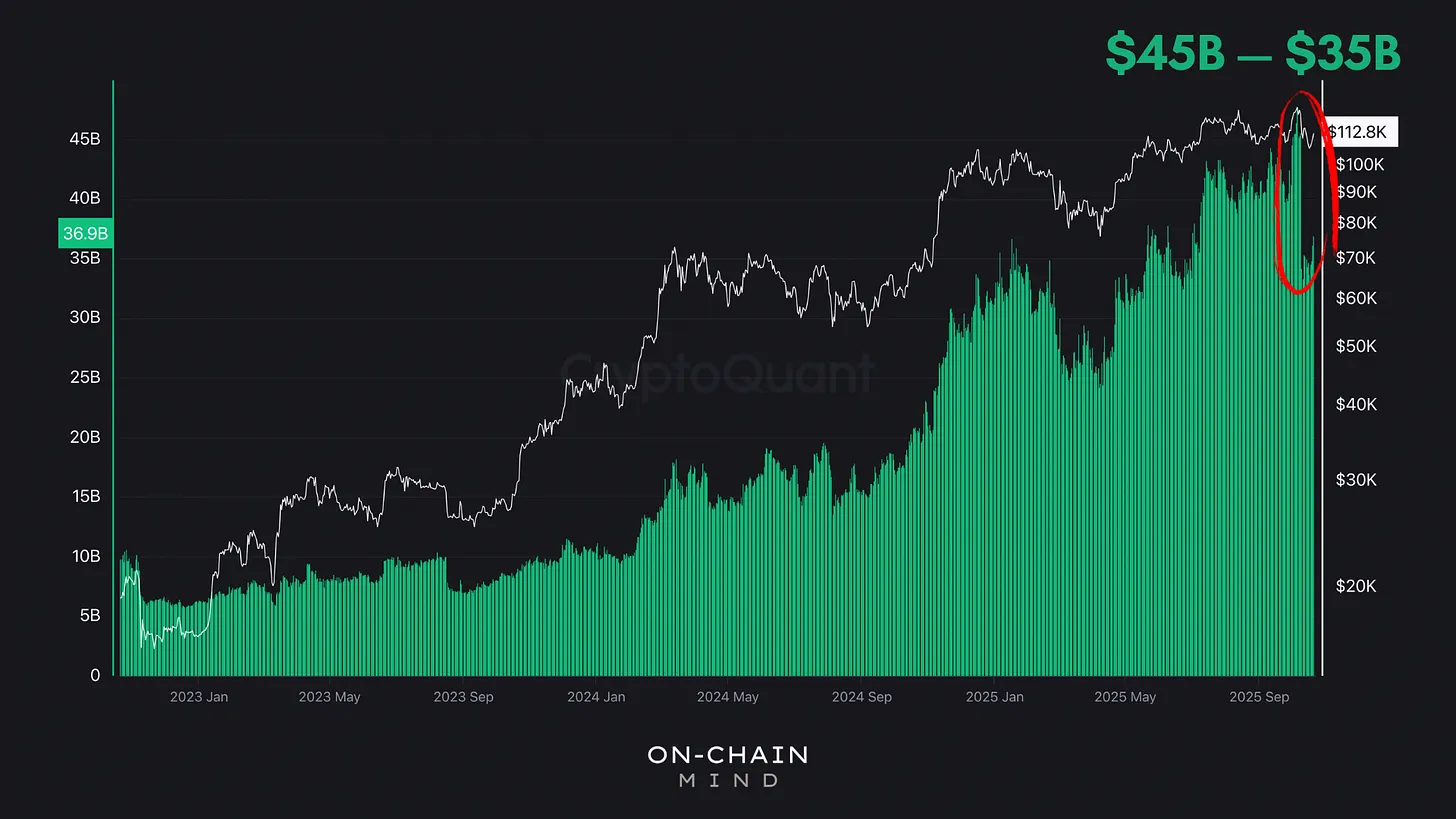
Open interest represents the total number of outstanding contracts, reflecting speculative interest. A sharp decline often correlates with reduced volatility in the short-term, as the “hot money” exits, creates a lower-risk entry point. It’s painful, but essential for robust growth.
Liquidation as a Signal
Looking deeper, this was the 3rd largest long liquidation in 3 years. The previous 2 coincided with major cyclical turning points:
The absolute capitulation bottom of the prior bear market.
The retracement to around $80k after Bitcoin’s initial surge to $100k.
In each case, liquidation spiked dramatically, then began tapering, signalling that the worst of the forced selling had passed. But what usually happens next? Well normally, the market stabilises and resumes its uptrend.
A long squeeze works like this: traders with too much leverage on the upside are forced to sell as prices fall, pushing the market down temporarily. Once the over-leveraged positions have been cleared, the market stabilises. Historically, these moments mark structural lows, not the end of cycles.
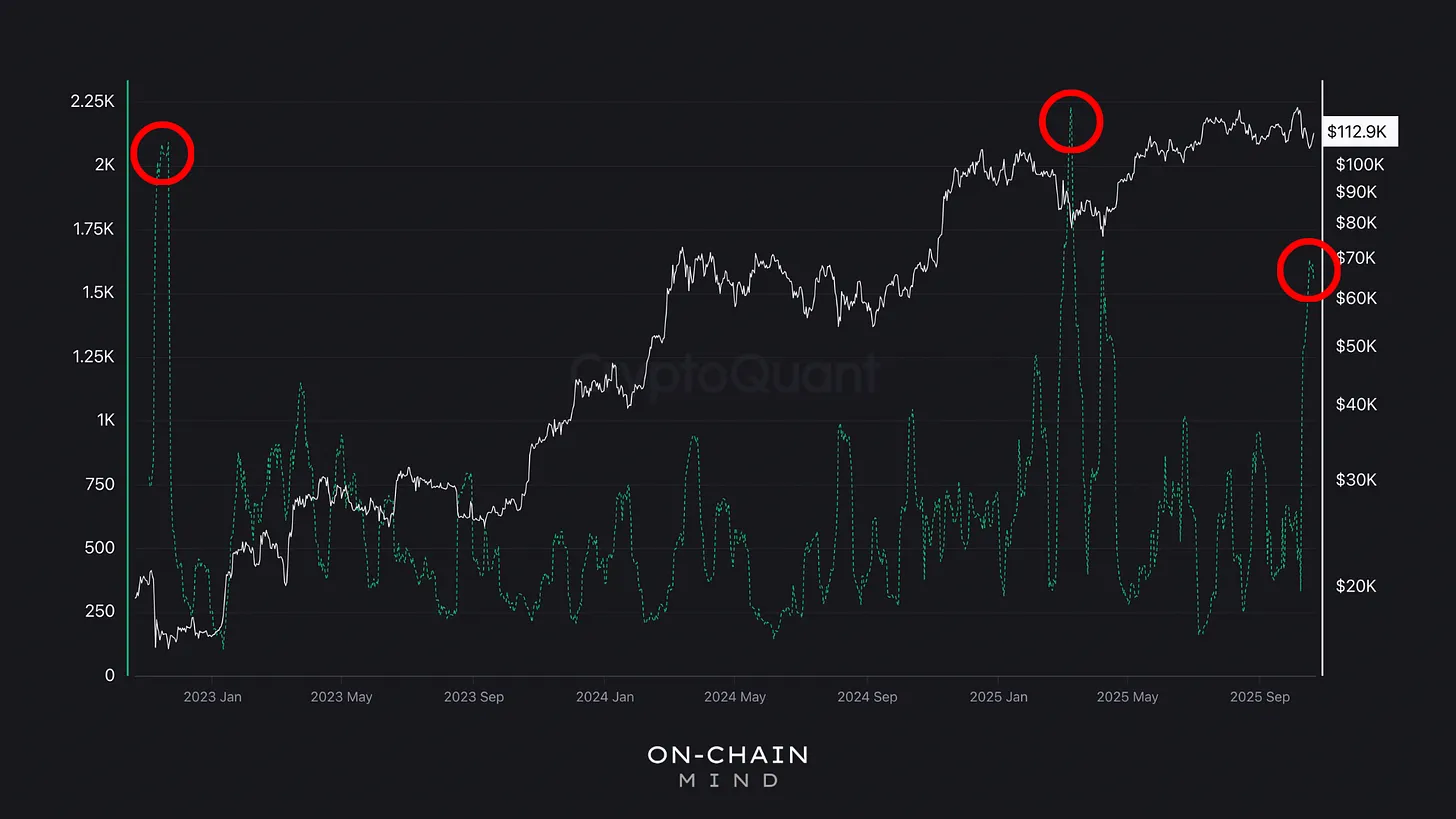
These patterns in long liquidations aren’t coincidental. In a long squeeze, overleveraged bulls are forced to sell as prices fall, exacerbating the decline. Once the cascade ends, however, the selling pressure dissipates as there’s simply no one left to liquidate.
Market Structure Through Futures
One of the clearest ways to understand what just happened is by looking at the Futures Long-Short Liquidation Dominance chart. This simple tool shows whether longs or shorts are being wiped out more heavily.
Historically, heavy long liquidations act as a contrarian signal: when over-leveraged longs are forced out, it usually marks the point at which buying opportunities emerge. Conversely, if shorts are being squeezed, the market is overextended, and chasing moves becomes risky.
Right now, the chart is solidly in the green zone, indicating that long positions have been heavily flushed. This aligns perfectly with the view of a structural reset. Speculative excess has been purged, positioning is cleaner, and opportunity is quietly returning to the market.
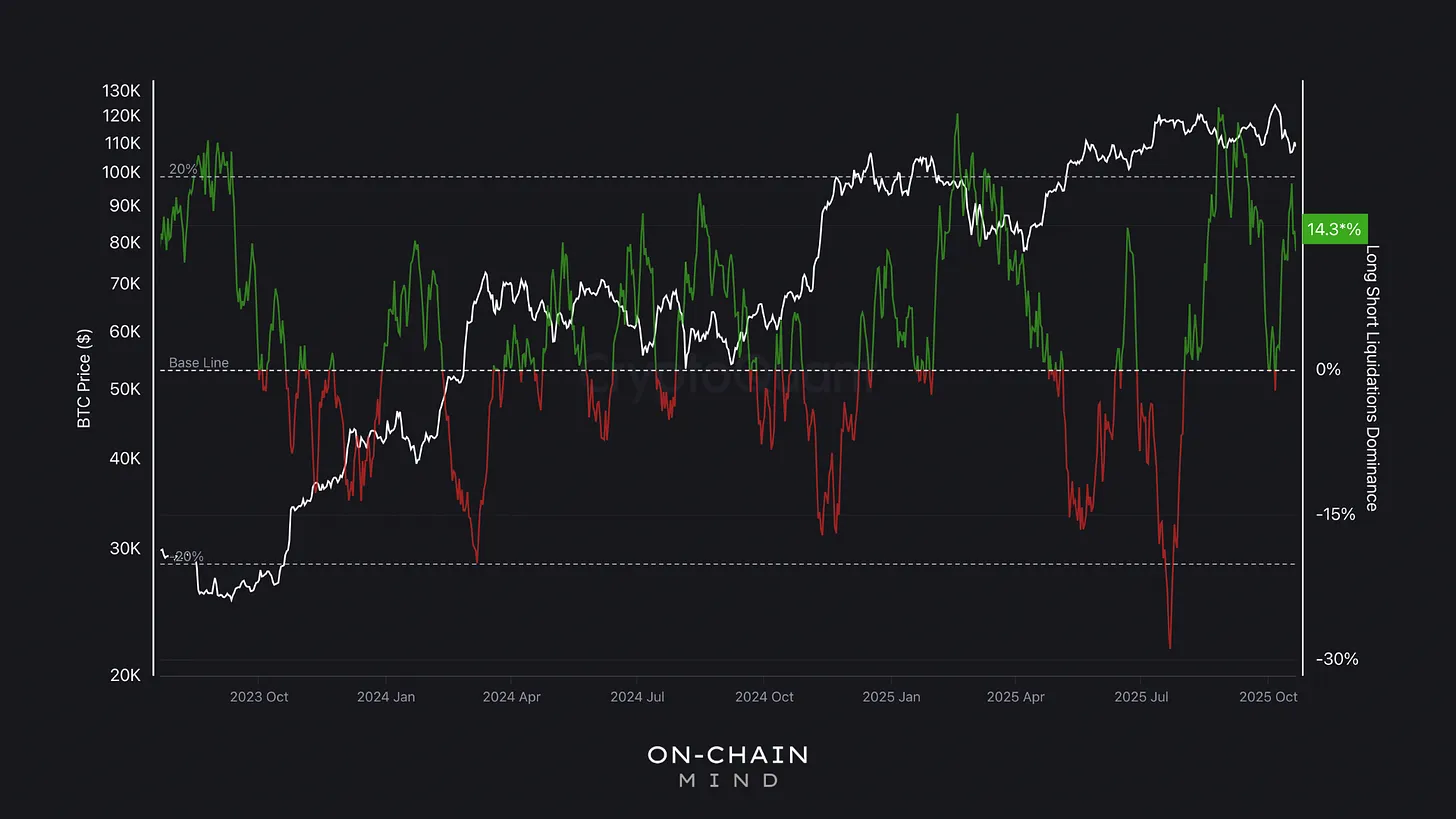
Green = long liquidations outpacing shorts, red = the inverse. Green zones act as contrarian buy signals, indicating washed-out longs and cleaner positioning. Red warns of potential overextension.
On-Chain Support
Beyond derivatives, on-chain structure provides crucial context. Bitcoin’s price is currently hovering around the short-term holder cost basis at roughly $113,000. This level represents the average acquisition price for coins held less than 155 days,representing the most recent buyers — often the most reactive cohort.
This is one of the most important support zones in a bull market. As long as the price remains above this white line, the ongoing bull thesis holds firm. Breaching it and testing it as resistance would signal that short-term holders are under pressure and market dynamics are shifting.
But for now, the support is intact, meaning that despite the large futures flush, the underlying market structure remains robust.
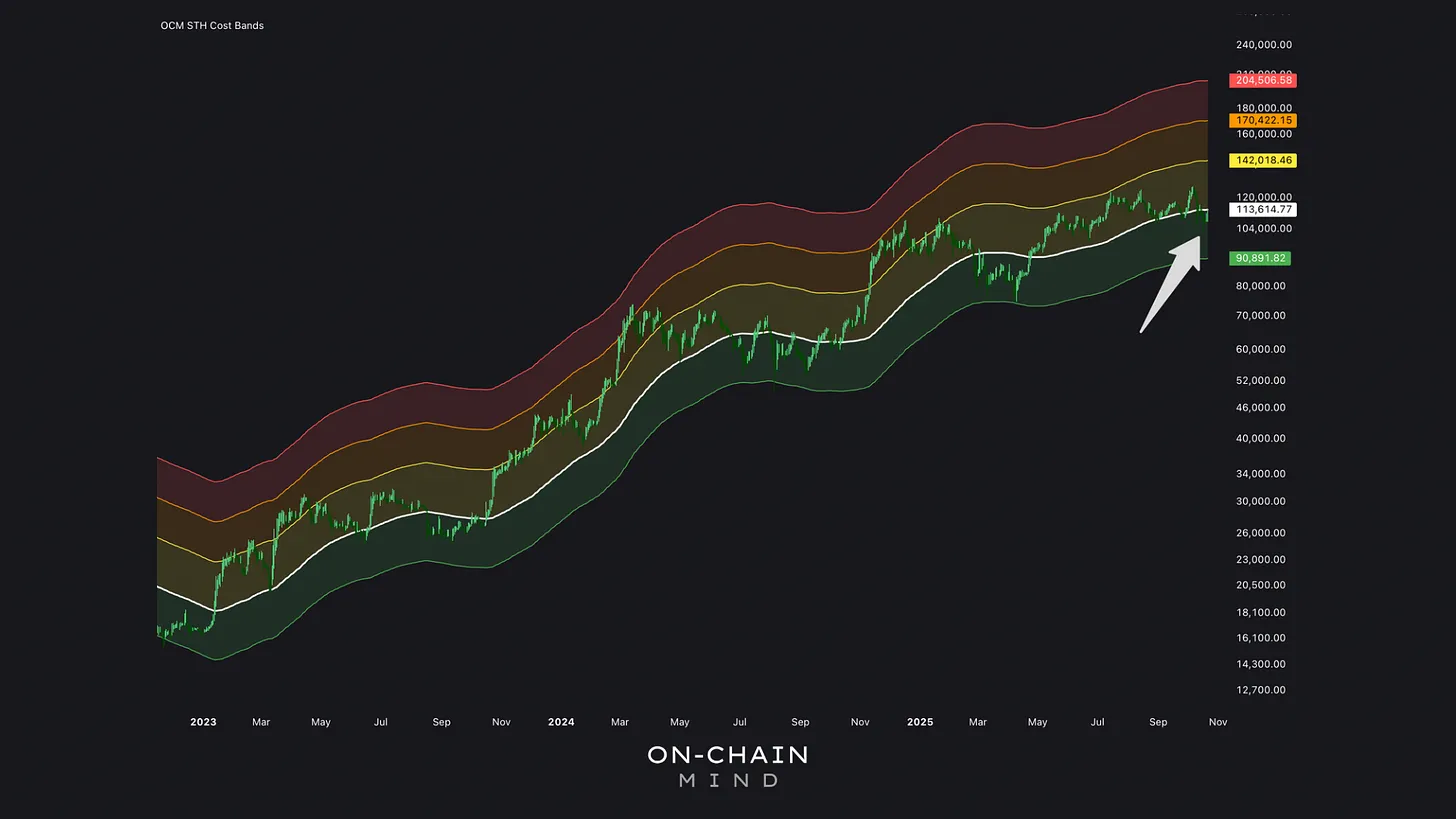
The green Cost Band spanning $90,000 to $113,000 marks an optimal dip-buying zone. Entering it means short-term holders are near breakeven, a psychological pivot where weak hands capitulate, and conviction-heavy buyers emerge.
Measuring Risk in a Resetting Market
One of my favourite tools to navigate these periods is the Short-Term Risk Score, which quantifies near-term speculative risk by blending multiple indicators into a single composite measure. It combines factors like:
Sharpe Ratio (risk-adjusted returns).
Stablecoin Supply Ratio (liquidity flows).
MVRV Δ (average profit/loss exposure).
Short-term holder MVRV (recent buyer profitability).
SOPR-Z (spending behaviour of coins in profit/loss).
Momentum overlays (including 30/60 Ratio Vector, Velocity RSI, the Mayer Multiple).
Microstructural Risk (drawdown, volatility, fragility).
The score offers a simple interpretation:
Above 70%: high short-term risk; speculative positioning is stretched.
50–70%: moderate caution; scale in carefully.
30–50%: accumulation-friendly conditions.
Below 30%: historically asymmetric buying opportunities.
Right now, after the $10B leverage purge, the score dropped from 47% to 38%. That’s a clear signal that risk has been neutralised and the speculative layer stripped away, leaving a market environment that I’m more than happy to start accumulating in.
Applying Risk-Based DCA
For me, this isn’t a buy or sell signal — it’s context. It guides how I pace my dollar-cost averaging (DCA) strategy: I scale back when risk is high, allocate steadily in neutral zones, and increase contributions when risk is historically low.
After this recent flush, the environment is perfect for measured accumulation. With these large leveraged positions cleaned out, I can build exposure confidently while the market absorbs the shock and prepares for hopefully the next leg higher.
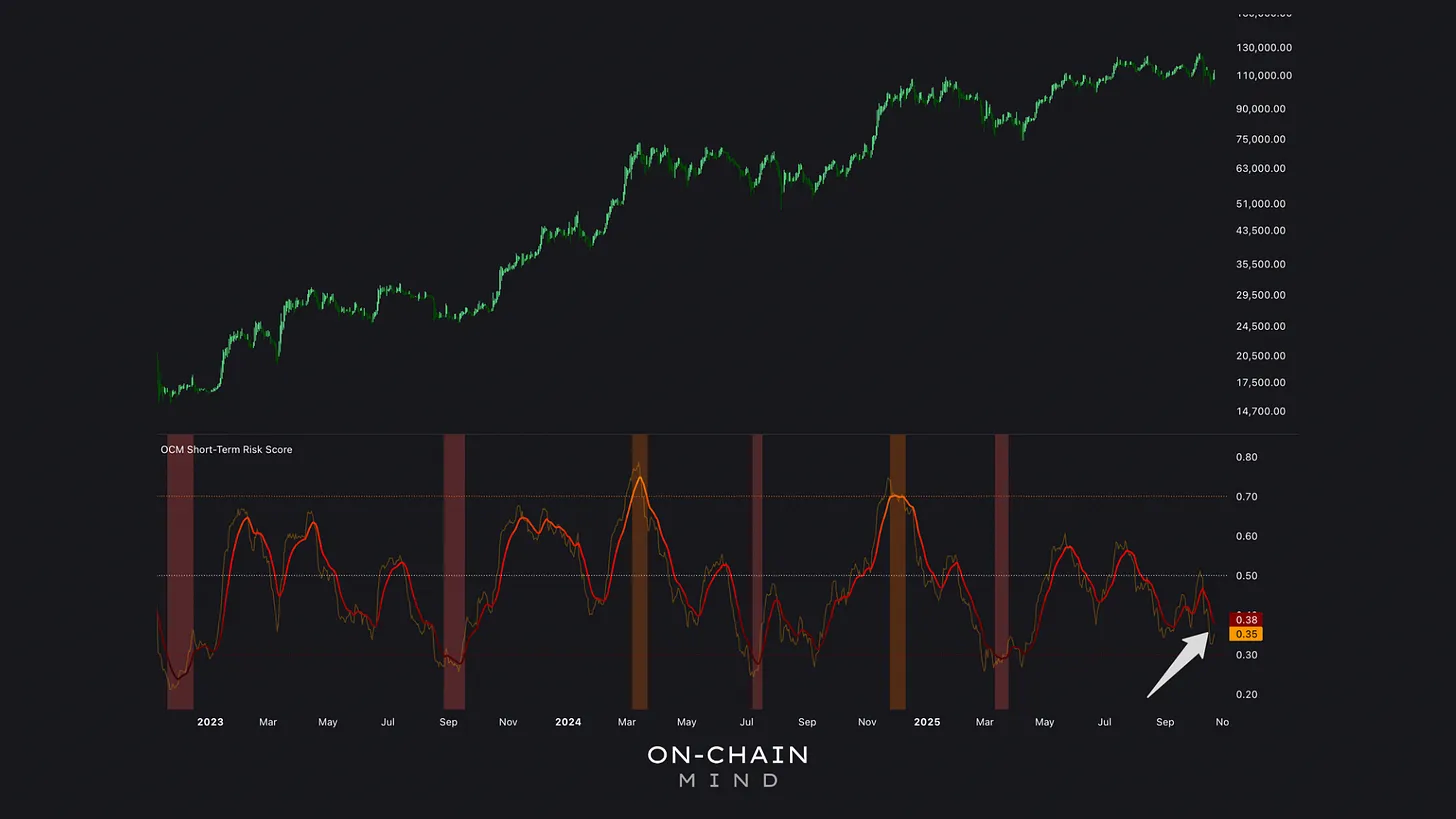
The Short-Term Risk Score has fallen to 38%, showing that leverage has been purged and the market is now in a lower-risk, accumulation-friendly zone.
My Thoughts on the Bigger Picture
As I ponder this event, it strikes me how Bitcoin’s volatility, often maligned, is its greatest teacher. This $10 billion purge wasn’t random; it was the market’s way of enforcing discipline, reminding us that speculation unchecked often leads to fragility.
Taken together, the data paints a clear picture: this was not capitulation. Leverage has been purged, price remains above critical support, and risk-adjusted metrics signal accumulation-friendly conditions. In my experience, these flushes are not cycle-ending events — they are cycle-strengthening events.
History often repeats itself: major derivatives flushes tend to precede renewed strength rather than prolonged weakness. Every time forced liquidations spike and then subside, the market finds footing and begins accumulating momentum quietly beneath the surface. The current situation fits that pattern perfectly.
I treat this flush as an opportunity rather than a threat. My approach remains simple: continue my systematic DCA, increase exposure where fear dominates, and let the market’s structure dictate my pace. No one can predict the next move with certainty, and anyone claiming otherwise is guessing.
The key is risk awareness, not price prediction. Understanding when risk builds, when it’s released, and when market conditions are favourable for accumulation is far more valuable than trying to perfectly time tops or bottoms. Right now, all the indicators point to an environment that is constructive and conducive to steady accumulation.
To me, the market isn’t panicking. It’s recalibrating.
I’ll catch you in the next one.
Cheers,