
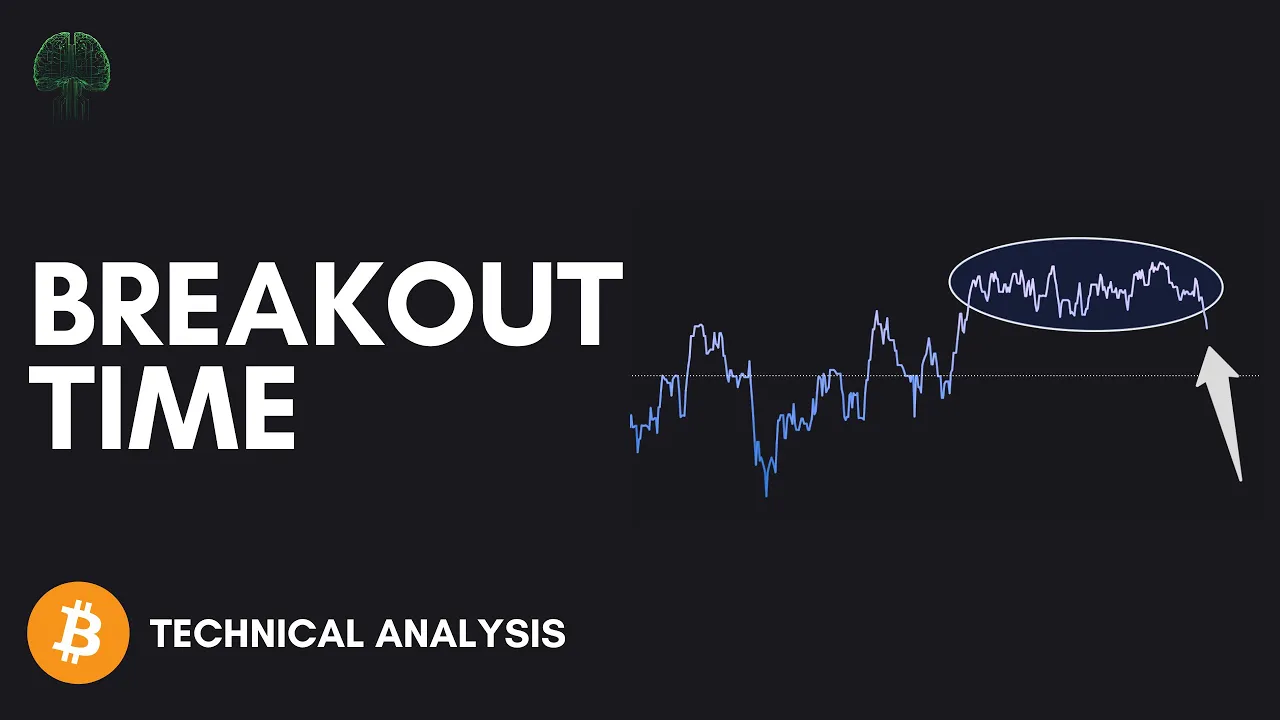
Why Market Equilibrium Points to an Impending Move
After 4 gruelling months of sideways chop, Bitcoin appears trapped in a frustrating limbo. The recent price seems chaotic, random, and disorganised — but beneath that apparent mess, a subtle reorganisation is taking place. The market is resetting its internal structure, and the indicators are beginning to align once again.
In this article, I’ll break down the underlying forces that are shaping Bitcoin’s consolidation structure and what they mean for the next move of the cycle.
Let’s get into it.
Equilibrium in Action: Bulls and bears are evenly matched, creating indecision that often precedes decisive breakouts.
Key Levels to Watch: $117,000 emerges as a pivotal resistance; reclaiming it could signal renewed bullish momentum.
Entropy’s Decline: High market disorder is easing, hinting at a resumption of the prevailing uptrend rather than a reversal.
Structural Resilience: Long-term supports remain intact, with downside risks limited unless critical thresholds are breached.
Sideways Market Psychology
If you’ve felt mentally drained by Bitcoin’s recent price action, you’re not alone.Prolonged consolidation phases often test conviction more than sharp drawdowns ever do. The market chops around, liquidity dries up, and even Bitcoin OGs begin to doubt their strategy.
But beneath that emotional frustration lies an important truth: consolidation is a structural reset. It’s how markets breathe before expanding again. What feels like indecision is often the process of redistributing supply between strong and weak hands.
The key is to look beyond price and into the underlying metrics to identify when chaos is quietly transforming into order.
Who’s in Control?
The Polyfactor SuperTrend is an advanced adaptation of the traditional SuperTrend indicator. Rather than relying on a single Average True Range (ATR) factor, it layers multiple ATR bands with increasing multipliers, creating a multi-dimensional view of price deviation and trend control.
Green-dominant regions: represent bullish dominance.
Red-dominant regions: show bearish control.
Mixed regions: highlight market indecision.
At the moment, this indicator is showing an almost perfect 50/50 balance between the two forces. There’s no clear dominance, no runaway move, just equilibrium.
Historically, when we reach this kind of symmetry, it’s followed by major volatility. Why? Because equilibrium is unsustainable in a market like Bitcoin. Eventually, one side overwhelms the other, and the resulting impulse often defines the next leg of the market cycle.
This balance, though uncomfortable, is exactly what precedes expansion.
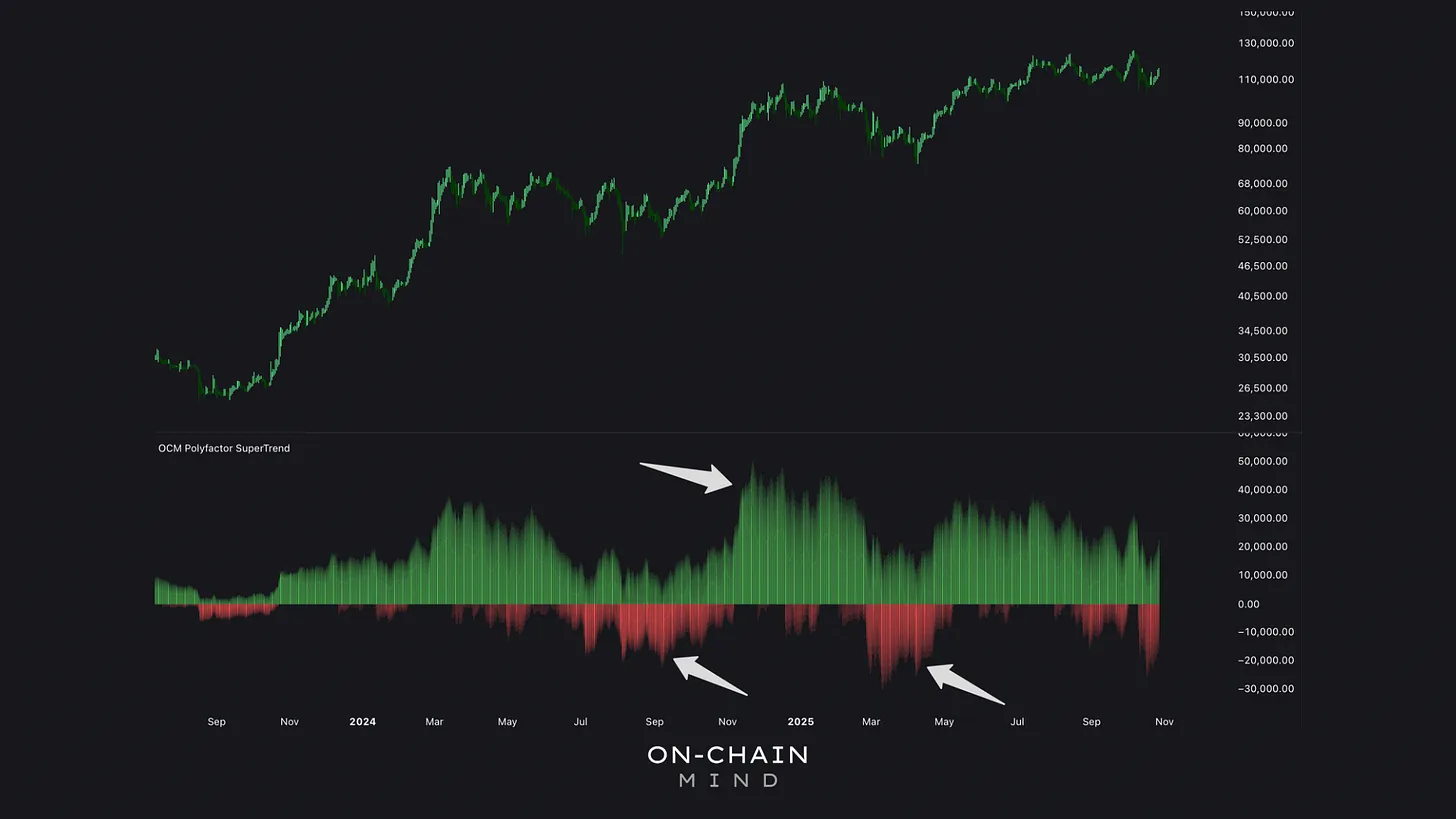
In bullish phases, green dominates the chart, reflecting strong buyer control. Bearish periods turn red, but only major downturns fully erase the green. Currently, a near-even green-red balance signals rare equilibrium, historically a coiled spring poised for sharp directional moves.
The Moving Structure Beneath the Noise
Next up: the Flow Ribbons, which are a layered set of exponential moving averages (EMAs) that represent dynamically moving zones of support and resistance.
Despite the choppy price action, these ribbons are still holding strong. The second-lowest ribbon, sitting around $105K, recently acted as a springboard for local support. Historically, touches on this ribbon during uptrends often precede sharp recoveries.
The bottom ribbon (now just shy of $100K) forms a crucial structural boundary. Losing this would mark a true shift in market character. But as of now, the Flow Ribbonsremain upward-sloping, signalling that the macro trend is still predominantly bullish.
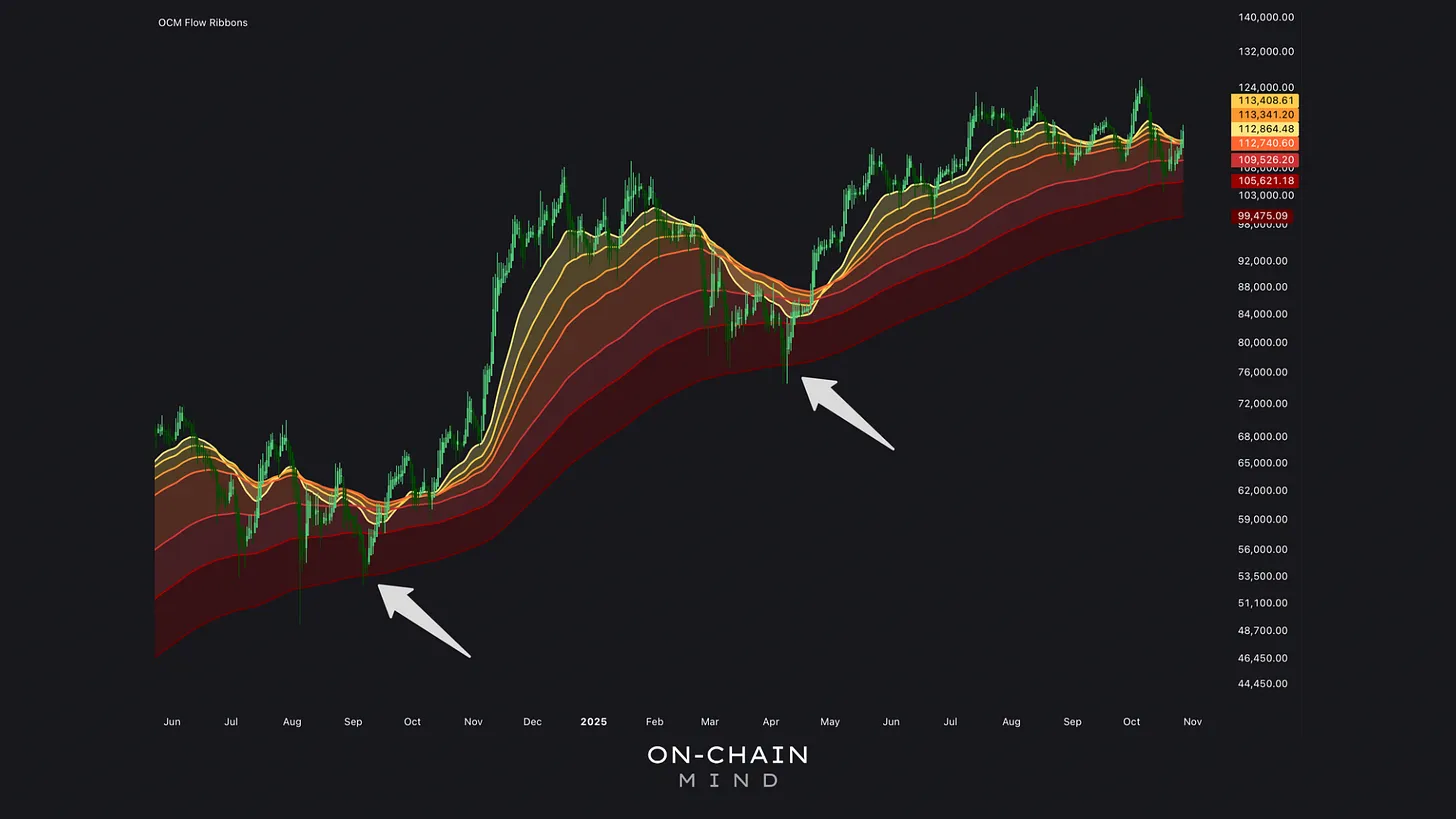
Despite recent dips that flirted with negativity, the ribbons have proven resilient. Bitcoin briefly touched the penultimate ribbon near $105,000, sparking a small panic, but it rebounded, which is a pattern echoed in many previous uptrends.
Quantifying the Chaos
Entropy is a concept borrowed from thermodynamics. It’s a measure of disorder within a system. In market terms, entropy quantifies how unpredictable price movements are.
Here’s how it works: Bitcoin’s price changes (log returns) are binned by size, their frequencies measured, and Shannon entropy applied to quantify how “spread out” these movements are.
High entropy: maximum unpredictability — typically seen during sideways chop or consolidation.
Low entropy: increased order — indicating trending or directional markets.
Currently, Bitcoin’s entropy readings have been among the highest in its history, which is a clear reflection of recent choppy action. But what’s fascinating is that entropy is now declining rapidly.
This means disorder is subsiding, at least in the short-term. The market is reorganising itself into a more predictable state, which historically precedes trend continuation.
In simple terms: the chaos seems to be cooling off. And when markets cool off after extreme disorder, they often resume the prior macro trend — which, in Bitcoin’s current case, is up.
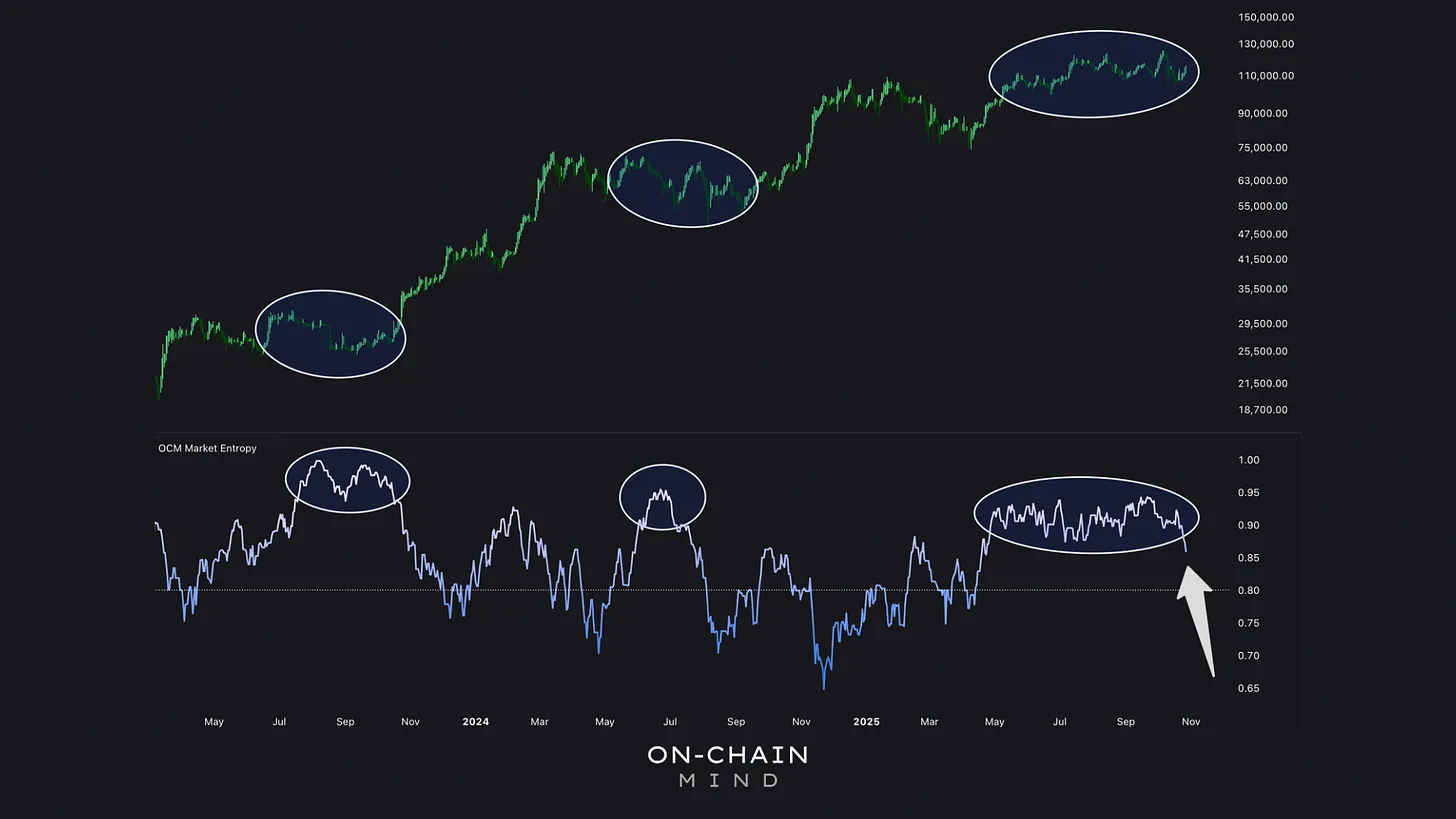
Bitcoin’s entropy has hit near-historic highs, confirming the recent trading’s messiness. Yet, extreme entropy often precedes trend resumptions, as markets revert to the existing trend. A sharp entropy decline now hints at subtle bullish momentum.
Mapping the Battlefield: Key Levels and Structure
Technically, Bitcoin is confined to a $20,000 range, with the tighter battlefield sitting between $106K support and $117K resistance.
Reclaiming $117K would confirm bullish momentum returning.
Losing $105K would indicate that bears are gaining serious traction.
Beyond that, secondary levels at $102K and $122K act as outer boundary zones where liquidity tends to cluster and where aggressive trading behaviour is most visible.
What’s clear is that $117K keeps appearing across multiple frameworks, which is rarely a coincidence. When several independent indicators converge on the same level, it becomes a magnet for market action.
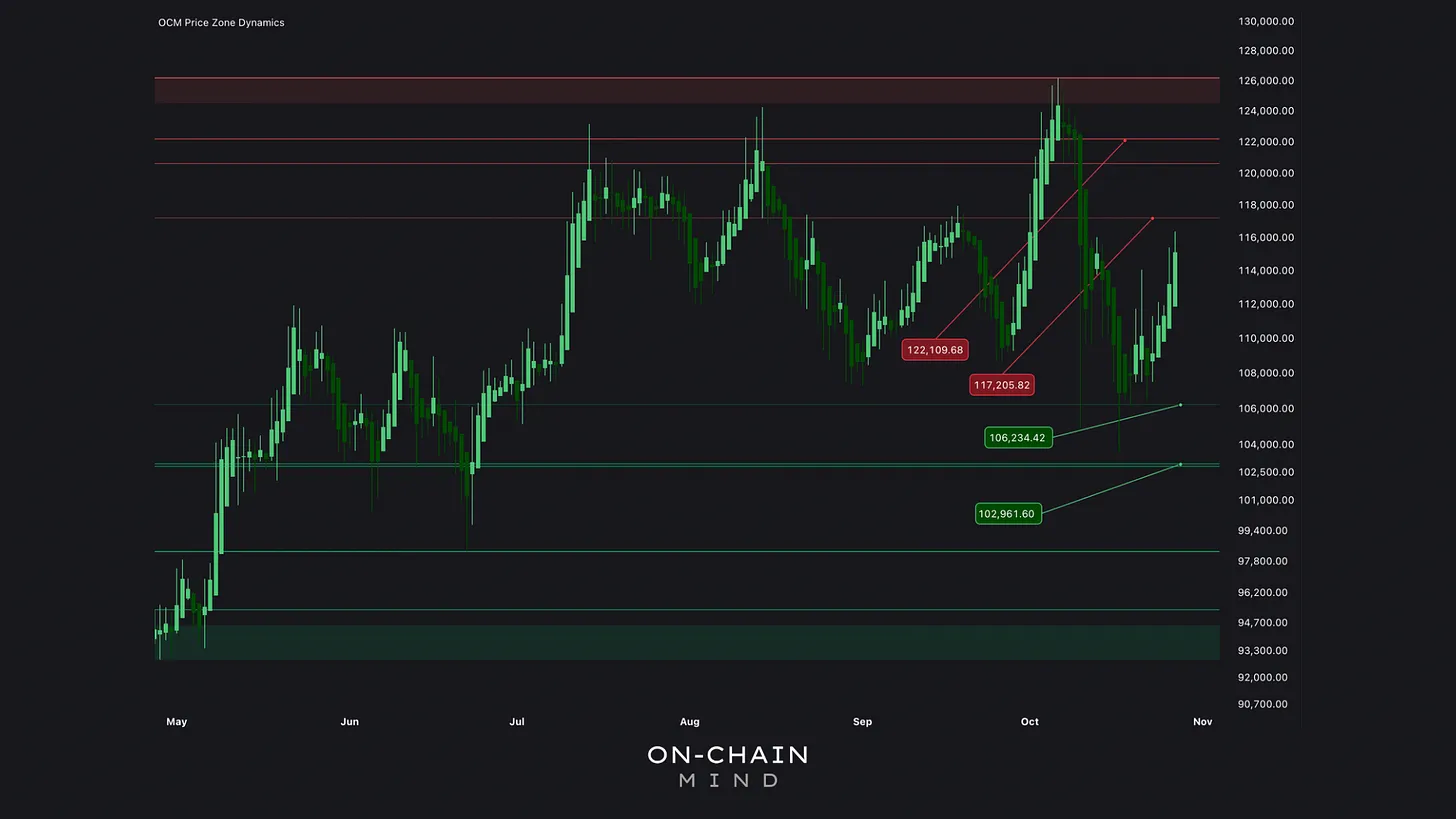
Breaking $117,000 would reclaim momentum and counter any bearish views. Key levels of $102,000 (secondary support) and $122,000 (secondary resistance) show volume clusters of heightened market activity.
Where The Local Liquidity Lives
The Local Volume Profile visualises traded volume across different price levels during this consolidation. Each price point has a horizontal bar showing how much volume occurred there.
The Point of Control (PoC), which is the level with the highest traded volume, currently sits at $117,000.
That’s significant for two reasons:
Structural: It’s the most accepted price during this consolidation. Breaking above it signals that the majority of market participants are willing to transact at higher levels, which is a bullish sign.
Psychological: It marks the line where conviction shifts. Traders who’ve been selling resistance may flip bias once the market holds above this line.
In essence, $117K isn’t just resistance — it’s a psychological pivot. It’s where the majority of traders “agree” on value, and once broken, that agreement resets higher.
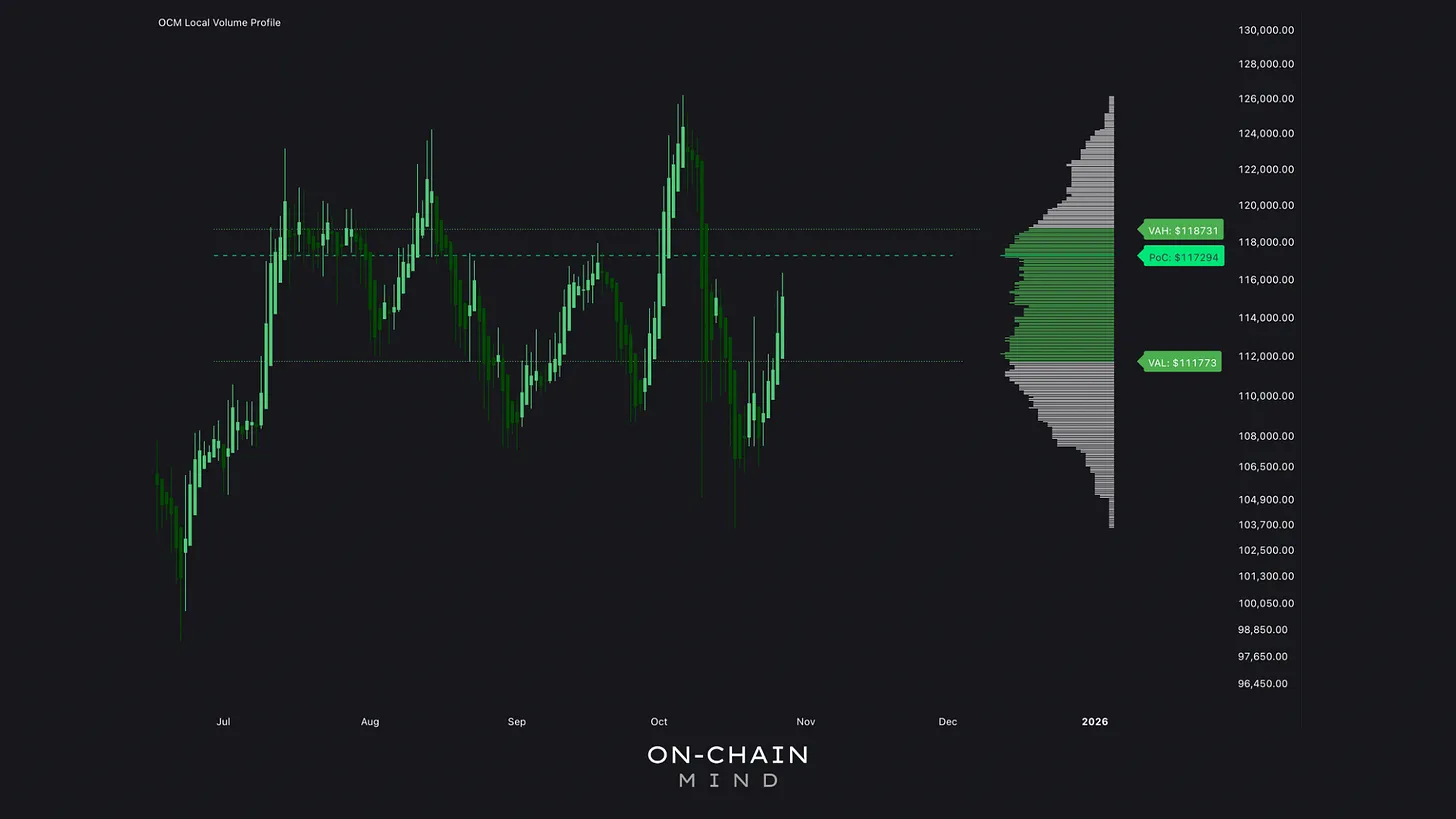
The PoC acts as a gravitational centre, attracting price due to embedded liquidity. Overcoming the PoC structurally validates bullish intent, as it implies absorption of overhead supply.
The Statistical Edge
To bring probability into play, I use the Z-Score Probability Waves. This indicator expresses price deviations in terms of standard deviations from the mean, allowing us to assess how extreme a move is, statistically speaking.
The framework gives us clear probabilistic boundaries:
+3σ: ~ $126K — near the previous all-time high.
+1σ: ~ $117K — the critical level for bullish breakout confirmation.
–2σ to –3σ: $101K–$105K — extreme downside range, statistically rare.
Breaking below $100K would represent a 3 standard deviation event, which is highly unusual and inconsistent with the current macro structure.
Statistically and structurally, the odds still lean bullish.
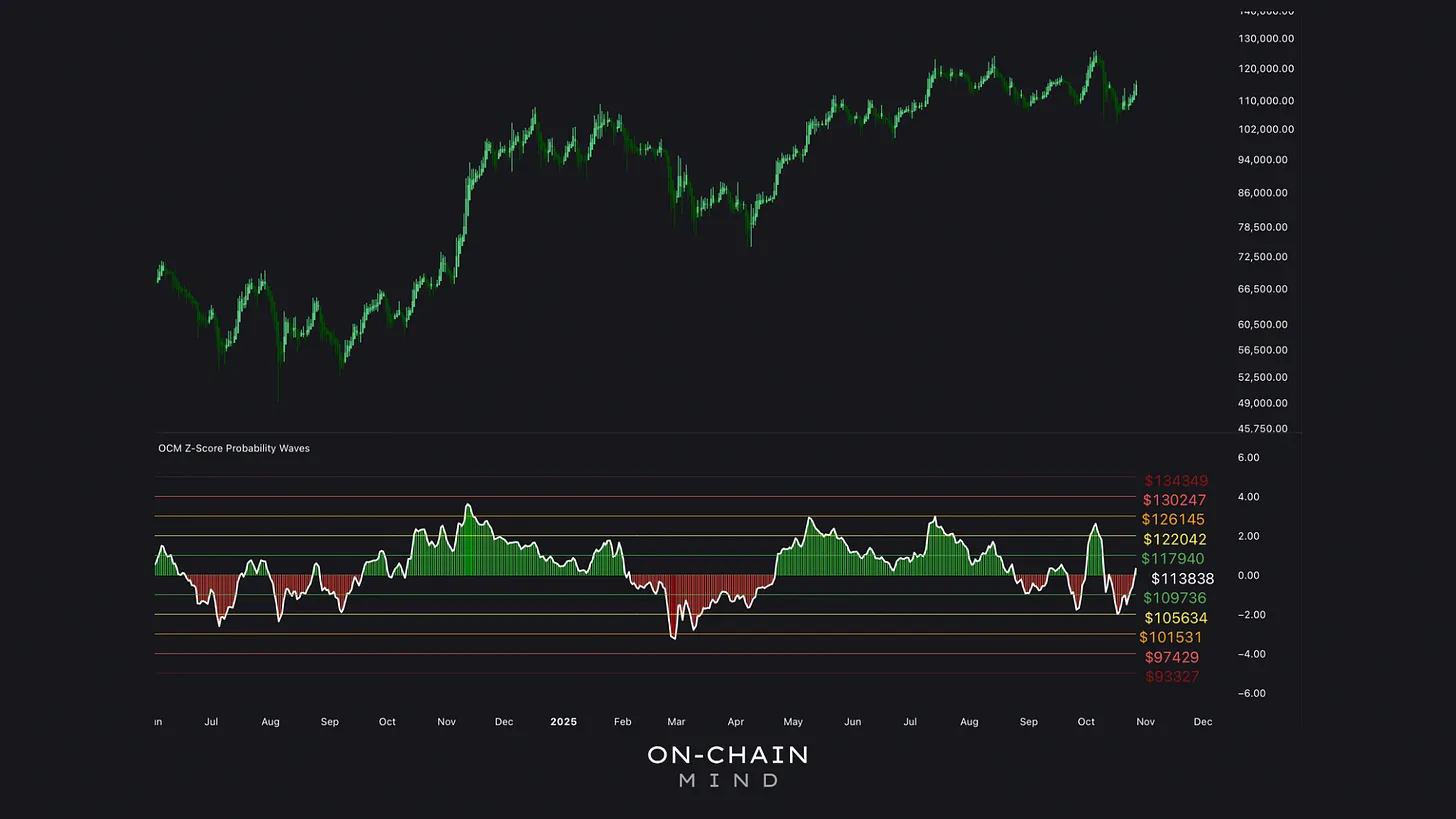
Price swings normally track within ±1-2σ, with upside targets at +3σ near local highs. Downside risk normally caps at -2 to -3σ in a bull market.
Confluence Across the Board
When viewed together, these tools paint a clear and consistent picture. The Polyfactor SuperTrend shows equilibrium between bulls and bears, while the Flow Ribbons confirm the long-term structure remains intact with a bullish bias. Market Entropy indicates market disorder is fading, hinting at a return to structure and trend.
The Price Zone Dynamics and Local Volume Profile both highlight $117K as the key liquidity pivot, and the Probability Waves show limited downside with upside potential aligned to historical highs. With all 5 indicators pointing in harmony, the collective evidence is hard to ignore.
My Take: The Calm Before Expansion
To me, this is one of those rare phases where Bitcoin feels both stable and explosive at the same time. $117K isn’t just another resistance. It’s the centre of gravity for this entire structure — a point where equilibrium breaks and trend reasserts itself.
Whether it happens next week or next month doesn’t really matter. What matters is that the setup is maturing. The market is flushing out weak hands and redistributing energy for its next expansion.
My view is straightforward:
As long as $100K holds, the macro structure remains bullish.
Reclaim $117K as support, and we’re likely looking at a run toward new highs.
Below $100K, all bets are off. It would imply a deeper structural reset.
The market rarely rewards impatience. What looks like stagnation is often the precursor to expansion. Until then, we sit in equilibrium: the market’s silent preparation for its next act.
I’ll catch you in the next one.
Cheers,