
How I’m reading Bitcoin’s short-term moves right now
2026 has been a perfect example of how quickly Bitcoin can transition from calm to chaos.
February delivered a sharp volatility spike and a violent price repricing that caught a lot off guard. Since then, the question I’ve been thinking about most is not simply where Bitcoin goes next, but rather what type of market environment we are now entering.
So in this Premium update, I want to walk you through how I’m currently interpreting the short-term structure of the market, and I'll introduce one my most powerful trading tools I’ve created yet.
Let’s get into it.
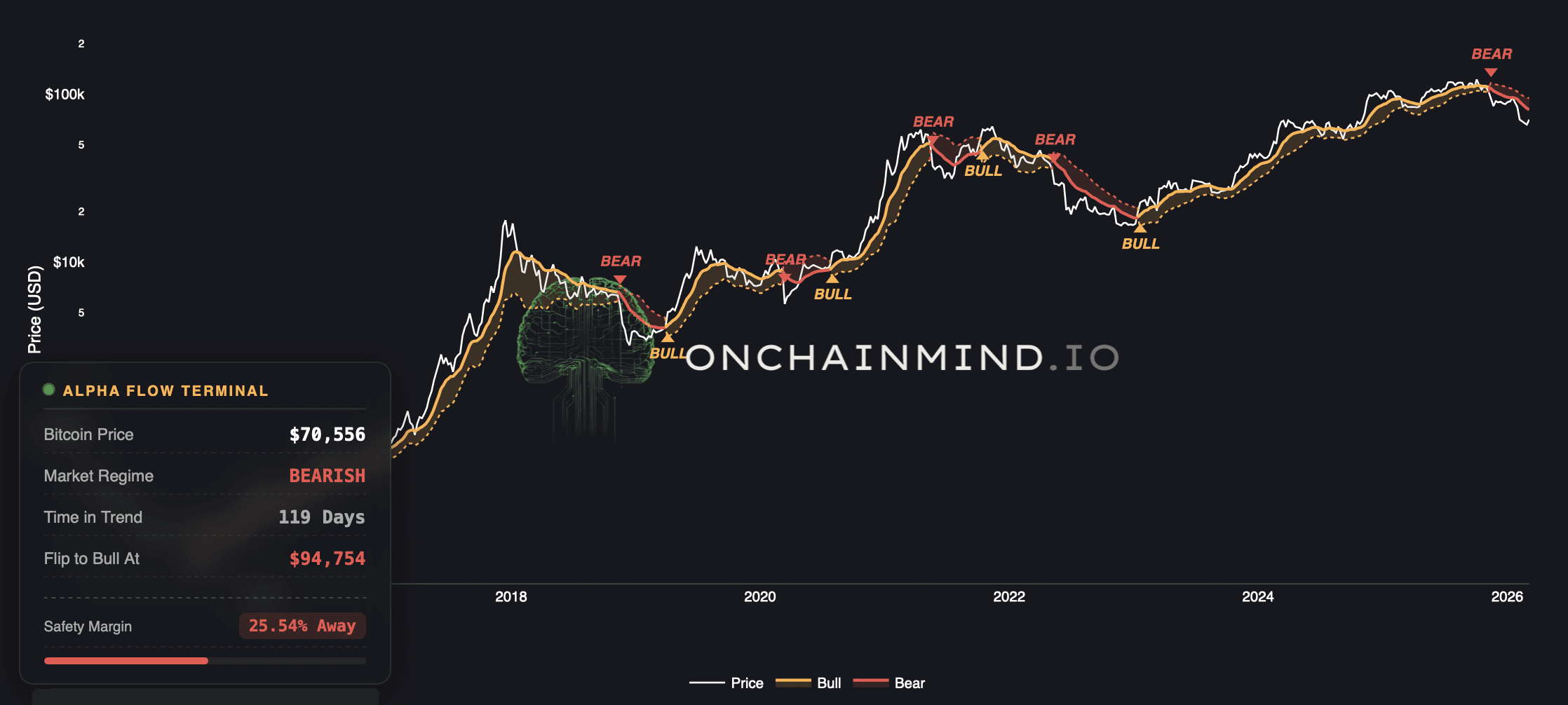
Alpha Flow Bearish Dominance: The macro trend remains firmly bearish since November 2025, suggesting that higher timeframes are still suppressing price.
Volatility Washout Consequences: Recent spikes show the market is still working through recent extremes.
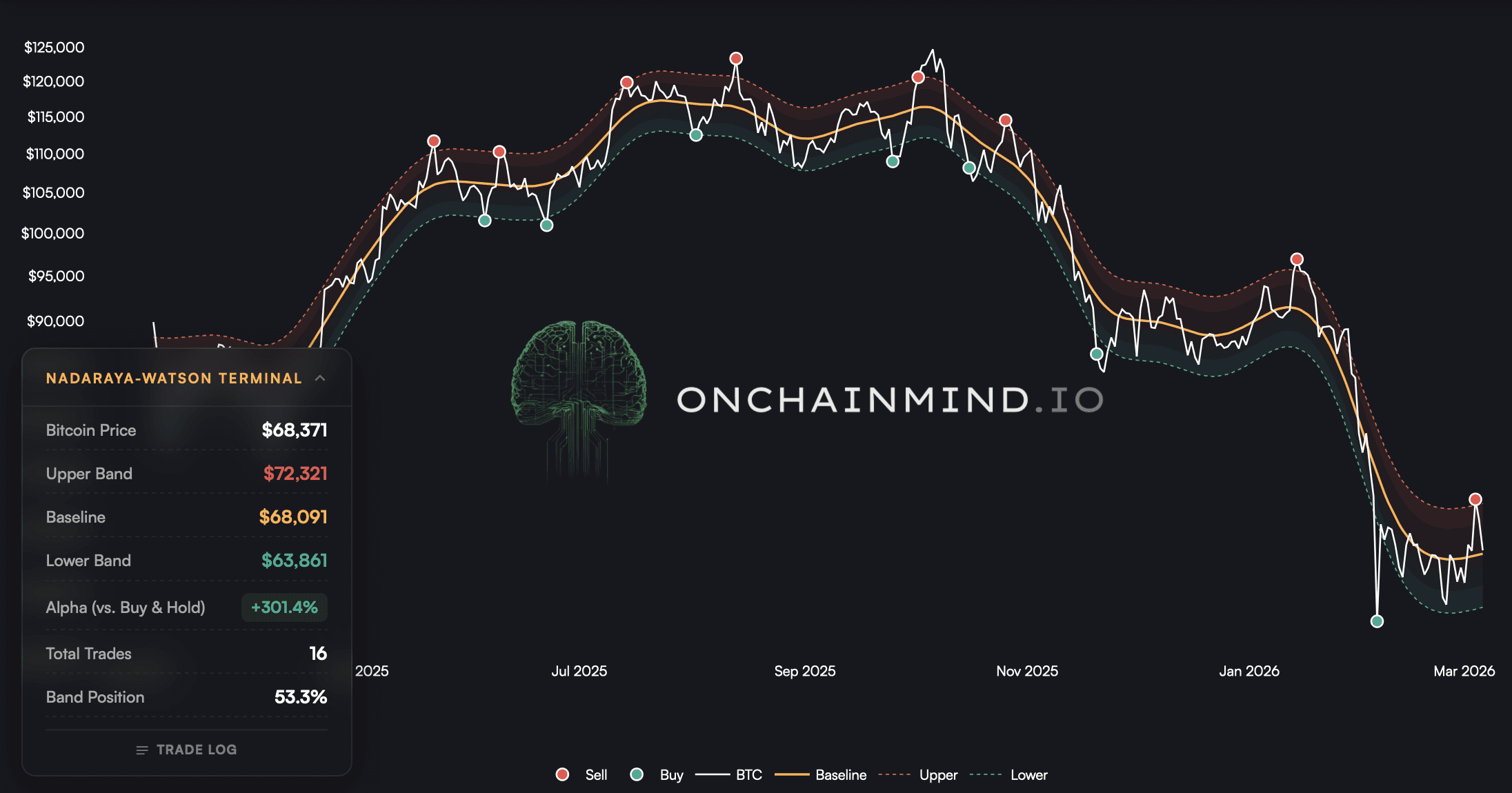
Tactical Mean Reversion: The brand new Kernel Envelope identified a short-term rejection at $74,000, with the high-probability return to the $68,000 baseline.
Market Digesting Recent Moves: Several signals suggest the current phase is about settling rather than pushing.
Why I’m Still Respecting the Bearish Structure
Whenever I’m assessing the market, I always begin with the higher timeframe trend.
Short-term signals are useful, but if they conflict with the structural direction of the market, they tend to lose reliability quickly. Bitcoin, like most assets, tends to respect the dominant trend on the higher timeframe.
One of the tools I use to track these shifts is the Alpha Flow indicator.
In a nutshell, Alpha Flow essentially monitors the flow of price action and volatility to determine when the market transitions into a sustained bull or bear regime.
But the simpler way to think about this is: it acts as a trend compass. It attempts to identify when the underlying direction of the market has genuinely shifted, rather than reacting to every short-term fluctuation.
And at the moment, that compass is still pointing down.
On the macro cycle timeframe, Alpha Flow flipped to a macro bear signal in early November 2025, when Bitcoin was trading around $103,000.
Since that signal appeared, the broader directional structure of the market has been firmly to the downside.
Now, even if we zoom in slightly to the swing trading timeframe, the signal is consistent with the larger picture. On this timeframe, Bitcoin has been in a bearish condition since late January, and we have not yet seen any bullish regime flip.
That’s important context for interpreting any rallies we see:
In a bullish regime, dips tend to get aggressively bought and trend continuation is common.
In a bearish regime, the opposite dynamic tends to dominate. Rallies occur, sometimes quite violently, but they often act as relief bounces rather than the beginning of new sustained uptrends.
This doesn’t mean Bitcoin cannot rally from here. It absolutely can.
But structurally, until the trend regime flips, the market is still operating under bearish conditions. That means I’m treating strength with a degree of caution rather than assuming we’ve already entered a fresh uptrend.
Bitcoin Alpha Flow - macro timeframe
The Market Needs Time to Reset
The next piece of the puzzle is volatility.
Volatility tells us a lot about what the market has just experienced psychologically. When volatility spikes, it means large amounts of positioning are being unwound very quickly.
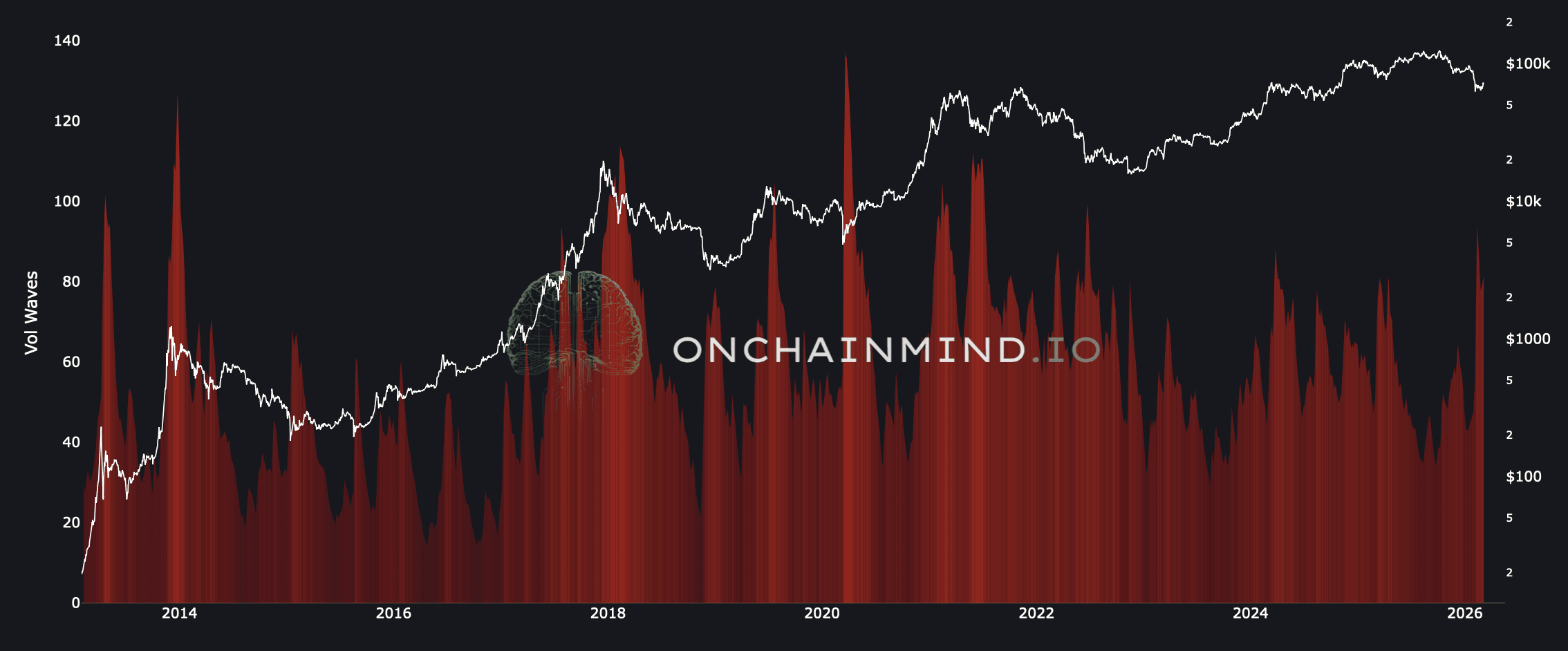
To track this dynamic more precisely, I use a model called the Volatility Waves.
This indicator measures Bitcoin’s volatility using a 7-day logarithmic return calculation, which captures the magnitude of recent price fluctuations across different cycles.
One of the interesting (and most obvious) characteristics of Bitcoin over the past decade is that its volatility has gradually declined.
In the early years of Bitcoin, 20-30% weekly swings were par for the course. As the market has matured and liquidity has increased, those moves have slowly compressed.
The Volatility Waves accounts for that maturation by adjusting its framework over time so that volatility extremes remain comparable across cycles.
And when we look at February’s early sell-off through that lens, the reading becomes very clear.
During that drop, the Volatility Waves indicator surged above 90. That level represents a very extreme volatility event for Bitcoin. Historically, events of that magnitude tend to produce a very similar aftermath.
The market rarely continues trending aggressively in the same direction immediately afterwards. Instead, what tends to follow is a period of consolidation.
We’ve seen this pattern repeatedly throughout Bitcoin’s history. After large volatility shocks, price typically spends weeks or even months moving sideways, gradually digesting the magnitude of the move that just occurred.
Because of that, my baseline assumption right now is that Bitcoin may enter a prolonged cool-down phase of choppy consolidation while the market digests February’s volatility spike.
Bitcoin Volatility Waves
A Brand New Trading Tool
Once the macro context is established, the next question is tactical: where is price positioned right now in the short term?
For this, I’m now relying on my Kernel Envelope, which is an incredibly powerful brand-new short-term trading model. It combines two advanced non-parametric regression methods, Nadaraya-Watson and Savitzky-Golay, allowing the price itself to shape the trend curve.
Unlike traditional moving averages or lagging regression lines, the Kernel Envelope adapts dynamically as market volatility evolves, giving a much sharper and more accurate read on statistical extremes.
From this baseline, the model builds upper and lower volatility envelopes using a concept called Mean Absolute Error (MAE). These boundaries represent points where price is statistically stretched relative to recent behaviour.
When Bitcoin enters these outer bands, it signals high-probability mean-reversion opportunities.
One of the most important features of this new model is that it is trend-agnostic, or in plain English, it doesn't care what macro regime we're in. Short-term price extensions eventually revert toward the local equilibrium regardless of whether Bitcoin is in a bullish or bearish macro trend.
Currently, the setup is clear:
Upper Envelope (Red): ~$72,000
Baseline (Amber): ~$68,000
Lower Envelope (Green): ~$63,000
Yesterday, Bitcoin reached the upper zone before cleanly rejecting. When this happens at the edges of the envelope, the probability favours a drift back toward the Baseline (currently $68,000), which it did.
Nothing in markets are a guarantee. But statistically paths of least resistance can certainly be modelled.
The Kernel Envelope is designed to answer the key question: is this short-term move truly extreme relative to the current regime? Right now, the answer is firmly no, Bitcoin is now sitting at its short-term estimated fair value. But when it does push higher or lower, this tool makes it easier to check if your instincts about the move are actually right.
For a more comprehensive breakdown of the Kernel Envelope methodology, check the description in the Studio for the full details.
I can’t wait for you to try this powerful new tool. It works not just for BTC, but for any Altcoin pair too!
New: Bitcoin Kernel Envelope
The Next Week of Trading
Here’s how I’m viewing the short-term:
The higher timeframe trend remains bearish.
The volatility regime suggests the market needs time to digest the February shock.
And the Kernel Envelope model shows price exhibiting a classic mean reversion towards short-term equilibrium.
And this combination actually tends to produce a very specific type of market environment. Instead of clean directional trends, the market often moves in wide, messy ranges.
From my perspective, the most probable scenario over the next week or so is:
Continued choppy consolidation.
Price oscillating within the Envelope boundaries.
Attempts to push higher encountering resistance within the broader bearish trend structure.
Gradual volatility compression as the market continues digesting February’s shock.
Of course, Bitcoin always retains the ability to surprise. But after a pretty wild start to the year, it usually points toward a period of digestion rather than immediate volatility expansion again.
And sometimes recognising that the market is entering a slower phase is just as valuable as identifying the explosive ones. Because the explosive phases almost always begin after the market has finished digesting the last shock.
Right now, that digestion process still appears to be underway.
I’ll catch you in the next one.
Cheers,