
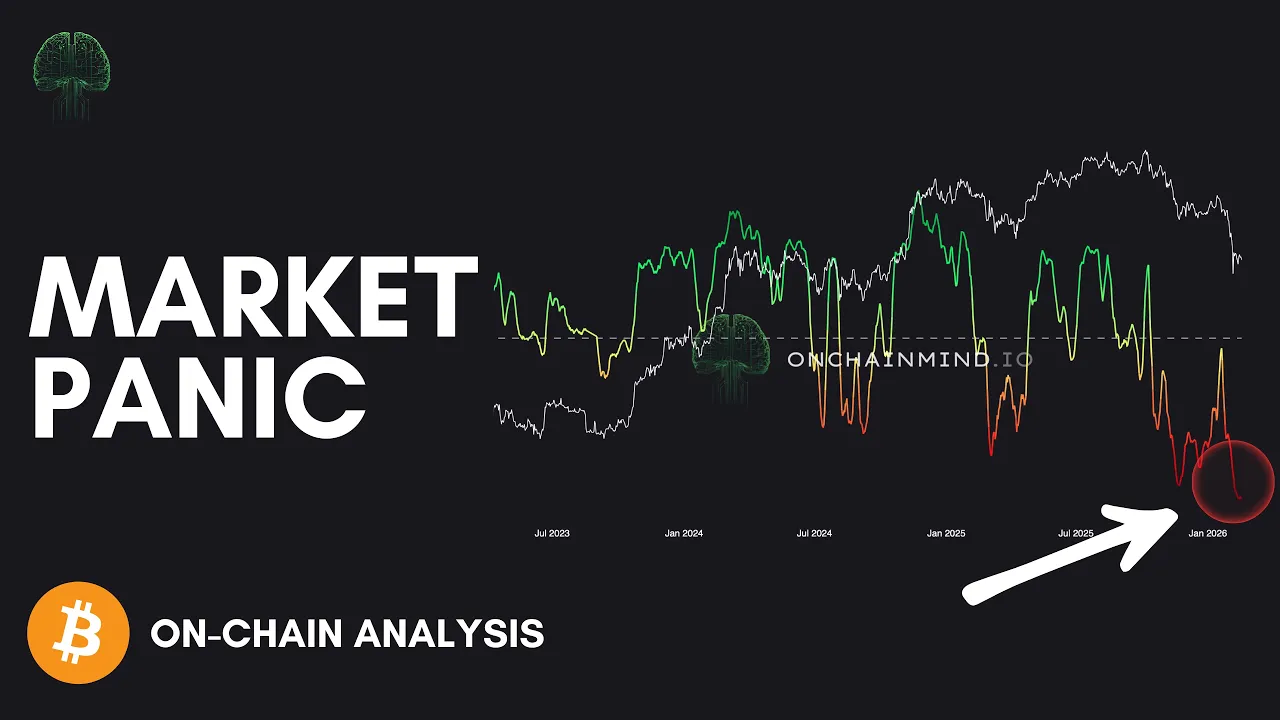
Extreme fear and capital outflows signal a market under pressure
The market is brutal right now.
Losses are mounting, capital is leaving the Bitcoin ecosystem, and fear has collapsed into levels we almost never see.
If you have spent any time looking at your portfolio recently, you have likely felt that familiar, tightening sensation in your chest. But beneath the surface, the structure is remarkably coherent.
In this piece, I’m going to walk you through the new investor pain, realised loss behaviour, capital flows out of the network, and the current state of crowd psychology.
Let’s get into it.
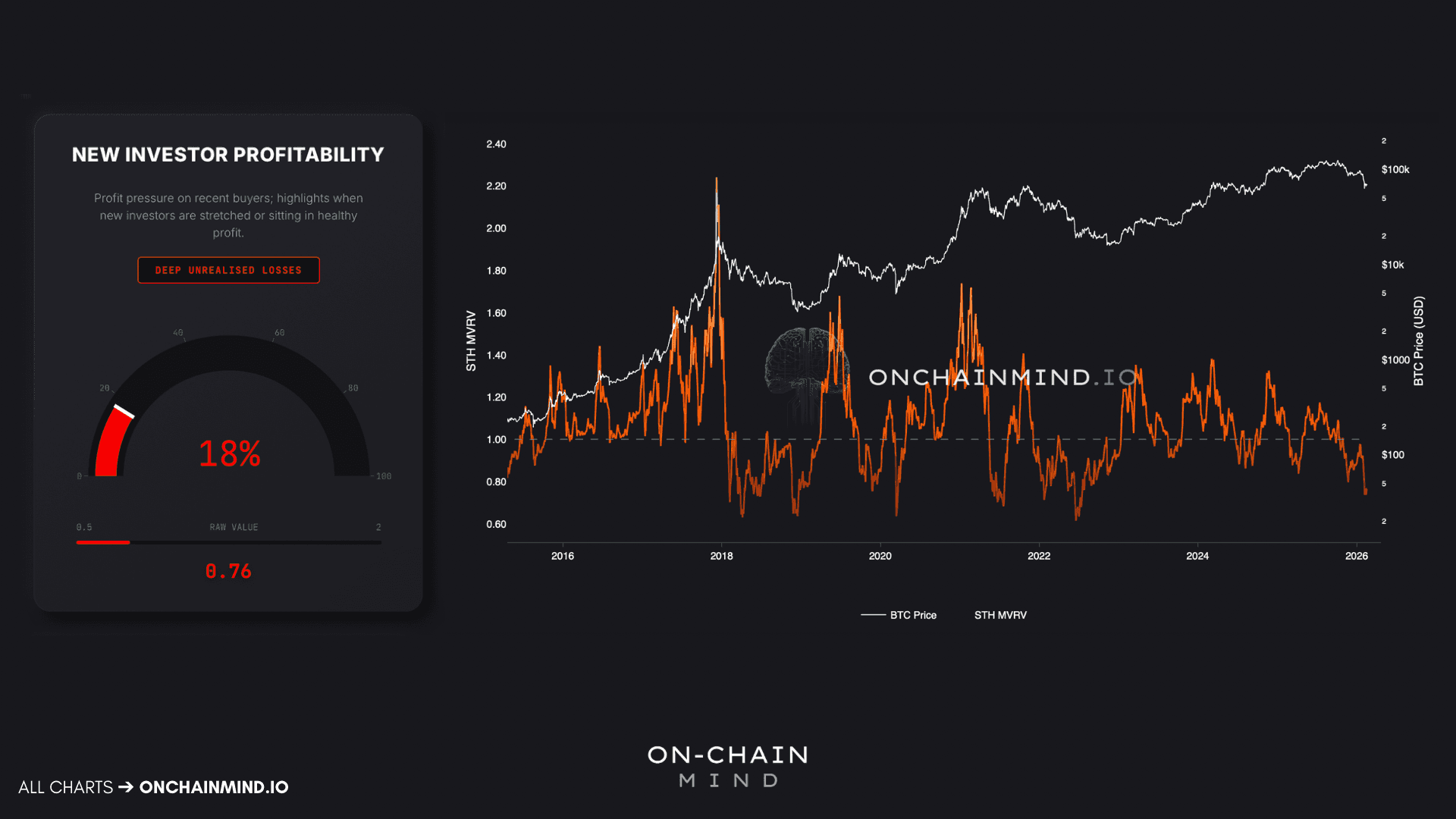
New Investor Pain: Short-term holders are currently facing deep unrealised losses, placing current profitability in the bottom fifth of Bitcoin's entire trading history.
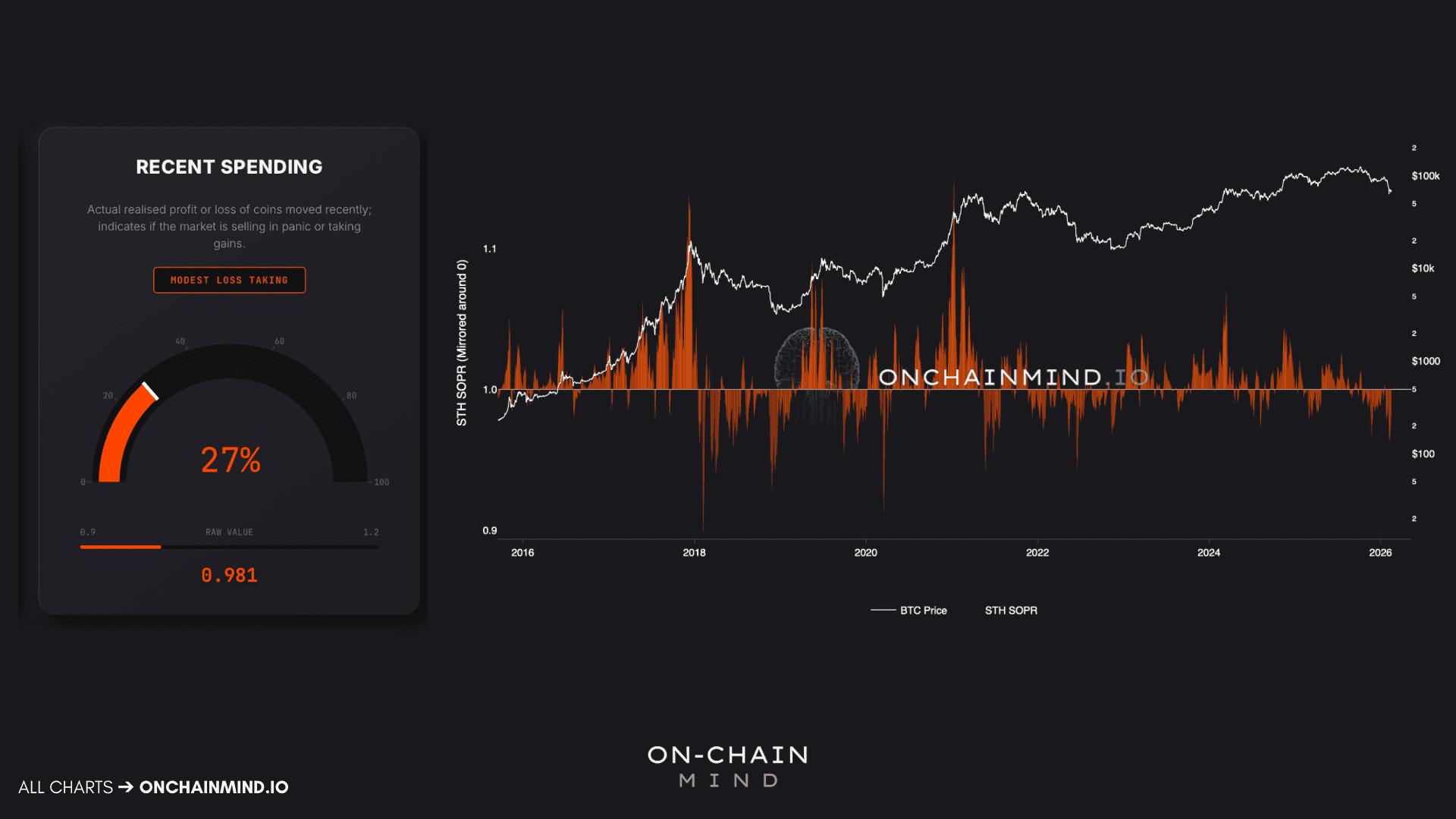
Controlled Bleeding: Realised losses are ticking up but remain measured, suggesting we are in a pressure building phase rather than total capitulation.
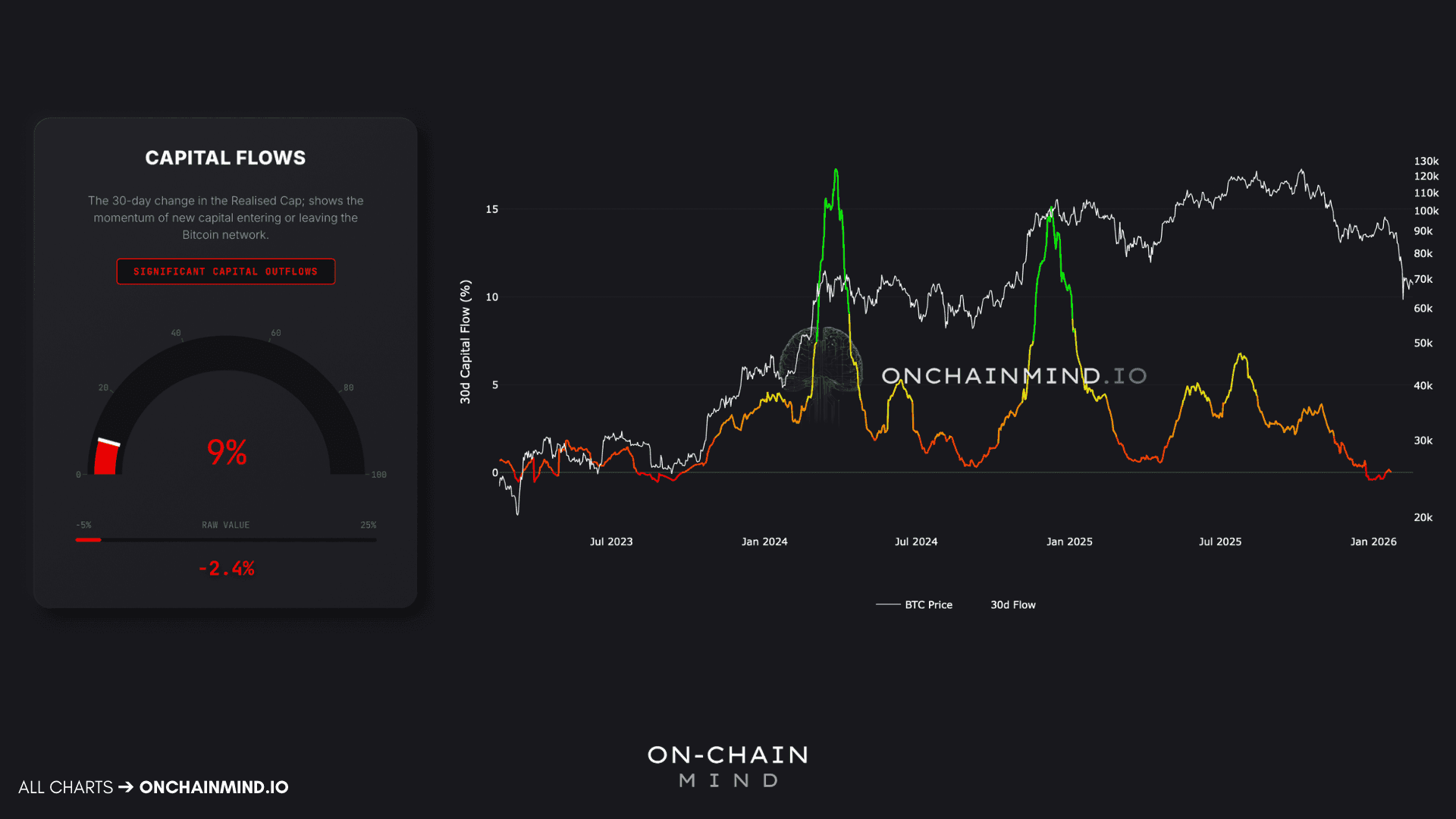
Capital Contraction: The Realised Cap shows a 2.4% monthly decline, a rare event indicating that committed capital is actually exiting the network.
Extreme Sentiment: The Fear and Greed Index has plunged to a reading of 9, matching the historical lows seen during the bear market bottoms and COVID crashes.
The Structural Pressure Building
To understand where we are going, we first have to understand who is currently holding the bag. In the world of on-chain analytics, we divide the market into two primary camps: Short-Term Holders (STHs) and Long-Term Holders (LTHs). The dividing line is 155 days (roughly 5 months).
Empirically, that 5-month threshold marks a behavioural shift. Coins younger than this tend to move more frequently, their owners are reactive, and they are particularly responsive to volatility. Coins older than this have survived volatility. They distribute into strength and accumulate into weakness. They tend to dampen the volatility rather than amplify it.
What we have observed over many Bitcoin cycles is that every cycle is driven by a behavioural rotation between these two cohorts. Right now, the pressure is sitting squarely on Short-Term Holders.
New Investor Profitability
This metric measures whether short-term holders are sitting in unrealised profit or unrealised loss. On a 0-100% scale, our current reading in new investor profitability of 18% places us in the bottom fifth of Bitcoin’s trading history.
That certainly doesn’t strike me as mild discomfort; more like structural stress.
In raw terms, the average short-term holder is significantly underwater. When this investor is deeply in the red, they face a binary choice:
Capitulation — lock in losses and exit.
Toughen Up — survive long enough to transition into a long-term holder.
This transition is a structural necessity for every Bitcoin cycle. We are currently in a zone of Loss Aversion, a concept in behavioural finance where the pain of losing money on paper is felt far more acutely than the joy of gaining it.
This psychological grind is designed to exhaust you. Every failed bounce and every week of sideways chop erodes your patience until you simply can't take it anymore. That is exactly when the market begins to bottom.
That migration from weak hands to strong hands is one of the most important mechanics in Bitcoin’s entire cycle structure. It is uncomfortable, but it is necessary. The market cannot reset without it.
Bitcoin’s New Investor Profitability
From Pressure to Behaviour
While unrealised loss tells us how much people feel the pain, Recent Spending tells us what they are actually doing about it. Currently, we see a score of 27% on Recent Spending. This is classic modest loss-taking territory. There is controlled bleeding in the system, but we are not yet in full-blown haemorrhaging mode (yet).
True capitulation is disorderly; it’s when the "get me out at any price" mentality takes over and margin gets aggressively unwound. We aren't there yet.
At 27%, we are in what I would call the compounding phase, where stress builds, but spending behaviour hasn’t transitioned into the aggressive loss realisation that historically defines the final bottom.
I suspect we may need one or two more meaningful flushes before exhaustion truly sets in. Bottoms are rarely neat. They are processes.
Bitcoin Recent Spending
The Network’s Structural Backbone
Now we move from behaviour to capital flows, which is arguably the most important metric to watch. Price can overshoot and narratives can distort perception, but capital flows are hard to fake.
To see this clearly, we need to distinguish between Market Cap and Realised Cap:
Traditional Market Cap multiplies the last trade price by total supply. It’s reactive and shifts with every trade. The Realised Cap, by contrast, values each coin at the price it last moved on-chain. In other words, it measures the network’s aggregate cost basis, essentially how much capital investors have actually committed to Bitcoin.
When the Realised Cap rises, new money enters and coins are repriced higher. When it falls, coins are leaving at lower prices and committed capital is shrinking. Right now, the 30-day change in Realised Cap sits at -2.4%, with a Capital Flow Score of 9%.
This is rare. For most of Bitcoin’s history, the Realised Cap trends upward even during corrections, and sustained negative readings typically appear only during late bear markets or systemic stress.
Negative capital flows imply:
Coins are being transferred below previous acquisition prices.
Conviction is weakening at scale.
Committed capital is shrinking rather than compounding.
This doesn’t automatically mean collapse. Capital leaves in waves: it slows, stabilises, and eventually turns back into inflows. What matters is whether outflows begin to decelerate, which signals that sellers are exhausting themselves.
At present, we are still firmly in contraction territory, showing that the stress in short-term holder behaviour is not isolated. It’s embedded in the capital structure of the network itself.
Bitcoin Capital Flows
The Reflexive Loop of Extreme Fear
Finally, let’s talk sentiment.
The Crypto Fear and Greed Index might sound like a meme metric, but it is actually a sophisticated behavioural model. It aggregates volatility, price momentum, trading volume, social engagement, Bitcoin dominance, and search trends to measure the “emotional temperature” of the market.
Right now, the index is reading 9. For perspective:
2018 bear market low: 11
March 2020 COVID crash: 9
Previous bear market low: 12
Recent crash: 5
A reading of 9 is not mild caution. It is extreme fear. And extreme fear does something quite important: it feeds back into liquidity.
When sentiment compresses into single digits, participation shrinks, traders reduce exposure, and retail engagement drops. Order books thin out, creating sharper moves, which then amplifies fear in a reflexive loop. Media narratives turn overwhelmingly negative (I’ve certainly noticed this), and even long-term holders begin second-guessing themselves.
Markets don’t bottom when everyone suddenly feels confident. They bottom when the majority of sellers have already acted and the emotional energy behind panic is spent.
This process rarely feels like an “opportunity”. It is slow, uncomfortable, and psychologically taxing, but historically it is exactly when the seeds of the next cycle are sown.
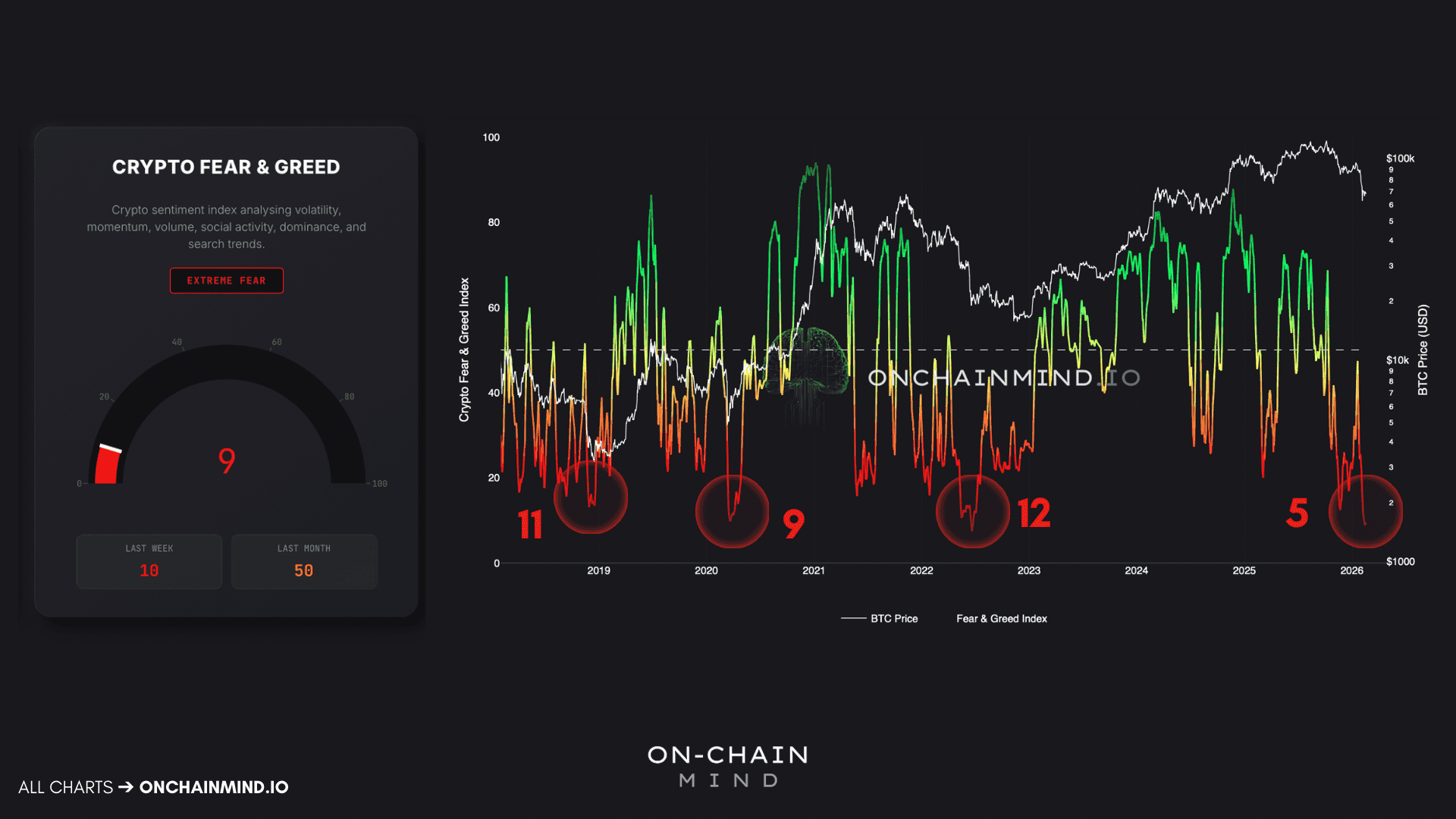
Crypto Fear & Greed Index
Finding Opportunity in the Discomfort
Right now, the market is under real, measurable pressure:
Short-term holders are deeply underwater.
Some are beginning to realise losses, but full capitulation has not yet arrived.
Capital is contracting month after month.
Sentiment sits at historic extremes of fear.
This all feels like a gut punch. But it is also what a structural reset feels like too.
From my perspective, seeing short-term holders in deep pain is exactly what I want to see when I am looking to accumulate. It is a necessary, albeit brutal, part of the market cycle. This controlled bleeding we are seeing right now is the market working through its internal pressures.
And let’s be real – Bitcoin’s not going anywhere. The network’s stronger than ever, with adoption still ticking up despite the noise. If you’re holding off for worse sentiment, fair play, but ask yourself: are you reacting emotionally like an STH, or thinking long-term?
I’m personally looking at these negative Capital Flows as another signal to start scaling in. It’s uncomfortable, certainly; my own portfolio has taken hits just like yours. But that is precisely the point: conviction isn’t built in euphoria. You’ll know from my recent pieces that I view anything in the $60ks as fantastic value. Anything starting with a "5" is, in my book, absolute bargain-basement material.
The legendary Warren Buffett quote, "Be fearful when others are greedy, and greedy when others are fearful", is often cited but rarely followed because it is inherently, viscerally uncomfortable to act against the crowd when the sky looks like it’s falling.
We are currently in the compounding phase of stress. The question you have to ask yourself is: are you going to let the Loss Aversion trap dictate your strategy, or are you going to look at the structural mechanics and see the immense value being created in the wreckage?
I’ll catch you in the next one.
Cheers,