
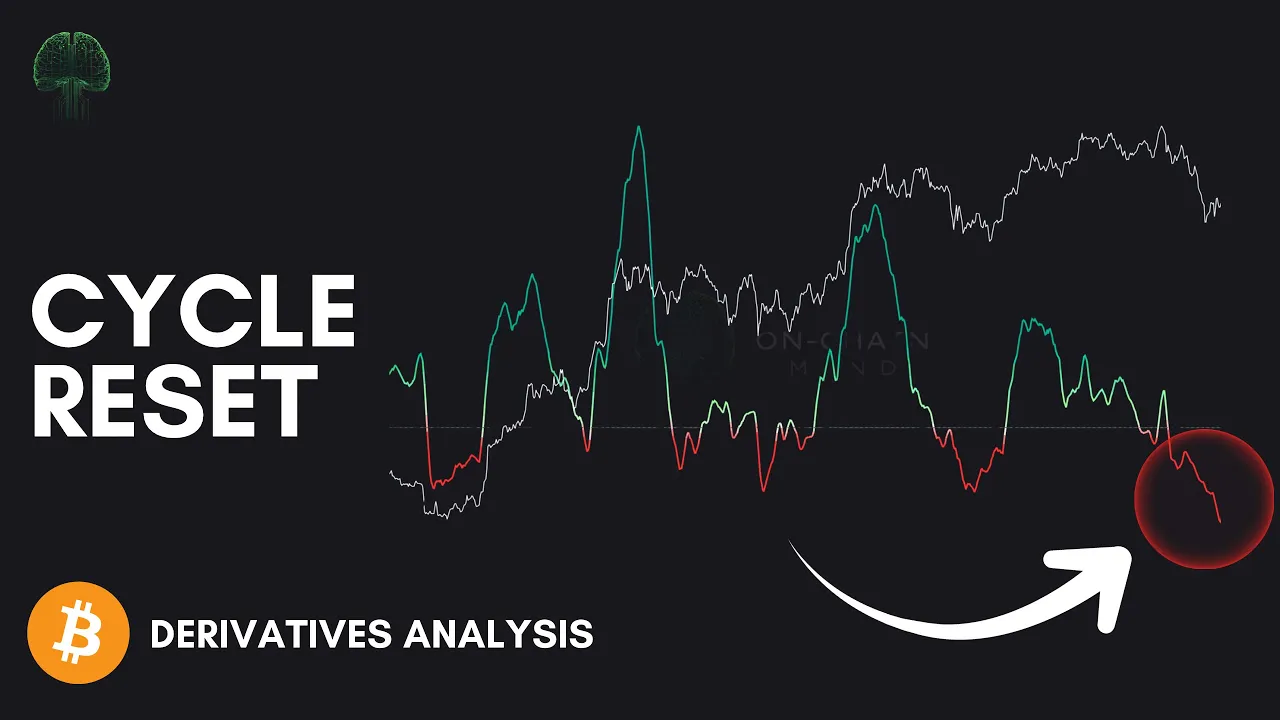
How 1/3 of all futures positions got wiped out
We have just witnessed the largest dollar-value wipeout of Bitcoin leverage in history, and the implications for the next 6 months are profound.
Hardly anyone is talking about it, but it’s driving the market’s behaviour far more than spot flows or catchy ETF headlines.
This article breaks down what’s really happening in the derivatives market and how you should interpret this moment in the Bitcoin cycle. Because when leverage unwinds this aggressively, the implications are rarely short-lived.
Let’s get into it.
The Derivative Dominance: Derivatives now control 75% of Bitcoin’s volume, making them the primary engine of price.
The Great Deleveraging: A record-breaking $33 billion in Open Interest was recently wiped out, clearing market excesses.
Sentiment via Positioning: Monthly and bimonthly changes in Open Interest act as high-signal contrarian indicators for bottoms.
Structural Market Maturity: The first negative year-on-year OI growth suggests a shift toward more stable capital.
The Hidden Engine
If you want to understand Bitcoin’s day-to-day volatility, you can’t start with spot markets. Spot flows tell the macro story of accumulation, distribution and long-term conviction. But spot alone doesn’t create the sharp intraday moves or cascading sell-offs we’ve become accustomed to.
The true heartbeat is derivatives.
And since they were introduced, it always has been. And with every passing cycle, that influence only grows.
In fact, around 75% of all Bitcoin trading volume now originates from the derivatives arena. Only the remaining 25% comes from spot. That means the majority of Bitcoin’s spikes, wicks, squeezes, and sudden reversals are not the product of organic buy-and-sell demand, they’re the by-product of leveraged traders positioning, over-positioning, and being wiped out.
Leverage amplifies everything.
It accelerates trends, exaggerates corrections, and turns otherwise modest moves into full-scale events.
The October 2025 crash was the perfect case study. As futures positioning became dangerously crowded, liquidations exploded to $600 million per hour at the peak. Forced selling created forced buying created more forced selling, which is a recursive loop that only leverage can generate.
Bitcoin’s volatility, whether we like it or not, is now dominated by derivatives.
A Quick Refresher
Before we dissect the indicators, let’s briefly revisit the derivatives landscape. If you already live in this world, feel free to skim.
Futures
A future is a contract to buy or sell Bitcoin at a predetermined price on a predetermined date. Institutions gravitate toward them because they’re regulated (e.g. CME) and predictable. Futures are the backbone of high-volume, directional positioning.
Perpetual Swaps (Perps)
The most iconic derivative in crypto. No expiry date. Instead, they rely on funding rates, which are a small fee exchanged between longs and shorts every 8 hours that keeps the perp price anchored to spot.
Perps dominate crypto because they’re easy, liquid, and available 24/7. They’re also the most abused in terms of leverage. But in crypto, absurd is normal.
Options
Options grant the right, not the obligation, to buy or sell Bitcoin at a certain price in the future. They allow sophisticated strategies such as hedging, volatility trading, spreads, straddles, and complex risk structures that you simply can’t achieve with futures or perps.
TradFi’s chosen derivative is no doubt options, but the crypto options markets (mostly Deribit) have started to grow massively in maturity recently.
The Spark in the Powder Room
Open interest (OI) is the total dollar value of open futures contracts that haven’t yet been closed or settled. Think of it as the sum of all active leveraged bets in the system.
High OI = crowded room full of dry powder and open flames.
Low OI = fewer sparks, less explosive potential.
This cycle, OI has consistently moved in lockstep with Bitcoin’s price. When price ran, OI ran. When price cooled, OI cooled. And in early October, OI hit a staggering $92 billion — the highest ever.
That was the breaking point. From that peak, open interest collapsed to $59 billion, the largest dollar-denominated decline ever recorded. A 35% wipeout in less than 2 months.
When a third of the entire derivatives market disappears that quickly, it isn’t because traders calmly took profit. It’s because the market forcibly removed them.
This is not rotation. It’s liquidation.
And liquidation is always information.
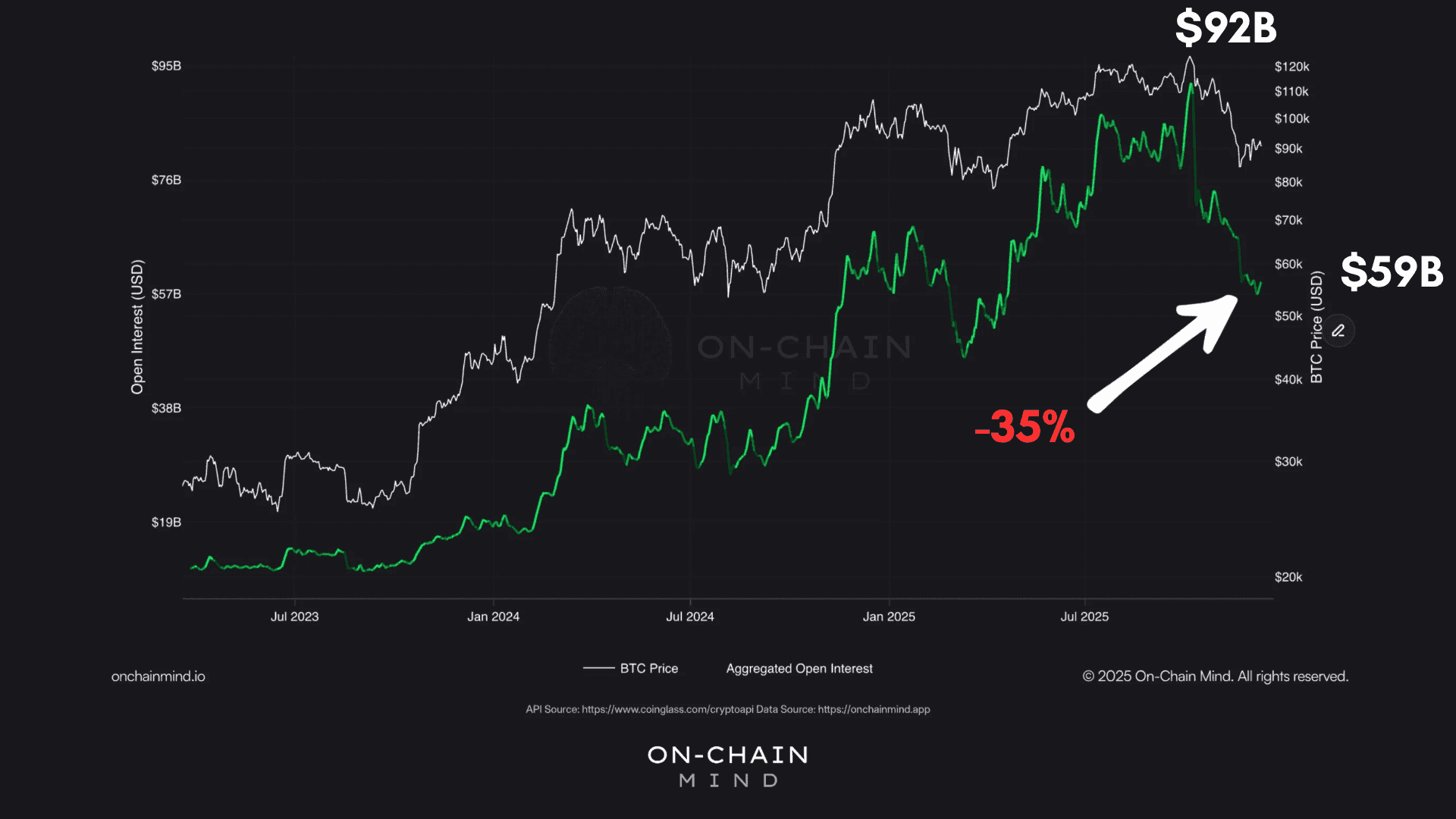
BTC Aggregated Open Interest
Contrarian’s Dream
The raw OI number is helpful, but the 30-day Open Interest % Change is where the real signal lives. It tracks how aggressively traders are piling in or getting washed out across major futures venues like Binance, CME, Bybit, OKX, and others.
Here’s the timeless behavioural pattern:
Massive 30-day positive spikes (+40% to +60%) → local tops
Traders become overconfident. They chase moves. The market punishes them.Heavy 30-day negative spikes (-15% to -25%) → local bottoms
Fear takes over. Leverage is cleared. The market resets.
Right now, the 30-day metric sits at roughly -15%, aligning almost perfectly with previous bottoming zones over the last few years. It’s one of the clearest cyclical signals we have.
When speculative leverage drains in this magnitude, you’re typically closer to the end of a correction than the beginning.
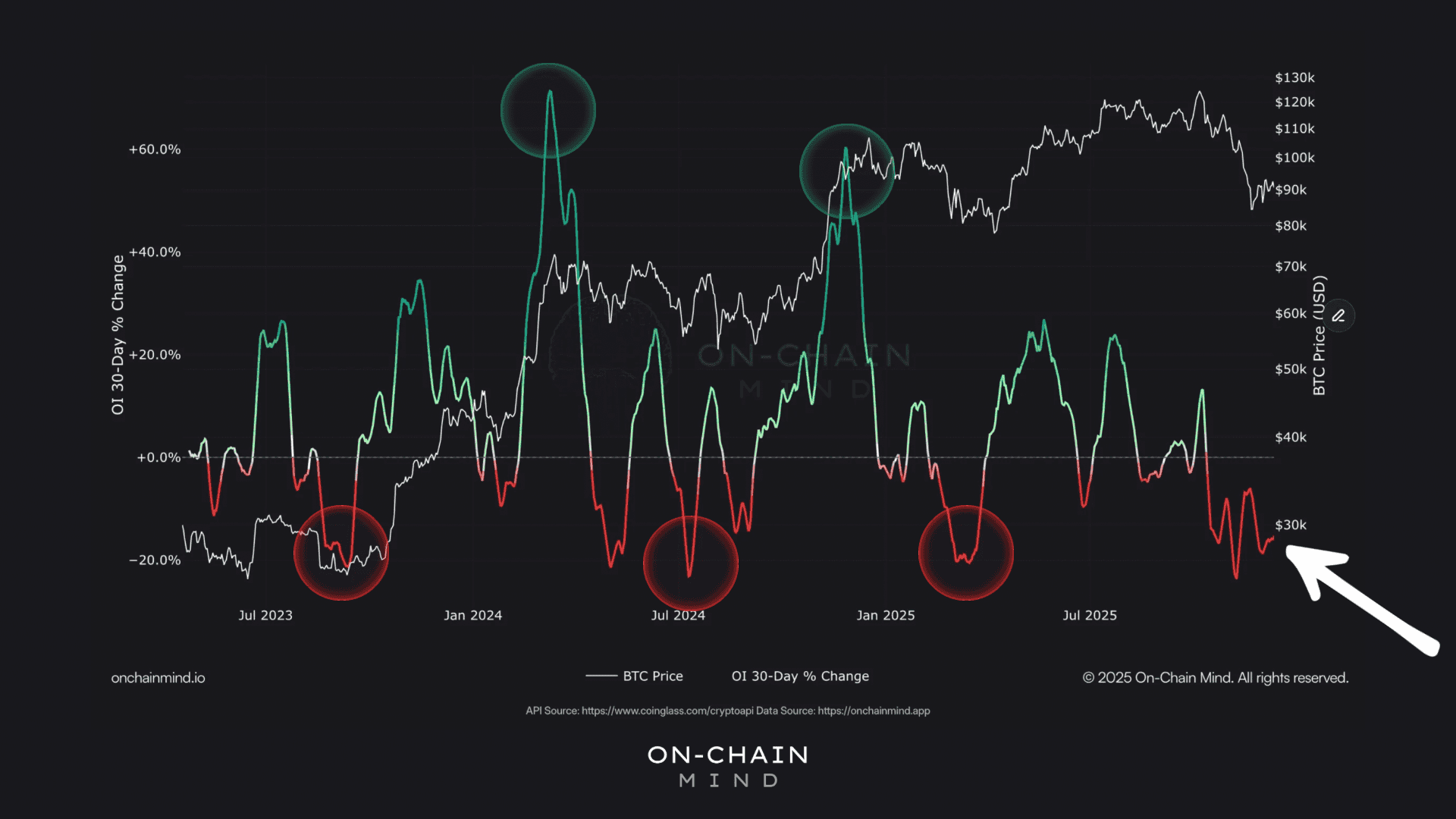
OI 30-Day % Change
Looking Through the Noise
If you want to eliminate noise entirely, most of the time the answer simply is: extend the window.
The 60-day Open Interest % Change is one of the most reliable long-cycle indicators in the derivatives toolkit. It filters out the short-term chop and reveals the more meaningful structural shifts underneath.
And right now, this metric is printing the lowest reading of the entire cycle at -30% over two months.
This confirms several things:
The flush was not superficial.
The deleveraging was broad, not localised to one exchange.
Momentum traders were forced out systematically.
What remains is stronger, stickier capital.
A bimonthly decline this steep almost always marks a reset phase. The froth evaporates. The tourists leave. You’re left with durable participants who aren’t operating on razor-thin margins.
In market-structure terms, this is the bedrock from which sustainable moves emerge.
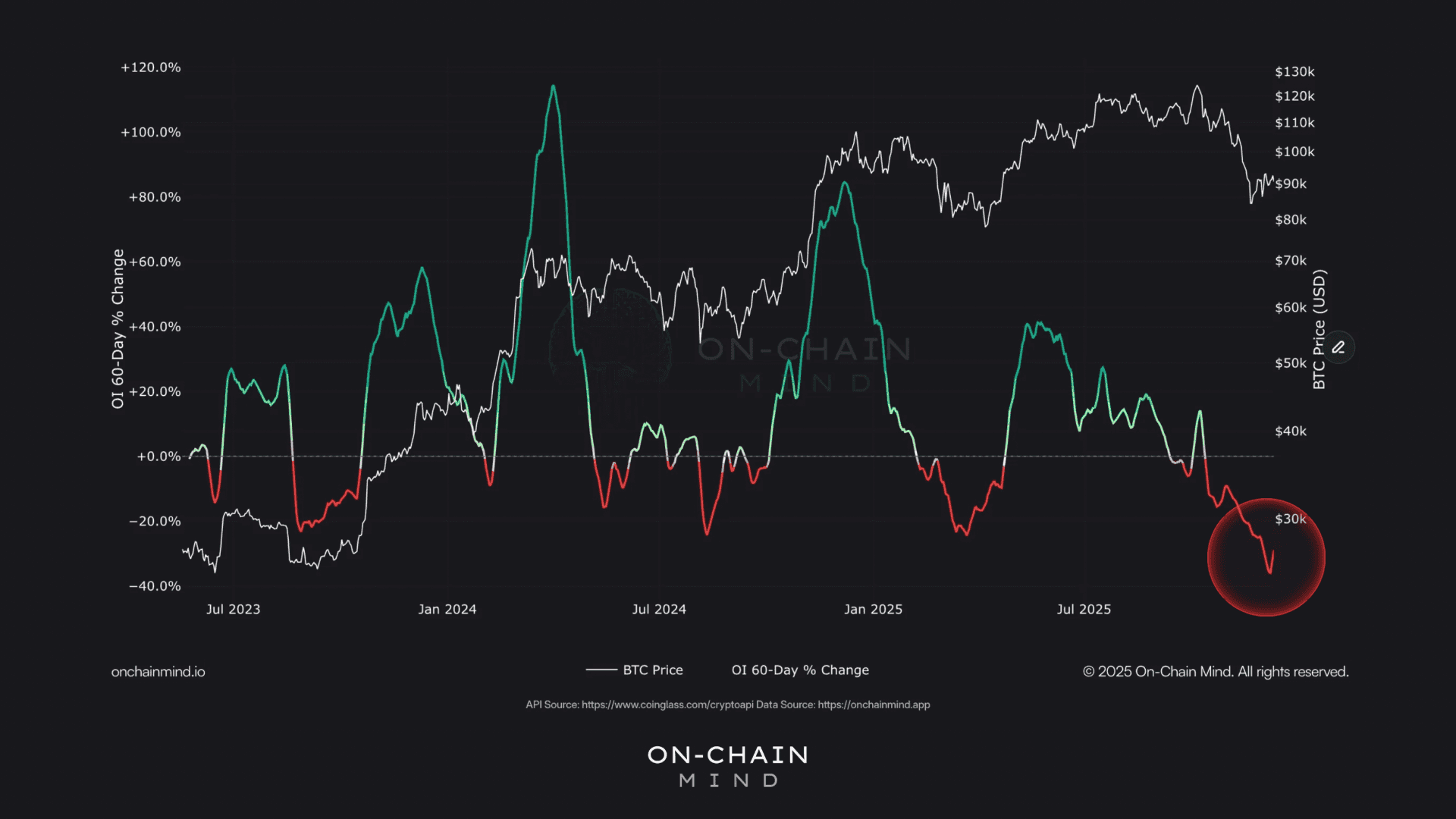
OI 60-Day % Change
The Macro Warning Sign
This one surprised me.
For the first time since reliable exchange-wide data became consistent in 2022/23, the year-on-year open interest change is down ~5% or about -$2 billion YoY.
This is unusual. Derivatives have been in a multiyear structural uptrend as adoption grows and “sophisticated” participants enter the space. Even during volatile periods, the broader trajectory has always pointed higher.
A negative year-on-year reading tells us:
Growth in speculative leverage is below trend.
The derivatives market hasn’t simply stabilised, it has contracted.
The reset is structural, not a blip.
Capital currently deployed appears more resilient and long-focus, not hot and reactive.
When you combine this with the 30-day and 60-day collapses, the message is obvious:
The market has undergone a complete derivatives washout and we are sitting with a cleaner slate than almost anyone expected.
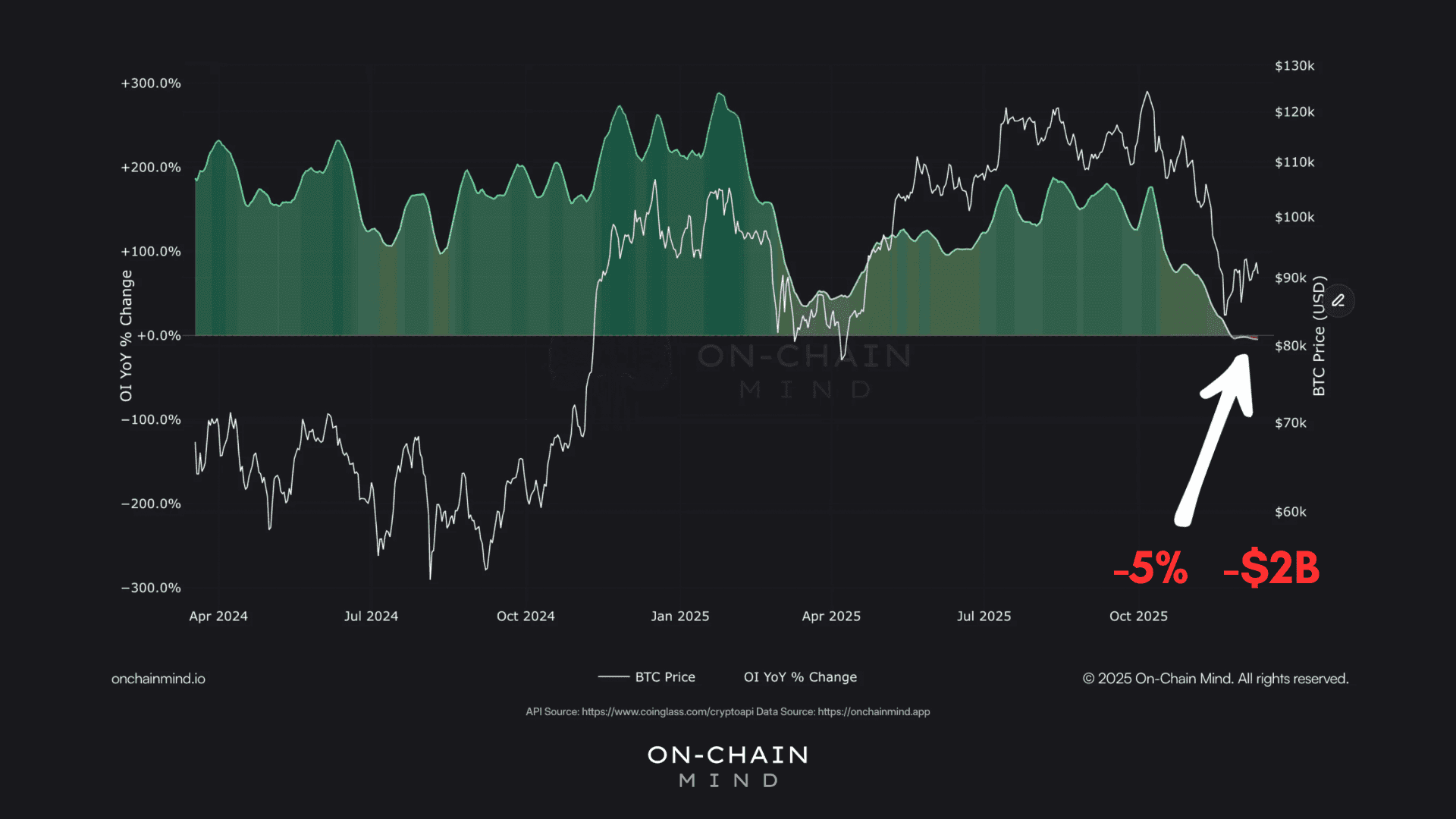
OI Year-on-Year Change
The Beauty of a Boring Market
If you’ve been following my analysis for a while, you know I have a bit of a love-affair with “boring” markets.
Bitcoin and crypto always dances between phases of excess and cleansing. Leverage piles up, traders crowd into momentum, and then the market wipes the slate clean. It’s part of the cycle’s DNA.
To the average retail trader, a market that chops sideways or flushes out leverage feels like a failure. They want the “up-only” adrenaline hit every single day. But to me, this massive deleveraging event is the best thing that could have happened to Bitcoin.
I genuinely believe that we were headed for a disastrous blow-off top if that $92 billion in Open Interest had kept climbing. When the market gets that top-heavy, the eventual crash that follows is catastrophic. By flushing out $33 billion now, and eventually stabilising at ~$90,000, the market has effectively taken a massive pressure release valve and opened it wide with not many disastrous consequences.
In my opinion, we are moving into a phase where the tourists are completely gone. Good riddance. The market is now being built on a foundation of spot demand and institutional hedging. This might mean we chop around for a few more months, and honestly, I hope we do. The longer we consolidate without excess leverage, the more powerful and sustainable the next breakout will be.
I’m still expecting a slow and steady grind around current levels. I’m ignoring the noise of the liquidations because, as the data shows, the system seems to have been cleaned. We’ve seen the humbled trader effect in full swing, and historically, that is exactly when the smartest money starts to accumulate in earnest.
If you’ve been frustrated by the chop or confused by the recent price behaviour, don’t be.
This is what a deleveraged Bitcoin looks like. Messy. Flat. Uncertain.
But ultimately, in my view, Bitcoin has hasn’t looked this good in over a year.
I’ll catch you in the next one.
Cheers,