
Measuring multiple metrics to uncover the timing of Bitcoin’s bearish cycles
How long does a Bitcoin bear market actually last?
At first glance, it sounds like something that should be easy to answer. But markets rarely behave with that kind of neatness. No single indicator can reliably call the exact start and end of a bear market.
So instead of relying on 1 signal, I decided to measure 4 independent indicators, each capturing a completely different dimension of market behaviour, to see how long the bear phase typically lasts.
The results were surprisingly consistent.
And if history even rhymes, the finish line for our current misery is closer than it feels, but perhaps further than the impatient would like to admit.
Let’s get into it.
The Hidden Clock of Bear Markets: Bitcoin bear cycles show remarkable consistency when measured through independent structural and statistical indicators.
Pain Concentrates at the End: The deepest phase of a bear market tends to last a consistent amount of time below key on-chain cost bases.
Indicators Resolve at Different Speeds: Momentum indicators recover faster, while long-term supply metrics take longer to exit bear territory.
A Converging Timeline: Most metrics currently cluster around a similar timeframe for a potential bear market resolution and a definitive bull market return.
The Structural Pain of Long-Term Holders
The objective here is simple: measure how long each indicator typically spends in bear territory and then repeat this process across the 3 previous major Bitcoin bear cycles.
Let’s break each one down one by one.
The first metric comes from on-chain data and focuses on a particularly important group within the Bitcoin ecosystem: long-term holders.
These are investors who have held their coins for extended periods, often through multiple cycles. One of the most revealing signals within this cohort is the % of long-term holder supply currently sitting at a loss.
When the market collapses deeply enough, even these seasoned holders begin holding coins below their cost basis. That represents true structural pain within the network.
For this analysis, I defined bear territory as the moment when:
More than 25% of the Bitcoin supply held by long-term holders is in loss.
The bear market then ends once this figure falls back below 25% as prices recover.
On average, across the past 3 cycles, this process takes ~12 months. It is a slow, grinding measurement of structural pain, capturing the deeper trends that fleeting rallies can't mask.
In other words, this is one of the slowest indicators to resolve, but also one of the most structurally meaningful.
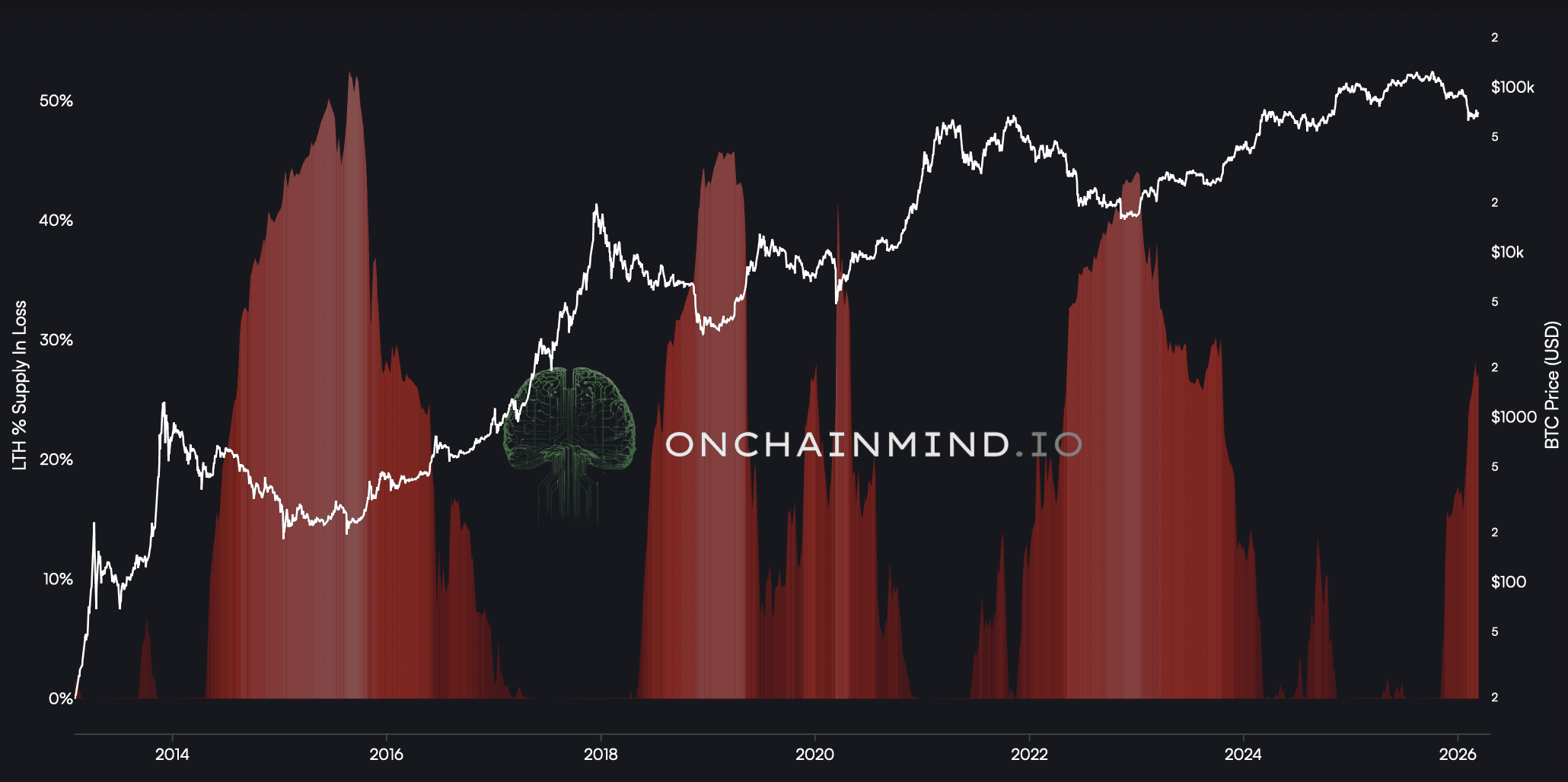
LTH % Supply In Loss
The Momentum Perspective
Our second lens is the Mean Reversion Oscillator. While the LTH metric is about on-chain reality, this is about pure momentum and price psychology.
Specifically, this is built in a similar fashion to an RSI-style indicator, but applied on the monthly timeframe.
Momentum indicators measure something very different from on-chain metrics. Rather than focusing on investor behaviour or supply dynamics, they track how stretched price becomes relative to its long-term equilibrium.
Averaging this out across the last 3 cycles gives us a duration of just under 10 months.
That makes this indicator faster to resolve than the long-term holder supply metric. And that makes intuitive sense.
Momentum tends to turn before structural supply conditions fully recover. Once price stabilises and begins trending upward, momentum indicators can exit bearish regimes relatively quickly.
Think of it like the early signs of spring. The temperature might start rising before the snow has fully melted. Momentum captures that early shift.
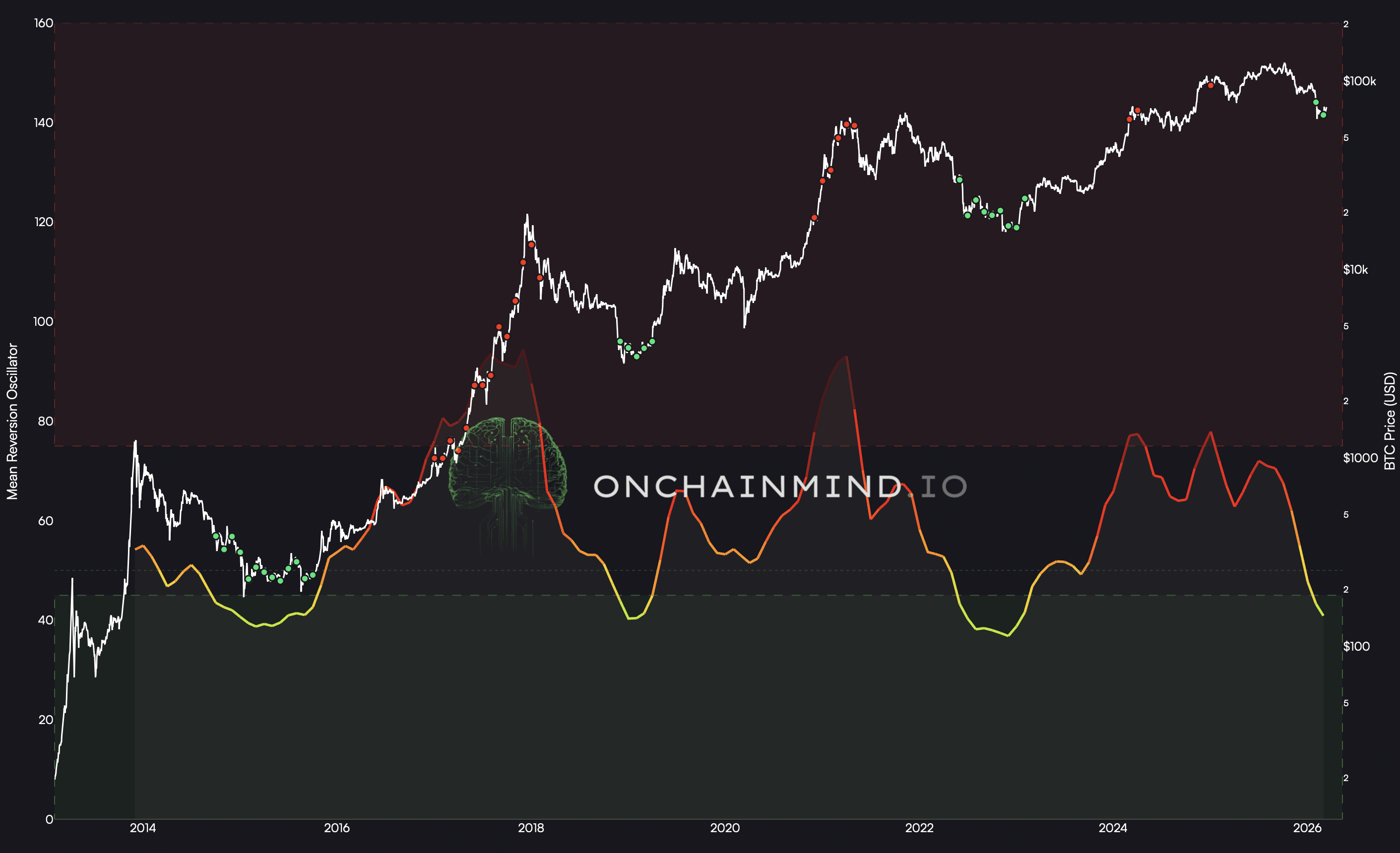
BTC Mean Reversion Oscillator
The Probabilistic Approach
The 3rd metric we’ll look at is the Z-Score Probability Waves. This brings a mathematical, probabilistic standpoint to the table.
By looking at the Z-score on a long-term timeframe, we can identify when the price has deviated so far from its fair value that it enters the red zone of extreme undervaluation. By measuring how long the indicator remains in this regime before returning to neutral, we obtain another estimate for bear market duration.
And once again, the result lands in a similar range to the other indicators. Across the previous cycles, the bear phase measured by this statistical framework tends to last ~12 months.
Despite coming from a completely different analytical approach, the conclusion ends up remarkably consistent.
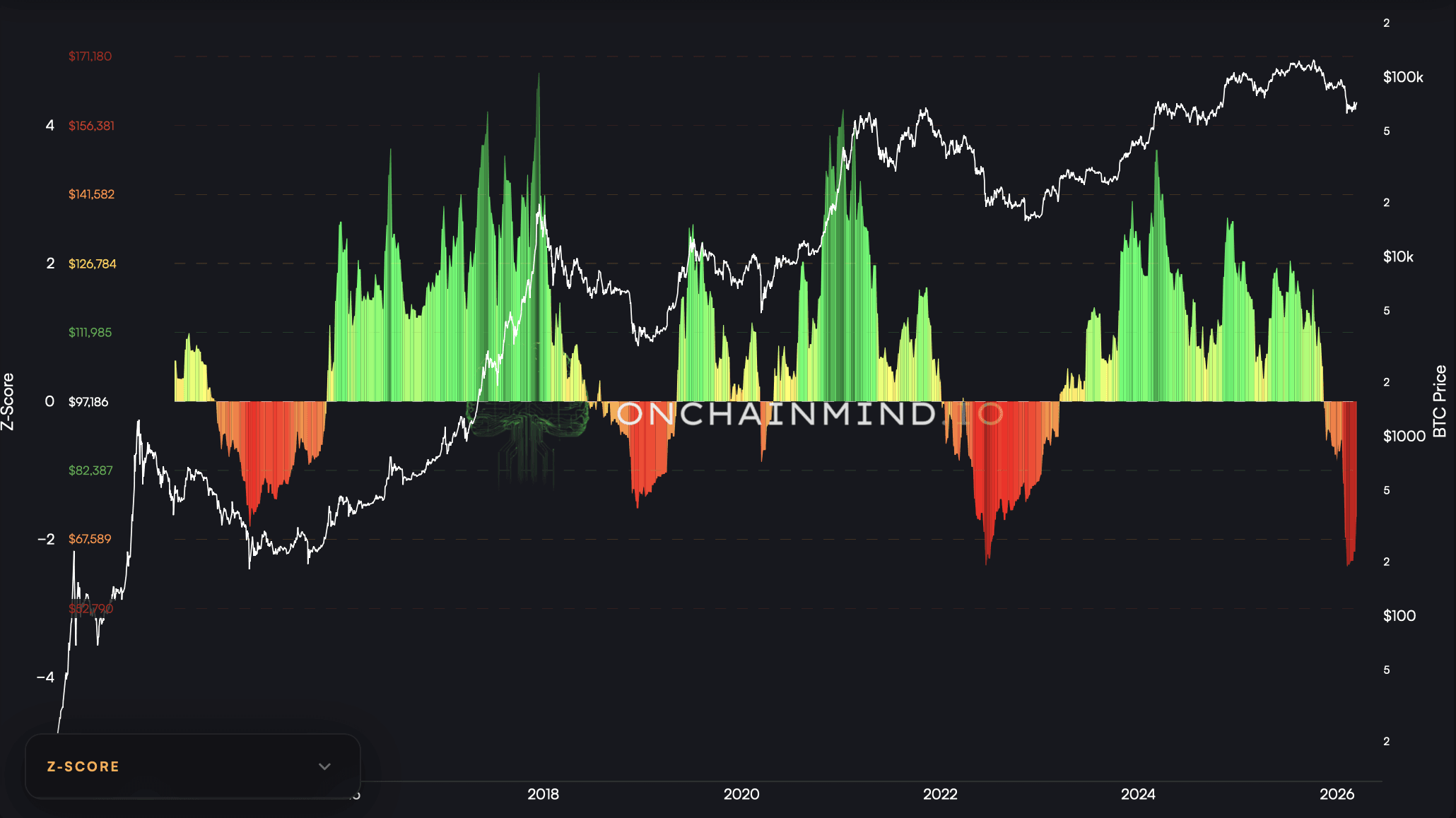
Bitcoin Z-Score Probability Waves
The Final Capitulation Phase
The final metric takes an entirely different perspective again.
Instead of measuring the full bear market, the Short-Term Holder (STH) Days Spent in Loss is my preferred tool for measuring Bitcoin’s "darkest hour". It focuses on the deepest, most brutal phase at the end of the cycle.
This isn't about the entire downtrend from the all-time high; it’s specifically counting the number of consecutive days price remains below the STH Realised Price (the average on-chain cost basis of new market entrants).
This is a measurement of pure capitulation.
Every single major bear market has spent roughly the last 200 days of its life in this state. It is the final, brutal squeeze that flushes the last bit of hope out of the system. This phase averages about 7 months, and it is arguably one of the most important windows for any long-term investor to monitor.
Ironically, it’s also where the foundations of the next bull market are usually formed.
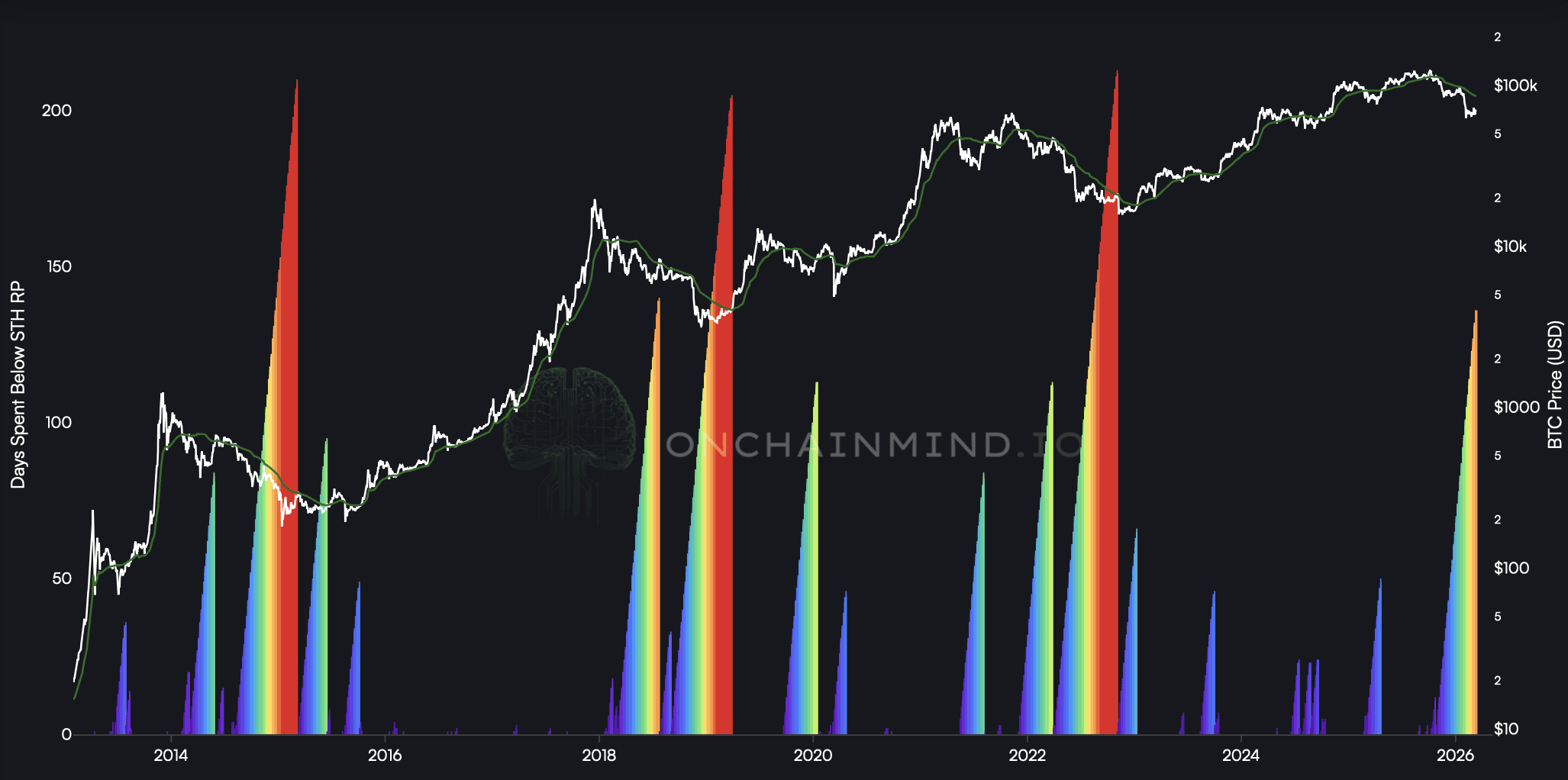
Bitcoin STH Days Spent in Loss
The Road to Q4
Now, let’s apply this to our current reality. If we look at where these indicators sit today, the data begins to point toward a very specific window in time.
Across previous Bitcoin cycles:
Most bear markets last between 10-12 months
The final capitulation phase typically lasts around 7 months
The fastest indicator, the STH Days Spent in Loss, is already well underway. We have currently spent over 136 days below the STH Realised Price. Given its 7-month (roughly 210-day) average, this metric suggests a resolution as early as June 2026. This is the optimistic view, suggesting the most brutal part of the flush-out might be over by mid-summer.
However, the slower, more structural metrics demand more patience:
The Mean Reversion Oscillator points toward October 2026.
The Z-Score Probability Waves project a recovery around November 2026.
The LTH Supply in Loss (our slowest metric) suggests we may not be fully clear until January 2027.
When you step back and look at these projections as a group, they cluster remarkably tightly around the fourth quarter of 2026. If the current cycle behaves with even a modicum of the consistency we’ve seen over the last decade, November 2026 stands out as the most probable pivot point where the bear market truly resolves and a new bull cycle begins to take flight.
It is a sobering thought for those hoping for a V-shaped recovery in the next month or so, but there is a strange comfort in the data. The current bear market has been undeniably brutal, starting with a sharp drop and offering no real relief rallies to speak of. That is certainly different to previous bears.
While the STH metric shows we are more than halfway through the pain phase, the structural plumbing of the market still needs time to reset.
So if the current cycle behaves similarly to the previous three (and that assumption always carries uncertainty), the most probable timeframe for the next bull phase would sit somewhere around the fourth quarter of 2026.
Do I Trust the Clock This Time?
I have said many times before that markets do not move with calendar precision. If you try to trade based on a specific date, you will almost certainly get caught on the wrong side of a wick. Markets are living, breathing entities driven by human emotion, and human emotion is rarely "on time". However, I find the current clustering of these metrics too significant to ignore.
There is a certain aesthetic to this bear market that feels different. In previous cycles, we usually saw a "sucker's rally" or a period of hope before the final floor fell out.
This time, it has been a relentless, grinding descent. The fact that the STH metric is already 136 days into its typical 210-day cycle tells me that we have front-loaded a lot of the misery. We have essentially skipped the denial phase and went straight into depression.
It shows how severe the current environment has been. This bear market has offered very little relief compared with previous cycles. But historically, that kind of persistent pressure tends to happen closer to the end of bear markets than the beginning.
In my view, this front-loaded brutality might actually be a gift. It means the fast resolution in June is a distinct possibility if we continue at this pace of capitulation. But as a realist, I’m keeping my eyes on late 2026. There is a fundamental gravity to the 12-month reset that Bitcoin has never been able to escape.
Personally, I think the most realistic path forward is something like this: A prolonged period of sideways consolidation, occasional relief rallies, and continued volatility, gradually transitioning into a more constructive environment as we move towards late 2026.
Instead of trying to predict the exact day the bull market begins, it’s far more useful to watch when these metrics themselves begin exiting bear territory. I’m not looking for the bottom; I’m looking for the exhaustion.
When the LTH supply in loss finally starts to curl down and the Z-Score/MRO begin their ascent from the floor, the calendar date won't matter.
But if you're asking me to place a bet on when the vibe of this market finally shifts from survival to growth, I’m circling Q4 2026 on my desk calendar.
It’s going to be a long year, but for the first time in a while, the exit sign is starting to flicker in the distance.
I’ll catch you in the next one.
Cheers,