
Modelling the downside if equities unravel
Bitcoin is down 46% from its most recent all-time high.
But here’s the question most people are avoiding:
What happens to Bitcoin if the stock market actually crashes?
Because whether we like it or not, Bitcoin no longer trades in isolation. It trades inside the same global liquidity machine as equities.
So instead of debating whether the bear market is over, I’m breaking down the correlation, the historical drawdowns, and a fully quantified worst-case scenario.
Let’s get into it.
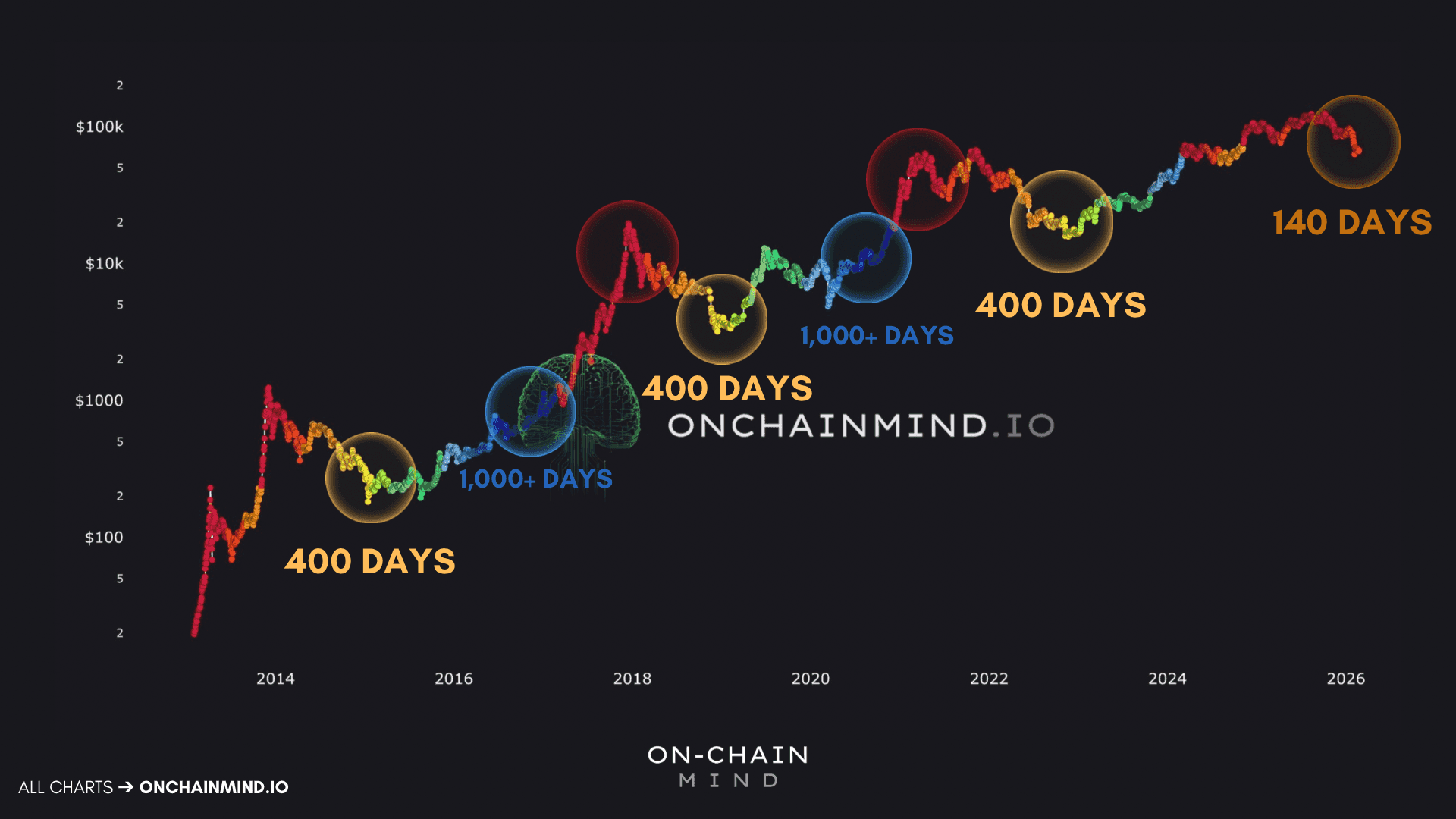
Time Since Peak Matters: At 140 days post-ATH, Bitcoin is not historically deep into a bear market yet, at least based on time.
Macro Correlation Is Real: Like it or not, since 2019, Bitcoin has traded increasingly like a leveraged Nasdaq proxy.
Volatility Multiplier Effect: Bitcoin’s drawdowns have averaged 2-4x deeper than the Nasdaq’s over the past few cycles.
Time Is the True Edge: Over any 3-year holding period, Bitcoin’s historical loss probability falls below 1%.
The Illusion of Time
It feels like an eternity since Bitcoin was printing fresh all-time highs. We have seen lower highs, lower lows, failed breakouts, and sentiment crushed into dust. The psychological weight of that decline makes it feel far longer than it actually is.
Yet, the data does not care how it feels.
It has been roughly 140 days since the last all-time high, which in the context of Bitcoin’s historical cycles is barely a warm-up act. When we map time since previous peaks across history using a heat map framework, red zones represent consistent new highs.
As time passes without reclaiming the peak, the colours cool into orange and yellow. Deep blues represent multi-year structural rebuilds where Bitcoin reconstructs its base.
Historically, major cyclical bottoms have often formed around 400 days after the previous all-time high. In some cycles, it has taken over 1,000 days just to reclaim prior peaks.
This perspective is interesting. At 140 days, we are not statistically deep into historical bear territory. This does not mean we must go lower, but it does mean we cannot assume the worst is already behind us simply because sentiment feels exhausted.
Markets stretch time precisely when participants crave resolution. They force patience before they reward it.
However, the deeper risk may not be about cycle duration at all. It may be macro.
Bitcoin Days Since ATH Heatmap
The Elephant in the Room
There is a persistent narrative that Bitcoin is digital gold, a hedge against fiat debasement and an escape valve from monetary excess. There may well be many elements of truth in that thesis over the long term. I certainly believe so.
But the market has consistently shown us that this is not the narrative it is trading. It is actually trading liquidity.
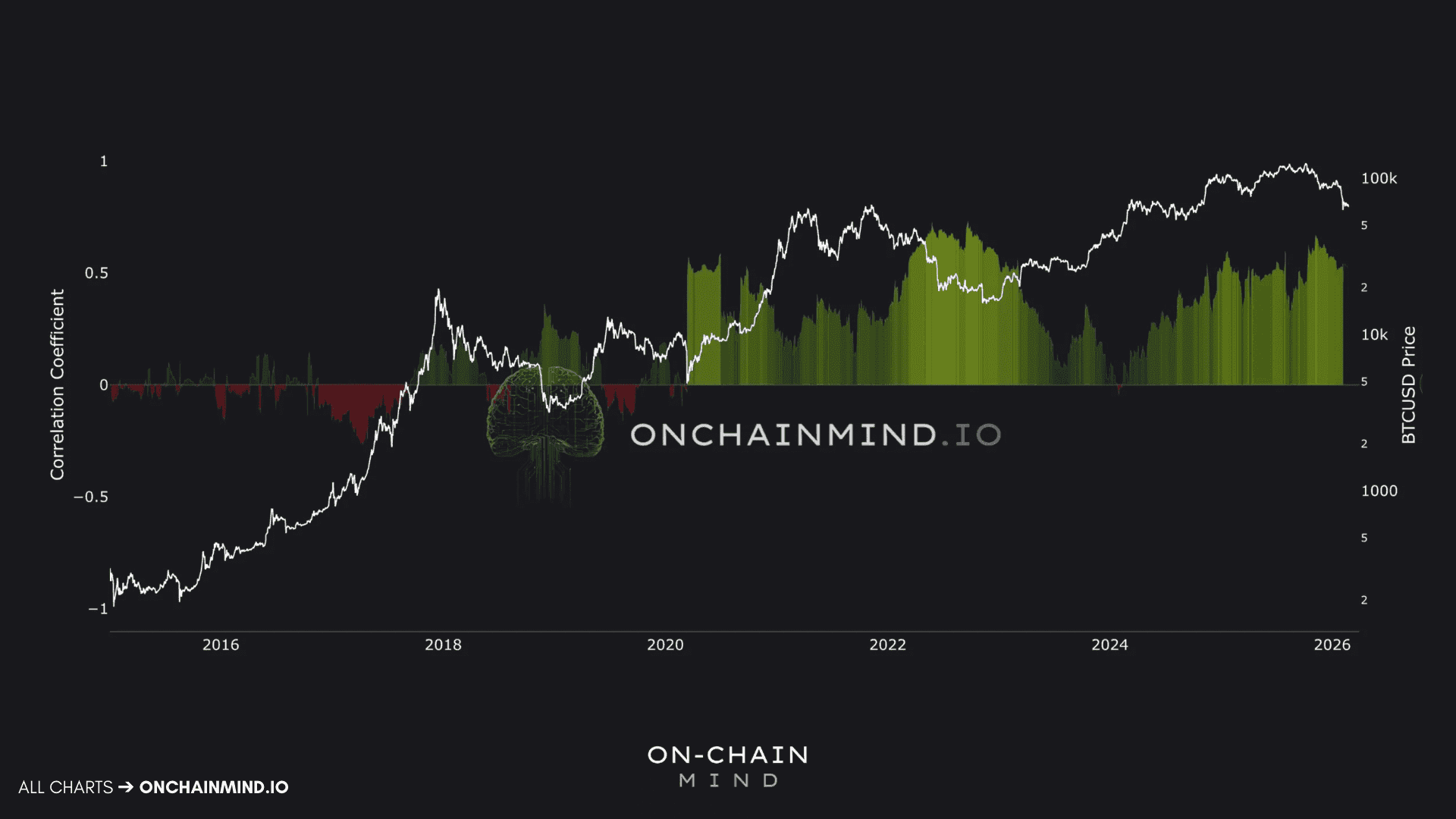
Since 2019, Bitcoin has behaved increasingly like a high-beta technology stock. When we analyse the rolling correlation between Bitcoin and the Nasdaq 100, a structural shift becomes clear. Before 2019, correlation was inconsistent. Bitcoin was smaller, less liquid, almost completely dominated by retail flows, and structurally disconnected from global macro capital movements.
Then the March 2020 liquidity shock hit and correlation spiked sharply. From that point onward, the relationship tightened. It has not been perfect, but it has been persistent.
More importantly, the highest sustained peaks in correlation have aligned closely with Bitcoin bear markets. In 2018, we saw the first major sustained sign of positive correlation. March 2020 delivered another spike during the liquidity crunch. The 2022 bear market showed the largest sustained correlation period on record. Over the past couple of years, correlation has gradually crept higher again.
So if the Nasdaq sells off aggressively, the probability that Bitcoin follows is extremely high. And because Bitcoin is structurally more volatile, it does not simply follow in equal measure. It amplifies everything.
Bitcoin vs. Nasdaq 100 Correlation
The Mathematics of Amplification
Let us quantify this relationship.
Bitcoin’s current 365-day annualised volatility sits around 44%. The Nasdaq’s sits around 21%. That means Bitcoin remains roughly twice as volatile.
Volatility refers to the statistical dispersion of returns, essentially how widely price swings around its average. It measures amplitude rather than direction. While Bitcoin’s volatility has structurally declined over time, which is a sign of maturation, it still trades at approximately double the Nasdaq’s volatility.
From a simplified market perspective, calling Bitcoin a “leveraged tech stock” is not really the craziest statement in the world. It’s a description of how capital currently treats it, whether we like it or not.
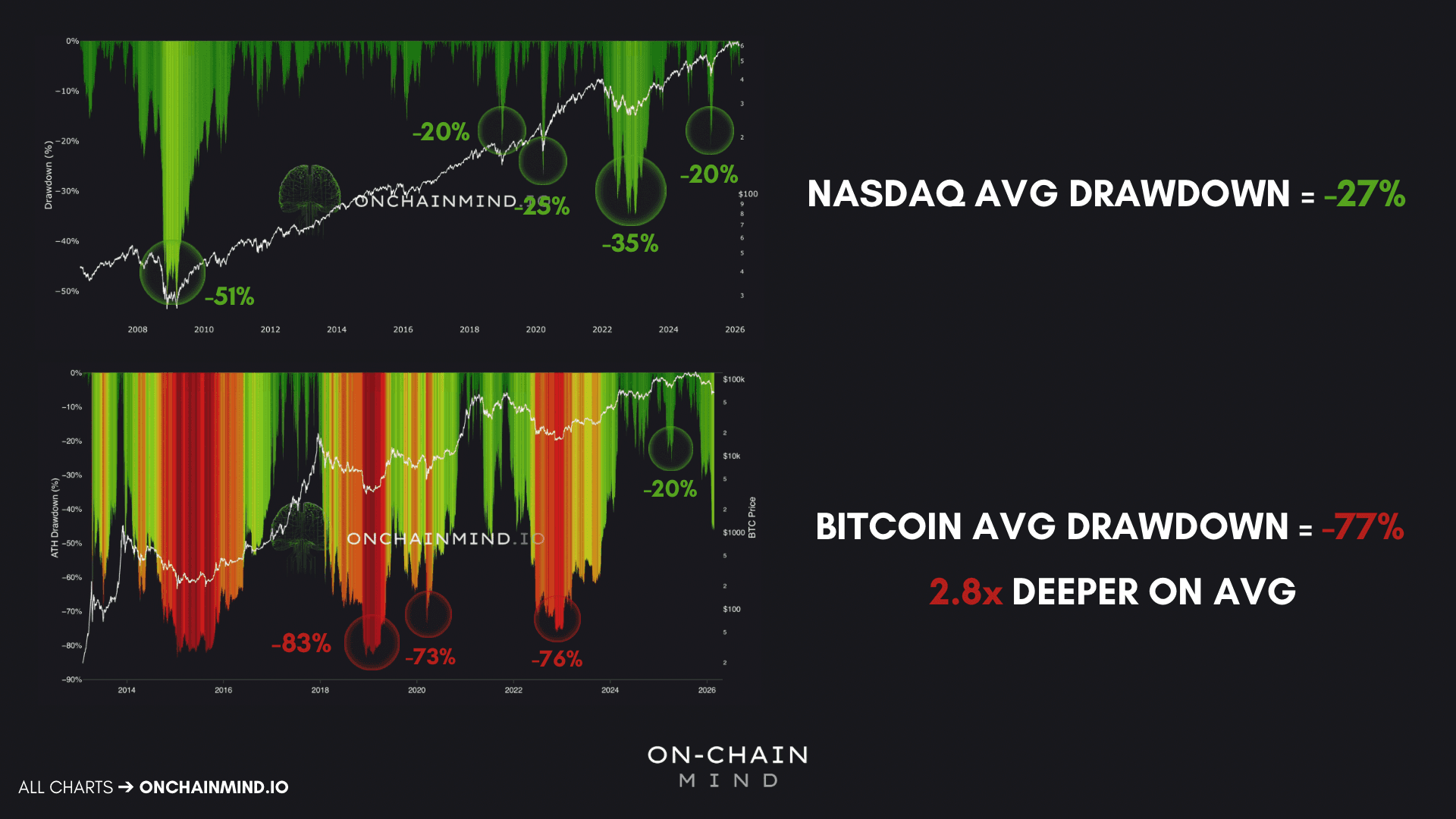
Historical drawdowns reinforce this point. Staying within the post-2008 monetary regime, where quantitative easing and liquidity injections became standard policy, the largest corrections for the Nasdaq (and it’s corresponding Bitcoin correction) have been around:
-20% Nasdaq, -83% BTC in 2019
-25% Nasdaq, -73% BTC in 2020
-35% Nasdaq, -76% BTC in 2022
-20% for both Nasdaq and BTC in 2025
Across these windows, the Nasdaq’s average drawdown was about 27%. Bitcoin’s average drawdown was roughly 77%. That implies an average multiplier of ~2.8x.
Interestingly, that multiplier appears to be compressing over time. In 2019, Bitcoin’s decline was around four times deeper than the Nasdaq’s. In 2020, it was closer to three times. In 2022, roughly twice as deep. In 2025, near parity.
This compression suggests structural maturation and possibly the dampening effect of institutional participation. It does not, however, remove downside risk. It simply refines the scale of potential amplification.
Nasdaq and Bitcoin Drawdowns
A Probabilistic Tail Risk Scenario
Let us apply this framework to the present moment.
The Nasdaq currently sits around 4% below its all-time high. As we saw above, large corrections in this liquidity regime have averaged approximately 27%. So if the Nasdaq were to complete a typical major correction from here, that would imply roughly another 23% downside.
Now apply a conservative 2x volatility multiplier to Bitcoin. That would suggest a potential 46% drawdown from current levels. With Bitcoin trading around $66,000, such a move would project a price near $35,000.
Is that possible? Yes.
Is it my base case? No.
My base case remains grounded in on-chain fundamentals and probabilistic cycle modelling. However, tail risks must be acknowledged because markets do not reward denial.
The key insight is not that $35,000 is inevitable. It is that even in a severe macro shock scenario, the outcome is measurable and finite. Personally, I assign roughly a 20% probability to that scenario. But tail risks must still be acknowledged.
Once you actually sit down and quantify the potential pain, as we have done here, it becomes far less abstract and far less frightening. The mind tends to exaggerate what it refuses to measure. When you convert fear into numbers, the emotional charge fades and you are left with probabilities instead of panic.
And once you have mentally processed that worst-case pathway, it is far less likely to catch you off guard. You are no longer reacting as if the world is collapsing around you, because you have already rehearsed the scenario in advance.
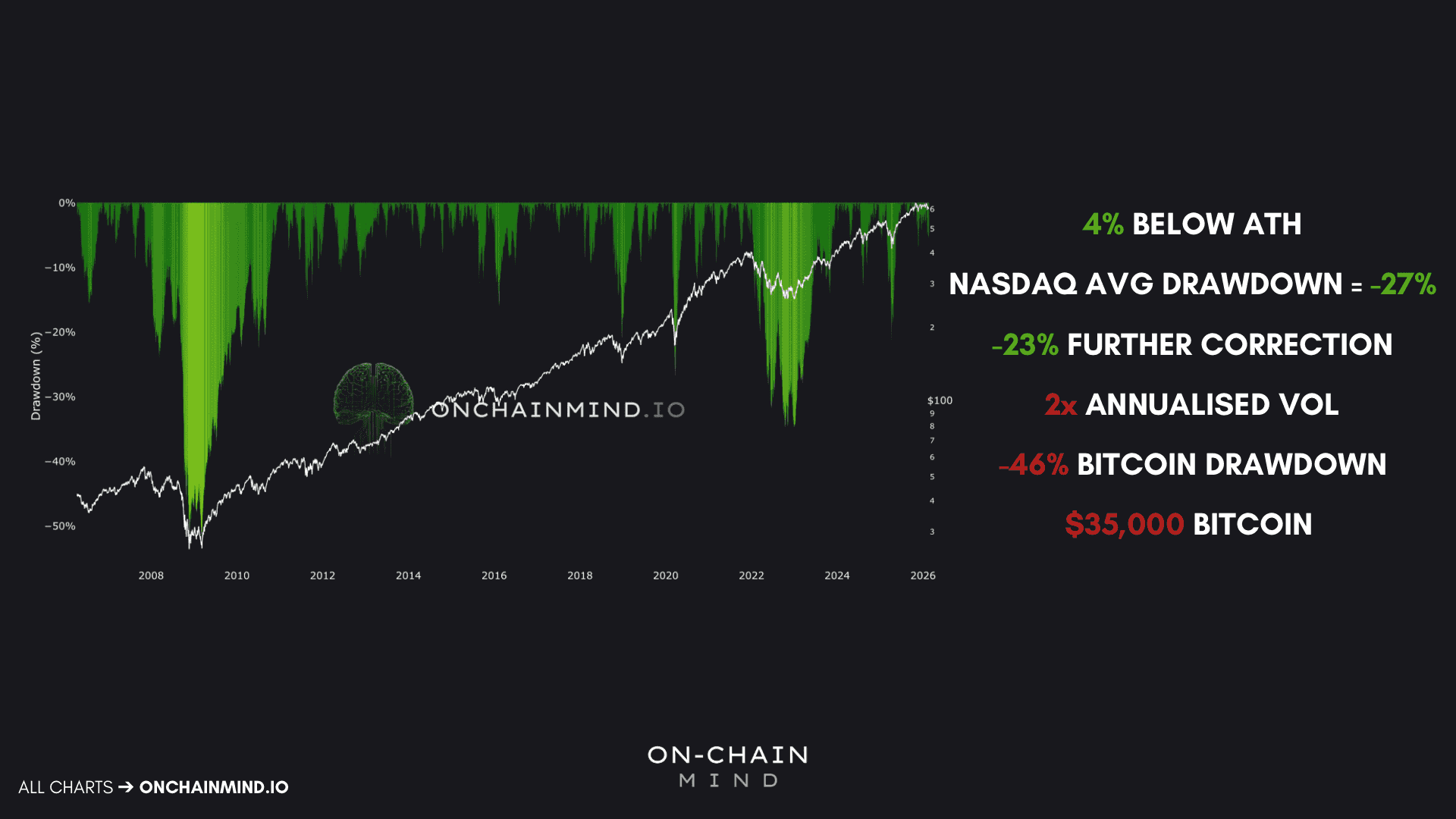
Simple drawdown example
Time Is the Asymmetry
There is one final framework that matters regardless of which macro scenario unfolds, and that is time.
Across Bitcoin’s entire history, if you held for one day, one week, or one month, your probability of being in a loss was roughly 45% (give or take a few percentage points). That is essentially a coin flip with a slight positive skew. Short-term horizons, unless backed by a proven trading edge, are essentially speculation. The data makes that clear.
Extend the holding period to one year and the probability of loss drops to around 25%. Historically, 3/4 one-year holders were in profit.
Now consider three years. Across any rolling three-year period in Bitcoin’s history, the probability of being at a loss falls to approximately 0.9%.
So if you are concerned about a severe risk-off event and short-term volatility is making you uneasy, zoom out. Unless you believe Bitcoin is going to zero, the historical relationship between time and outcome is unambiguous:
As your time horizon expands, the probability of a positive result increases dramatically.
We may or may not see a broad equity sell-off from here. Macro will do what macro does. But history suggests that patience, not precision timing, has been the true edge.
Volatility is part of the path, sure. But time is the real asymmetry.
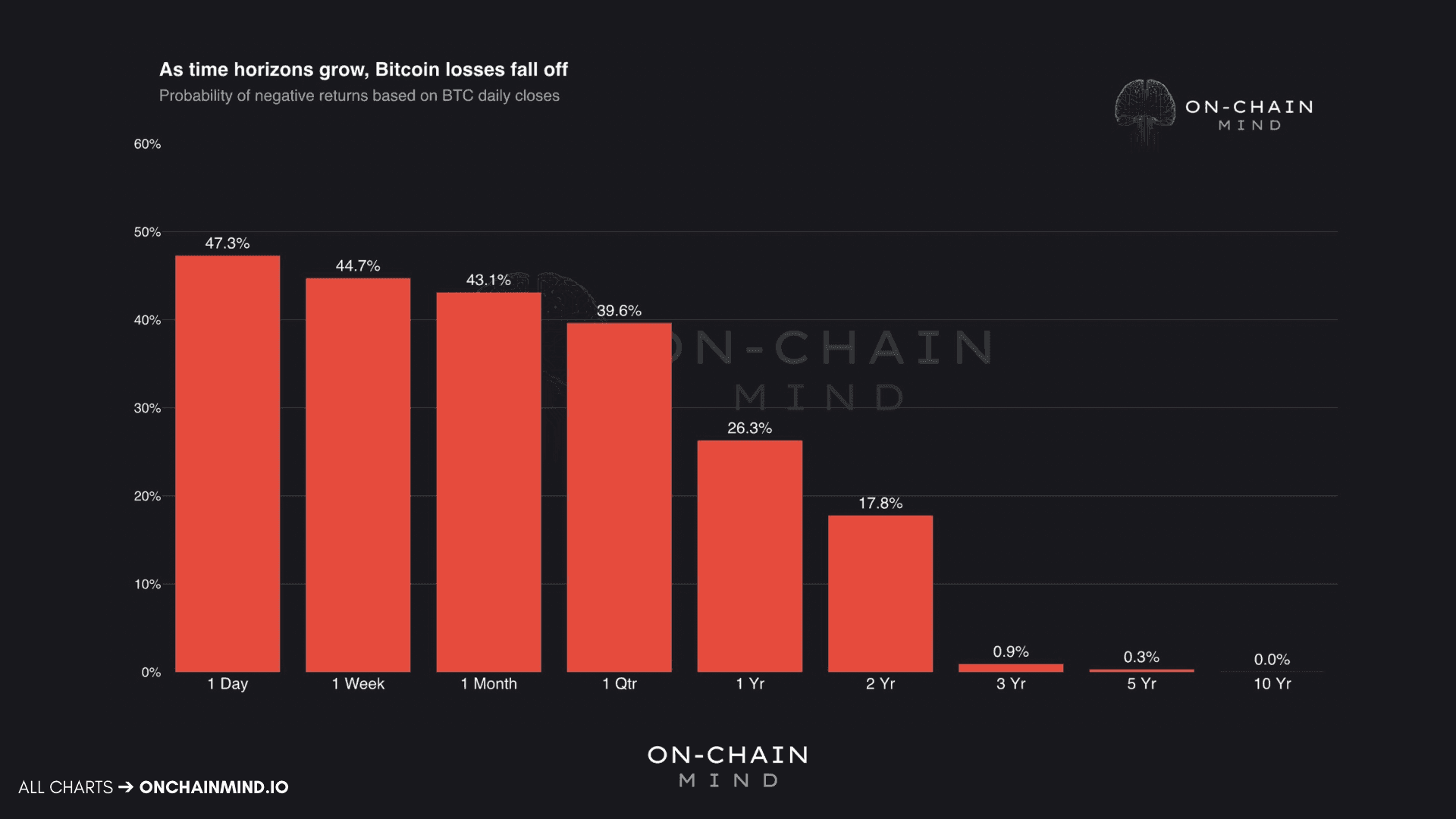
Bitcoin Holding Time Horizons
I’ll catch you in the next one.
Cheers,