
Two fundamental valuation frameworks that strip Bitcoin back to reality
Most people talk about Bitcoin as if it exists purely on a screen. But Bitcoin is not abstract. It’s a produced commodity, forged through relentless computational effort and real-world energy expenditure. And the most grounded way to assess its true value is to look at what it actually costs to bring new Bitcoins into existence.
In this premium article, instead of asking where Bitcoin is going next, this article asks a quieter, more important question:
What is Bitcoin actually worth, based on the work being done to keep it alive?
Let’s get into it.
The Difficulty Anchor: The network’s computational hardness creates a mathematical fair value for the asset.
Production Cost Floors: Bitcoin behaves like a commodity, anchored by the real-world cost of electricity and equipment.
The Halving Discontinuity: The pre-programmed supply shocks force a radical repricing of the network’s fundamental value.
The Miner’s Dilemma: We’ll identify the rare "too cheap to exist" zones where market price meets physics.
Security Is Not Free
Bitcoin is the first financial system in history backed by pure, unforgeable mathematics and thermodynamic security. The Difficulty Fair Value Model is our primary lens into this reality. It treats the network’s difficulty (the measure of how hard it is to find a new block) as the ultimate expression of the asset’s intrinsic worth.
Every 2016 blocks (roughly 2 weeks), Bitcoin automatically adjusts “difficulty” to keep block times at 10 minutes, no matter how much hash power floods in.
This adjustment is genius. As miners deploy more efficient ASICs or electricity prices drop, hashrate surges, and difficulty rises exponentially to maintain equilibrium. The Difficulty Fair Value Model captures this by applying a quadratic log-regression to historical difficulty data, plotting it against market price. The result is a long-term relationship between the cost of securing the network and Bitcoin’s traded value.
Why quadratic log? Because difficulty grows exponentially, but price doesn’t scale linearly with it. The regression reveals the underlying trend:
As difficulty climbs, so does the fair value floor.
It accelerates when hardware evolves rapidly or competition intensifies, reflecting the real capital and energy poured into the network. It represents the historic relationship between the sheer effort required to secure the network and the price the market is willing to pay for that security.
As difficulty rises, the "Fair Value" floor accelerates. This is because a rising difficulty signifies that miners are deploying more efficient, more expensive hardware and consuming more energy. They are essentially voting with their capital that the future value of Bitcoin justifies the present cost of extraction.
Right now, this model reads around $69,000.
It tells us that, based on the current computational hardness of the network, the market has a deep, mathematically justified anchor at this price point. When Bitcoin trades near this level, it is interacting with its own security budget. Historically, this anchor has acted as a reliable fair value mean reversion model, because no rational miner will sell below their all-in cost for too long.
What makes this model so powerful is its simplicity. It doesn’t require assumptions about electricity rates or specific hardware efficiencies. Difficulty already distils all those variables into one number: the ultimate proxy for network security.
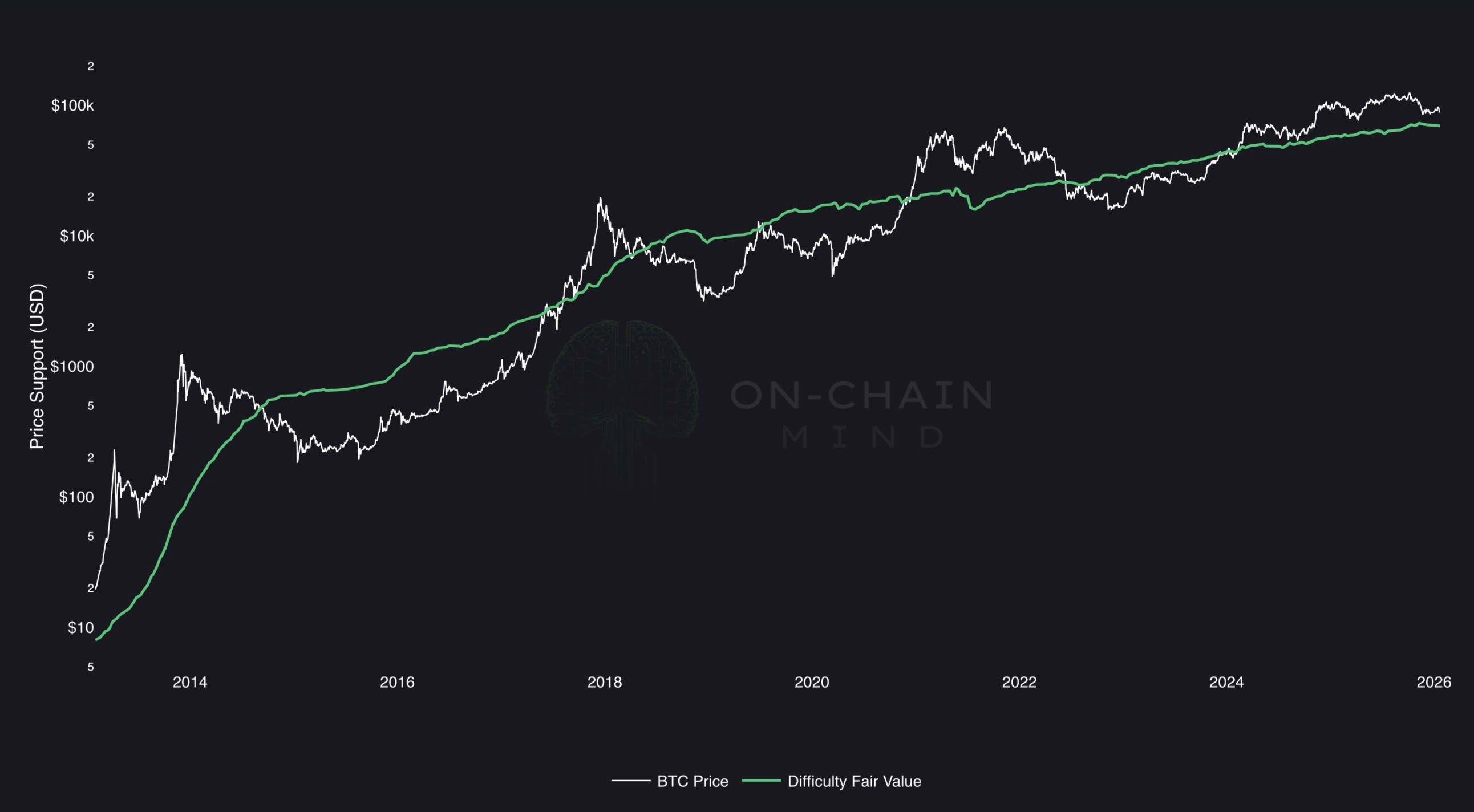
Bitcoin Difficulty Fair Value Model
Bitcoin Is A Commodity
If the Difficulty Fair Value Model tells us what it costs to secure Bitcoin, the Production Cost Model tells us what it costs to create it.
This model, heavily inspired by the pioneering work of Capriole Investments, shifts our perspective from Bitcoin as a "currency" to Bitcoin as a "produced commodity". Much like gold or oil, Bitcoin has a marginal cost of production. If the price falls below what it costs to pull the asset out of the ground (or in this case, the silicon), the system reaches a point of extreme tension.
The core idea is straightforward. Miners will keep producing as long as the price exceeds their costs. If price falls below, inefficient operations shut down, hashrate drops, difficulty adjusts downward, and costs fall until equilibrium returns. This creates a hard floor:
Bitcoin cannot sustainably trade below its global average production cost for extended periods.
The model calculates this cost by integrating 3 key inputs:
Global ASIC Efficiency (measured in joules per terahash, J/TH) — how efficiently mining hardware converts electricity into hash power.
Industrial Electricity Rates — the dominant variable expense.
Network Difficulty — the raw computational challenge (as explored above).
The visual hallmark of this model is its dynamic "staircase" line. Unlike the smooth curves of a regression model, this staircase accounts for the violent, pre-programmed shocks of the halving.
Every 4 years, the amount of Bitcoin produced per block is cut in half, instantly doubling the production cost for miners overnight, assuming all other variables remain constant.
The staircase captures the reality of miner economics beautifully. In bull markets, price surges ahead, profitability explodes, and new miners join, pushing difficulty higher. In bear markets, price falls towards the staircase, forcing weaker players out.
Miners begin to switch off inefficient rigs, the hashrate plateaus, and supply begins to dry up as those who remain in the game refuse to sell at a loss. This creates a hard floor based on real-world energy expenditure.
Currently, the model reads around $87,000.
That places Bitcoin’s price right around this production cost estimate, suggesting the network is in a marginal profitability squeeze. Miners are hanging on, but margins are thin. Historically, when price trades below this line, it’s a high-conviction accumulation zone, because the system’s incentives demand a rebound to restore miner viability.
Bitcoin’s value is energy-backed, and energy isn’t free. As efficiency improves and halvings bite, the floor rises relentlessly.
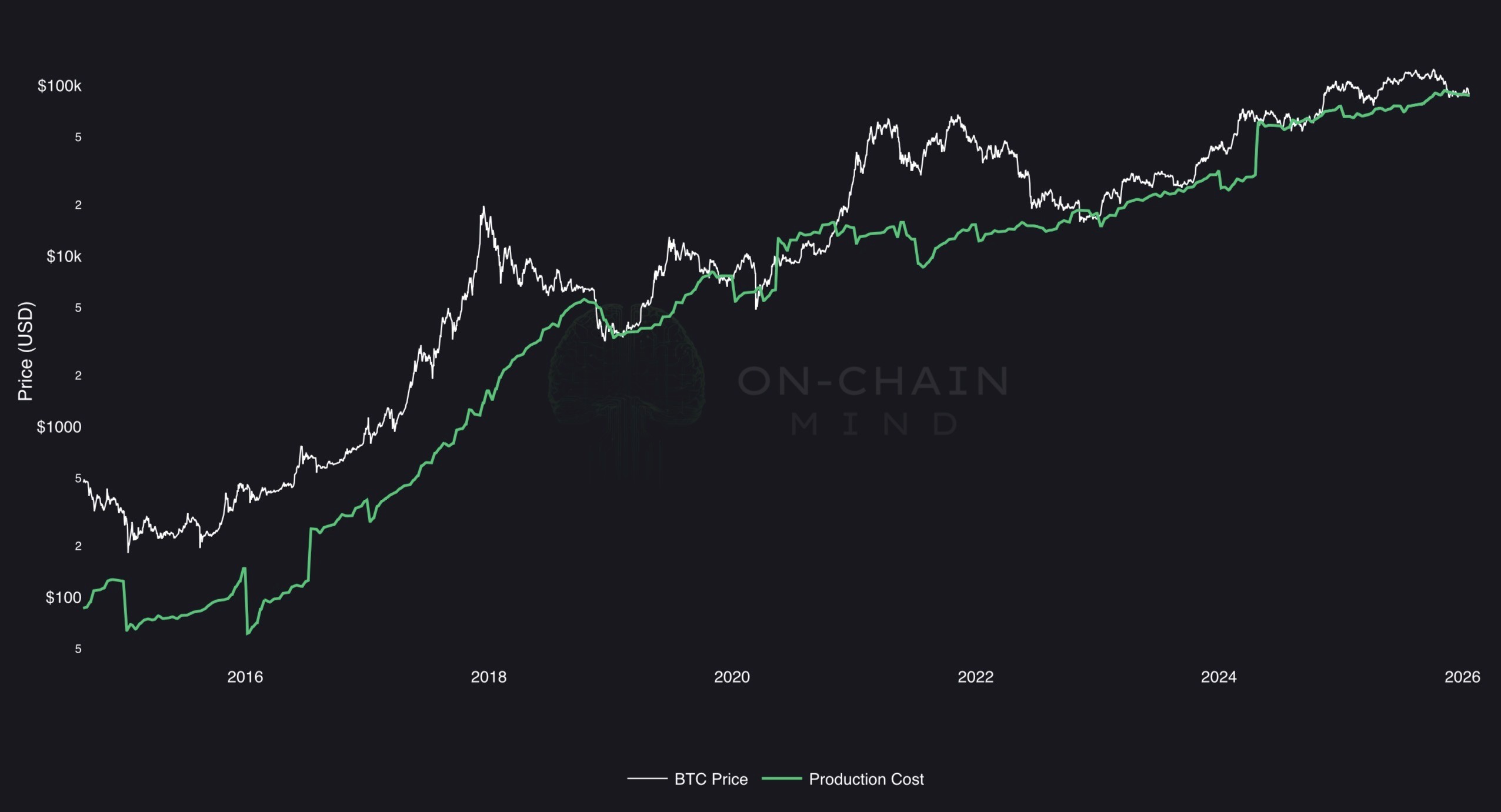
Bitcoin Production Cost Model
The Physics of Value
So why bother with technical, energy-heavy valuation frameworks at all? Because in a world of fiat debasement and endlessly expandable paper assets, Bitcoin stands alone. It is the only monetary asset that demands a physical sacrifice to bring into existence.
These two frameworks complement each other perfectly. The Difficulty Fair Value Model captures the network’s evolving mathematical and security-based worth, while the Production Cost Model defines its hard industrial floor. One reflects what the network is worth to secure; the other reflects what it costs to produce.
If you’ve followed my work for any length of time, you’ll know that these models are definitely my cup of tea.
Right now, a production cost of roughly $87,000 defines the present reality of miner profitability. And when that production cost steps higher (as it tends to after each halving) it creates something crucial: a supply vacuum. Fewer coins are economically viable to produce, even as demand remains unchanged.
If it costs $87,000 to produce a Bitcoin but the market is only willing to pay $75,000, that imbalance cannot persist. Either price must rise to meet the cost of production, or difficulty must fall sharply as miners are forced out. Historically, only one of those adjustments dominates.
Personally, I care far more about identifying the floor than calling the top. That’s what lets me sleep at night. And when price trades meaningfully below production cost, that’s when I start putting my buying hat on.
Because over time, price is almost always the variable that adjusts upward.
This is Bitcoin’s energy-backed value proposition. You cannot print Bitcoin. You must burn energy to obtain it. That thermodynamic constraint is what separates Bitcoin from every fiat currency in existence. It’s also why Bitcoin has never remained below its production cost for long. The physics of the system simply won’t allow it.
And in a market obsessed with stories, physics wins every time.
I’ll catch you in the next one.
Cheers,