
How portfolio concentration creeps up on you — and how disciplined rebalancing fixes it
What if the real edge in crypto isn’t picking the next Solana, but knowing when to trim it back?
Most of us obsess over finding undervalued assets. Far fewer pay attention to how large those assets become inside our portfolios. Yet, that second question quietly determines whether you compound wealth, or simply experience volatility.
In this article, we’ll explore how dynamic rebalancing compares to simply HODLing, why the timing of your resets can dramatically impact results, and how the further you move out on the risk curve, the more this discipline matters.
Let’s get into it.
The Rebalancing Alpha: Periodic resets turn volatility into disciplined capital rotation instead of creeping concentration risk.
Doubling Without Extra Capital: Rebalancing can potentially double your returns purely through disciplined rotation. No extra capital or perfect timing required.
High Beta Magnifies the Effect: The further out on the risk curve you go, the more powerful rebalancing becomes.
The Timing Sweet Spot: We determine what time period is long enough for trends to mature, but restrained enough to control drift and fees.
Outperformance Is Only Half the Equation
There is a persistent tension in crypto portfolios.
On one side is Bitcoin, the ecosystem’s “reserve asset”, with smaller drawdowns and relatively muted volatility. On the other side are Altcoins, high-beta assets that swing dramatically with market liquidity. When conditions are right, they soar; when conditions turn, they fall just as hard.
The allure of altcoins is clear: the upside can be staggering.
A $10,000 investment into Bitcoin in 2020 would have grown to ~$95,000 today. The same amount in Solana would have approached $870,000, which is an 800% outperformance gap.
On paper, that sounds like an easy decision.
In reality, it requires not only selecting the correct outperformer in advance, but holding through extreme volatility and tolerating drawdowns that would force most investors out of the position long before the final number materialises.
But there is another layer that rarely gets discussed.
Even if you pick correctly, winners eventually dominate your portfolio. A 25% allocation can quietly become 70%, leaving you undiversified and unknowingly exposed. Drift feels like success, but it’s actually risk quietly expanding.
This is where rebalancing becomes essential. It prevents concentration from taking over and turns volatility into a tool instead of a threat.
We're going to use the Portfolio Rebalancer to prove the point.
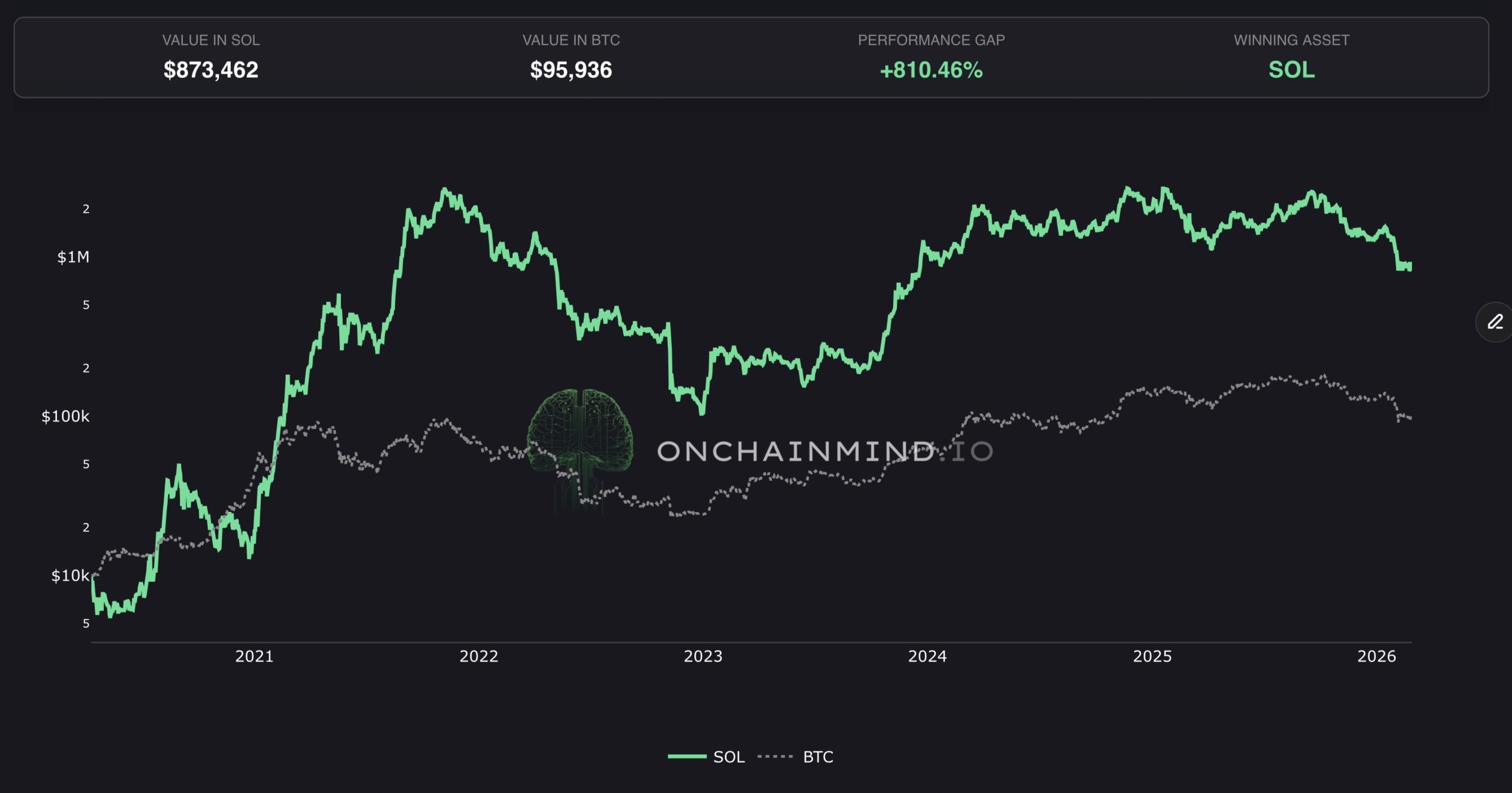
Opportunity Cost of BTC and SOL
The Illusion of "HODLing"
We are often told that "HODLing" is the ultimate virtue in the crypto space. The narrative is simple: buy Bitcoin, buy your favourite alts, and don't touch them for 5 years. While this approach has certainly minted millionaires, it ignores a fundamental mechanical flaw in portfolio construction: concentration risk.
Another strategy focuses on a concept called dynamic rebalancing. This involves periodically resetting the portfolio back to its intended allocation. The goal here isn't about ignoring gains; it’s about harvesting them so they don’t vanish during the next inevitable crypto winter.
On the surface, rebalancing looks like administrative housekeeping. In reality, it is forced behavioural discipline, effectively baking a "sell high, buy low" strategy into your portfolio. It prevents your risk profile from morphing simply because one asset outperformed faster than the others.
This matters more in crypto than in many traditional markets because volatility dispersion is wider. The gap between a moderate performer and an explosive one can be enormous.
Consider a relatively conservative allocation: 75% Bitcoin and 25% Ethereum, starting with $10,000 in 2020.
A static HODL approach would have resulted in approximately $109,000. Quarterly rebalancing would have delivered around $123,000 — roughly 12% rebalancing alpha.
It’s a nice bonus, but it doesn't fundamentally change your life. This is because BTC and ETH are conservatively correlated; they move in the same direction at similar speeds. There isn't enough "volatility gap" to harvest.
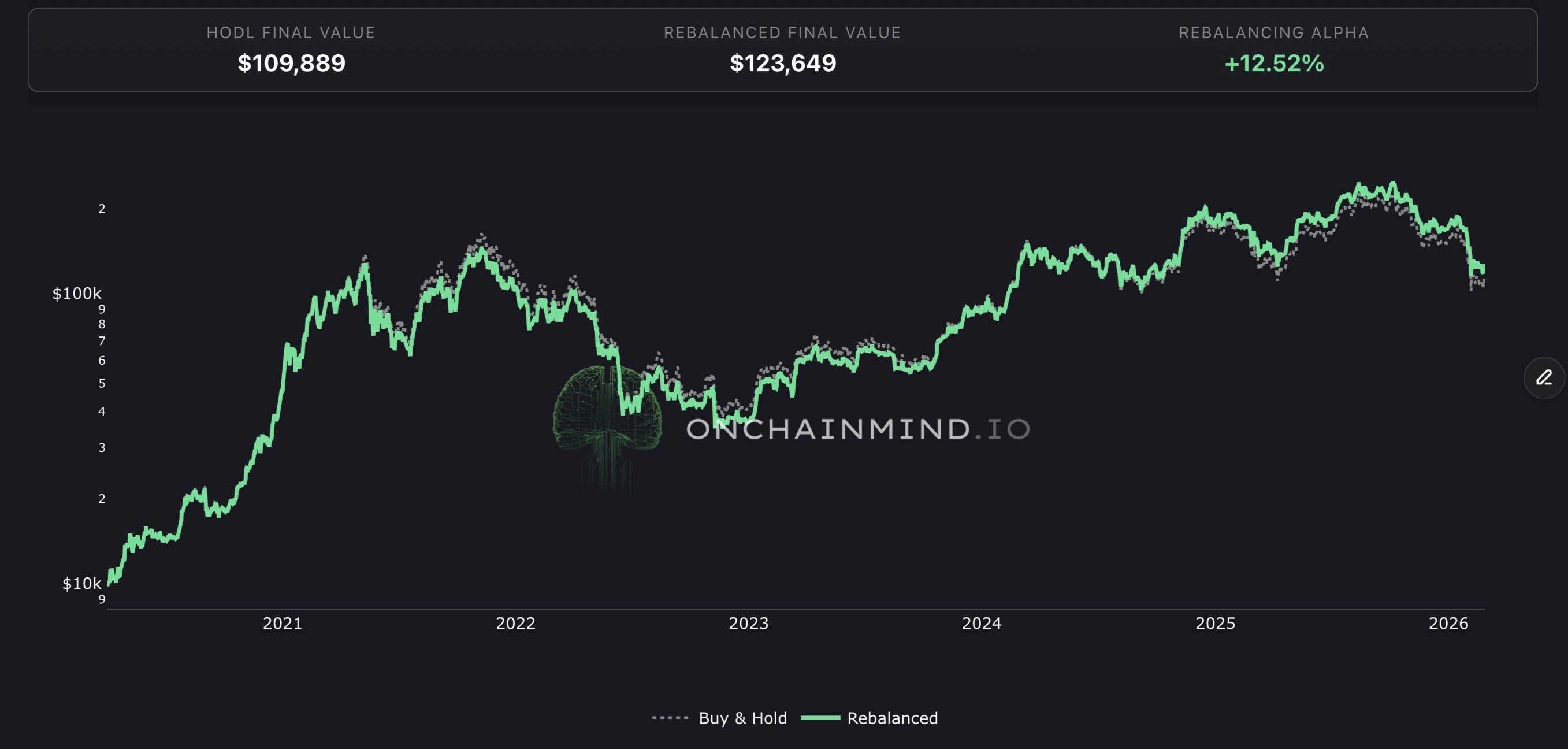
75% BTC, 25% ETH Backtest
From Conservative to High-Beta
If we start to move further out on the risk curve, and the numbers become staggering. Take a 75% Bitcoin and 25% Solana split:
HODL Final Value: $289,000
Rebalanced Final Value: $516,000
Rebalancing Alpha: 78%
The difference is no longer marginal.
By simply resetting your weights every 3 months, you would have nearly doubled your final outcome compared to just sitting on your hands, all because you trimmed Solana into strength and reallocated into it after sharp compressions.
Rebalancing limits the downside. When Solana crashed during the FTX debacle, the rebalanced portfolio had already locked in much of those gains by moving them into Bitcoin during the previous quarters. You weren't holding the bag at the bottom; you were buying the dip with Bitcoin profits.
You are not predicting cycles. You are harvesting volatility.
Push this further with a 50-50 Bitcoin-Solana allocation and the effect intensifies. Rebalancing alpha exceeds 122%. The final portfolio value more than doubles relative to static holding, without adding capital or attempting tactical timing.
Even more extreme is the altcoin-heavy portfolio. For this example, I chose 25% each of BTC, DOGE, ADA, and TRX. These are all Top 10 coins, so we aren't talking about obscure cryptos you’ve never heard about here.
In this scenario, the rebalancing alpha jumps to over 138%. This strategy captures the explosive, parabolic moves of an asset like Dogecoin, which can go up 10x in a month, and immediately distributes that wealth into more stable assets before the inevitable 80%+ crash.
It also mitigates the slow bleed of assets like Cardano, which have faced significant headwinds in recent years. You are essentially using the chaos of the altcoin market to fund the growth of your safe positions.
The idea is simple. When assets move very differently from each other, regularly rebalancing turns that volatility into growth.
Crypto has plenty of that kind of movement.
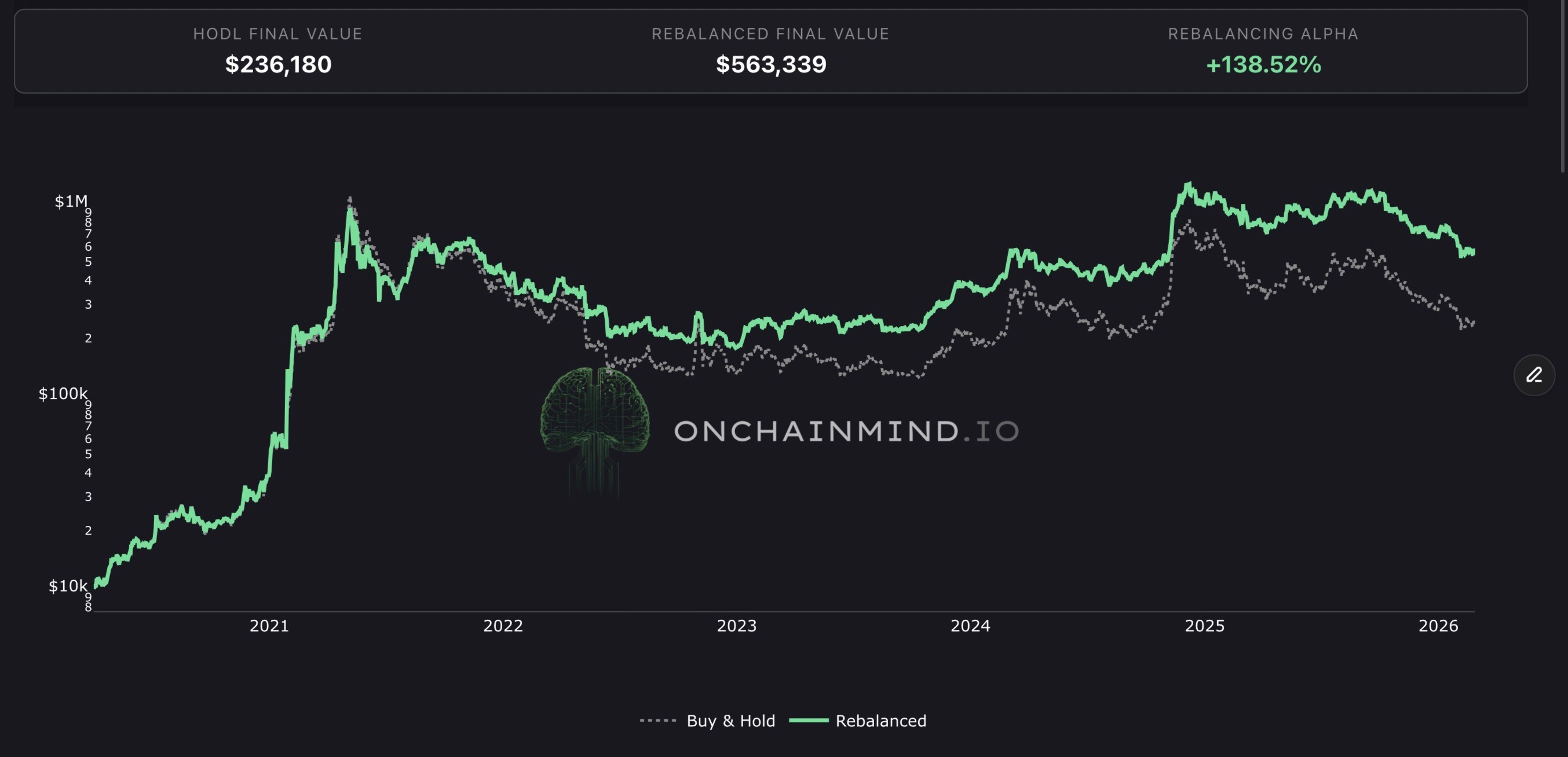
25% BTC, 25% DOGE, 25% ADA, 25% TRX Backtest
Why Quarterly Works
Across some extensive backtesting, I’ve found that quarterly rebalancing stands out as a sensible middle ground.
Crypto trends often last for months. If you rebalance too frequently, you cut those trends short and rack up unnecessary trading costs. If you wait too long, your winners grow too large, your portfolio drifts, and your risk becomes concentrated without you realising it.
Quarterly sits in between.
It gives assets enough time to run. It prevents any single position from taking over the portfolio. And it keeps trading costs manageable.
It’s not a universal rule. Different market conditions can favour different schedules. But in practice, consistency matters more than precision. A simple, repeatable process you can follow without second-guessing yourself will usually outperform a perfectly optimised strategy that you abandon when volatility rises.
The Mathematics of Detachment
If there is one thing I’ve learned from this space, it’s that your greatest enemy in investing is your own ego. We fall in love with our bags. We start to believe that a specific project is the "future of finance" and we refuse to sell because we don't want to miss the next leg up.
My honest opinion is that the market does not care about your loyalty. The market is a giant machine designed to transfer wealth from the undisciplined to the disciplined.
Rebalancing is the ultimate "get out of your own way" tool. It takes the decision-making, and therefore the emotion, slightly more out of the equation.
But I know the reality. Most of us will see an asset go up 500% and will do nothing. We will watch it go up another 100%, feel like a genius, and then watch it round-trip all the way back to your entry point. I’ve watched it happen to my own portfolio for 3 cycles now.
I’m less interested in perfectly picking the next explosive asset and more interested in designing a portfolio that can handle volatility intelligently. The goal isn’t to avoid swings. It’s to make those swings work for you instead of against you.
Rebalancing doesn’t remove risk. It redirects it. It stops big winners from quietly taking over your portfolio and turns strong moves into realised gains that can be redeployed elsewhere.
Crypto is not a market where doing nothing is always the best strategy. The price moves are too large and the gaps between assets are too wide. If you choose to invest further out on the risk curve, you need a structure in place. Otherwise, rapid gains can just as quickly turn into rapid losses.
Is it less exciting than trying to time the exact top of a memecoin rally? Of course it is. But the data doesn't lie. Especially when you move into high-beta assets, rebalancing isn't just a "tweak", it is the engine of your wealth. It turns the terrifying volatility of the crypto market into your greatest competitive advantage.
If you aren't looking at your portfolio through the lens of relative weighting, you aren't really managing a portfolio; you're just holding a collection of hopes and dreams.
Start treating your crypto like a professional fund manager would. Set your targets, pick your interval, and let the mathematics do the heavy lifting for you.
I’ll catch you in the next one.
Cheers,