
Altcoins Mayer Multiple Oscillator
onchainmind.io
© 2025 On-Chain Mind. All rights reserved.
Description:
Premium Indicator
Premium Indicator
Indicator Overview
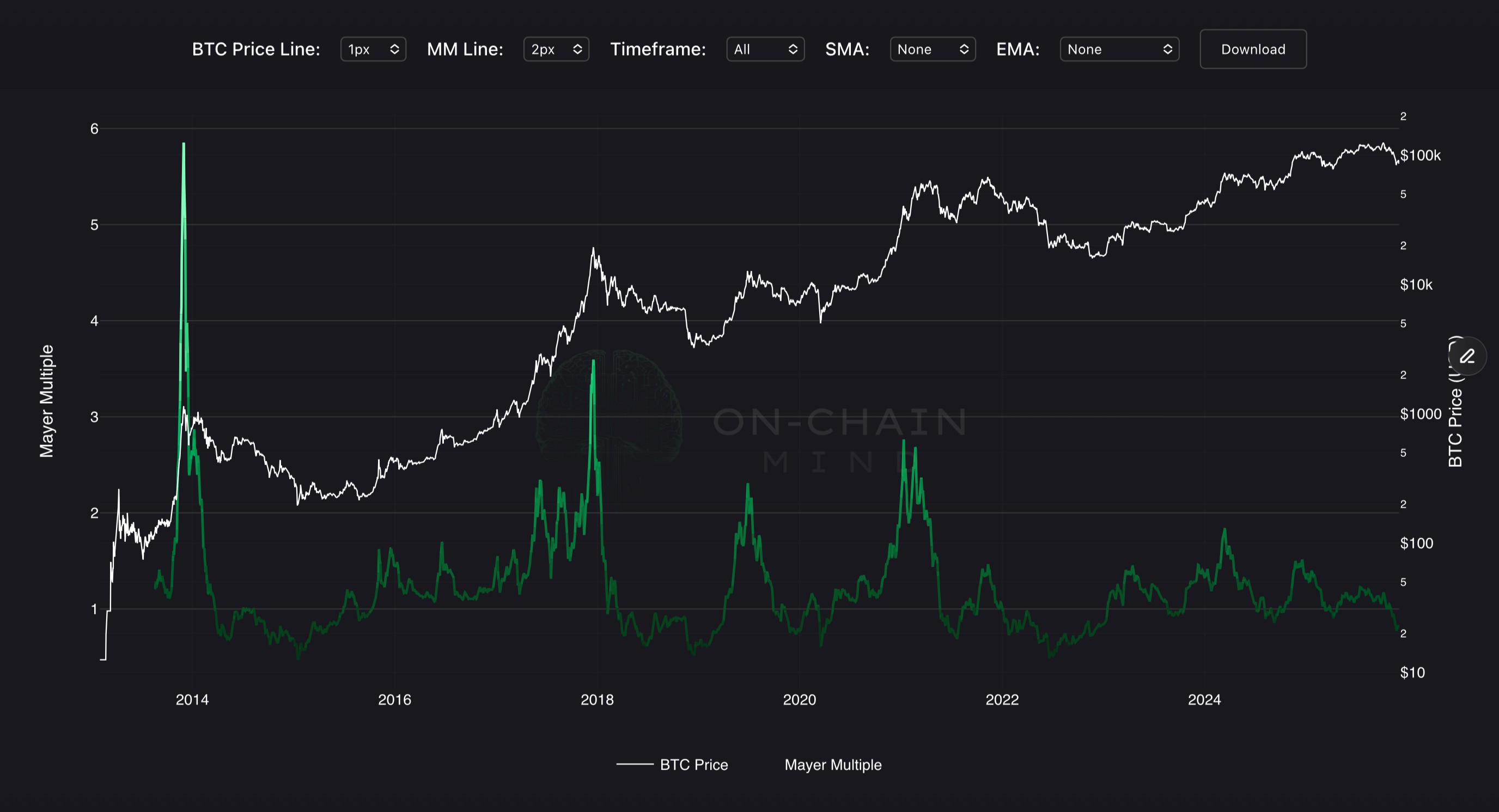
The Mayer Multiple Oscillator indicator computes price relative to its 200-day simple moving average (SMA), producing a smoothed oscillator that ranges typically from near 0 during deep bear markets to above 4 during extreme bull runs. It applies a fixed 3-day smoothing to the raw multiple for clearer trend visualisation, with the line coloured on a gradient from dark green (low multiples indicating undervaluation) to light green (high multiples signalling overextension). This provides a dynamic measure of market deviation from long-term fair value, helping identify cycle phases and potential reversals. The price is overlaid on a secondary logarithmic axis for direct comparison between absolute levels and relative valuation.
Dual-Ticker Comparison Logic
The ‘Crypto’ fields allow the indicator to operate in both absolute price and relative performance modes, making it suitable for outright positioning or pair-based allocation decisions.
Single Crypto Analysis: If Crypto 2 is left blank, the indicator measures Crypto 1 against US Dollars. This mode is designed to identify statistically stretched rallies, deep mean-reversion zones, and long-term accumulation conditions where price trades multiple standard deviations below its historical average.
Relative Strength and Ratios: When both fields are populated, the indicator automatically constructs a ratio of Crypto 1 divided by Crypto 2, such as ETH/BTC or SUI/SOL. The metric is then calculated on the ratio itself, isolating relative performance and stripping out broad market beta. This enables precise identification of overperformance, underperformance, and regime shifts between assets.
How To Use
Elevated readings above 2.4 signal overvalued conditions and potential cycle tops, while values below 0.8 indicate undervalued regimes and strong accumulation zones. Traders monitor crossings of the 1.6 midpoint for regime shifts, upward breaks may confirm bullish momentum, downward ones suggest increasing bearish pressure. Use persistent clustering in the upper gradient (light green) to anticipate corrections or euphoria-driven blow-offs, and lower bands (dark green) for contrarian buying during capitulation. The oscillator excels at contextualising volatility within historical cycles, aiding in position sizing and risk assessment for long-term holders and cycle-aware investors.
Copyright © 2025 On-Chain Mind