
Altcoins Price Zone Dynamics
onchainmind.io
© 2025 On-Chain Mind. All rights reserved.
Description:
Premium Indicator
Premium Indicator
Indicator Overview
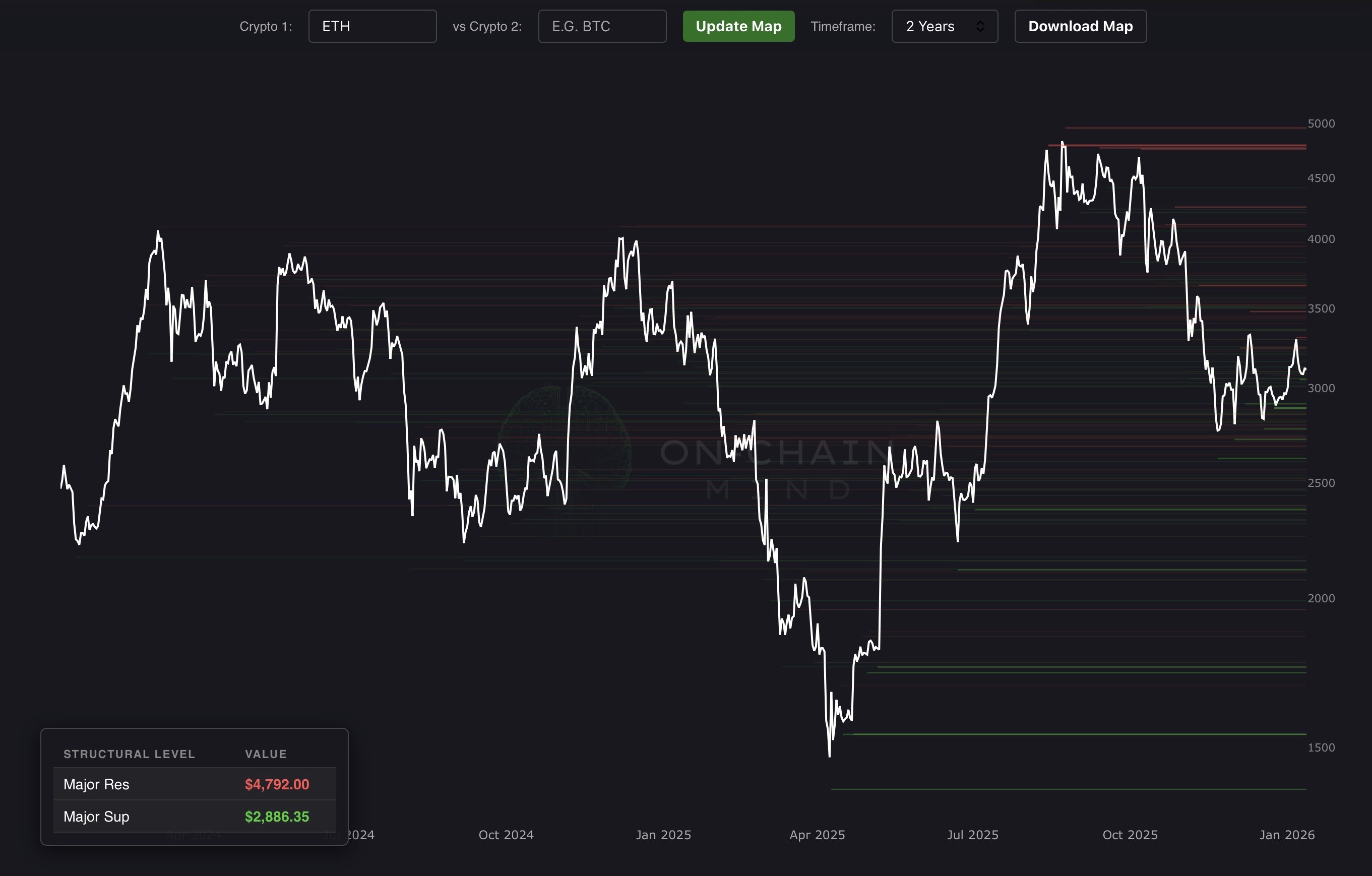
The Price Zone Dynamics map is a sophisticated algorithmic structural tool designed to quantify and visualise the latent support and resistance framework of stocks. By utilising a multi-pass pivot-sensing heuristic, the indicator identifies key high and low inflections across a user-defined lookback period. Each identified level undergoes a secondary structural grading process, where it is scored based on retests (price proximity) and "violation frequency" (breaks). This results in a dynamic heatmap of horizontal liquidity where line thickness and opacity represent the statistical significance and actual memory of each price zone.
Dual-Ticker Comparison Logic
The ‘Crypto’ fields allow the indicator to operate in both absolute price and relative performance modes, making it suitable for outright positioning or pair-based allocation decisions.
Single Crypto Analysis: If Crypto 2 is left blank, the indicator measures Crypto 1 against US Dollars. This mode is designed to identify statistically stretched rallies, deep mean-reversion zones, and long-term accumulation conditions where price trades multiple standard deviations below its historical average.
Relative Strength and Ratios: When both fields are populated, the indicator automatically constructs a ratio of Crypto 1 divided by Crypto 2, such as ETH/BTC or SUI/SOL. The metric is then calculated on the ratio itself, isolating relative performance and stripping out broad market beta. This enables precise identification of overperformance, underperformance, and regime shifts between assets.
How To Use
Traders can utilise the Price Zone Dynamics map to navigate the complex interplay between local volatility and macro structure. The indicator distinguishes between faded historical levels and Major Local Support/Resistance. The latter of which are dynamically isolated and projected in the real-time structural data table.
• Structural Confluence: High-opacity zones (bright red or green) represent hardened price levels where the market has historically reached a consensus on value. These act as high-probability zones for mean reversion or significant trend exhaustion.
• The Dynamic Table: The floating data module automatically filters the noise, presenting only the most statistically robust pivots within the current timeframe. Major Local Resistance (red) and Major Local Support (green) represent the immediate boundaries of the current trading range.
• Timeframe Sensitivity: By toggling between 3-month and 4-year durations, the algorithm re-calculates the pivot sensitivity, allowing users to transition from micro-structural scalping pivots to identifying the multi-year floors that define cyclical bottoms.
Copyright © 2025 On-Chain Mind