
Altcoins Volatility Waves
onchainmind.io
© 2025 On-Chain Mind. All rights reserved.
Description:
Premium Indicator
Premium Indicator
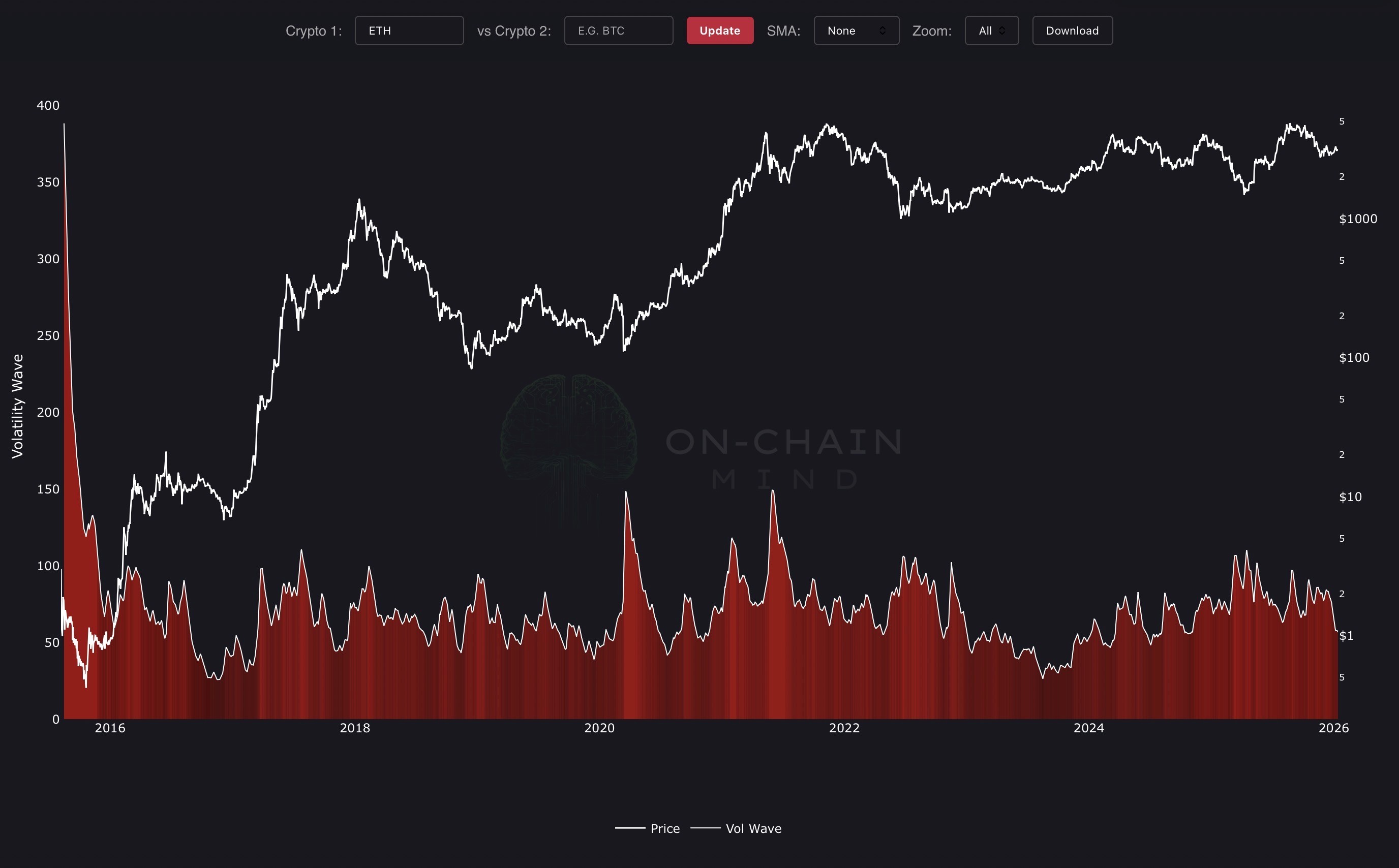
Indicator Overview
The Volatility Waves indicator measures the volatility of price using a seven-day logarithmic return calculation, smoothed and scaled to highlight market cycles. It reflects the intensity of price fluctuations, offering insight into market sentiment and potential turning points. Volatility is a critical metric for crypto, as it often signals periods of accumulation, euphoria, or capitulation within its cyclical market structure. By tracking short-term volatility, the indicator helps investors identify phases of heightened activity or consolidation, making it valuable for assessing market dynamics and timing entries or exits. Its cycle maturity scaling option adjusts for the evolving market behaviour, enhancing long-term relevance.
Dual-Ticker Comparison Logic
The ‘Crypto’ fields allow the indicator to operate in both absolute price and relative performance modes, making it suitable for outright positioning or pair-based allocation decisions.
Single Crypto Analysis: If Crypto 2 is left blank, the indicator measures Crypto 1 against US Dollars. This mode is designed to identify statistically stretched rallies, deep mean-reversion zones, and long-term accumulation conditions where price trades multiple standard deviations below its historical average.
Relative Strength and Ratios: When both fields are populated, the indicator automatically constructs a ratio of Crypto 1 divided by Crypto 2, such as ETH/BTC or SUI/SOL. The metric is then calculated on the ratio itself, isolating relative performance and stripping out broad market beta. This enables precise identification of overperformance, underperformance, and regime shifts between assets.
How To Use
Historically, high volatility spikes often coincide with price peaks or sharp capitulation events. Low volatility periods typically indicate consolidation or accumulation phases, often preceding significant price moves. You can use rising volatility to anticipate potential reversals or breakouts, while declining volatility may suggest a stable range or impending momentum shift. For investment, high volatility zones may signal caution, prompting profit-taking or risk management, while low volatility could indicate opportunities for accumulation. But try to avoid relying solely on volatility due to its lagging nature.
Copyright © 2025 On-Chain Mind