
Altcoins Z-Score Probability Waves
onchainmind.io
© 2025 On-Chain Mind. All rights reserved.
Description:
Premium Indicator
Premium Indicator
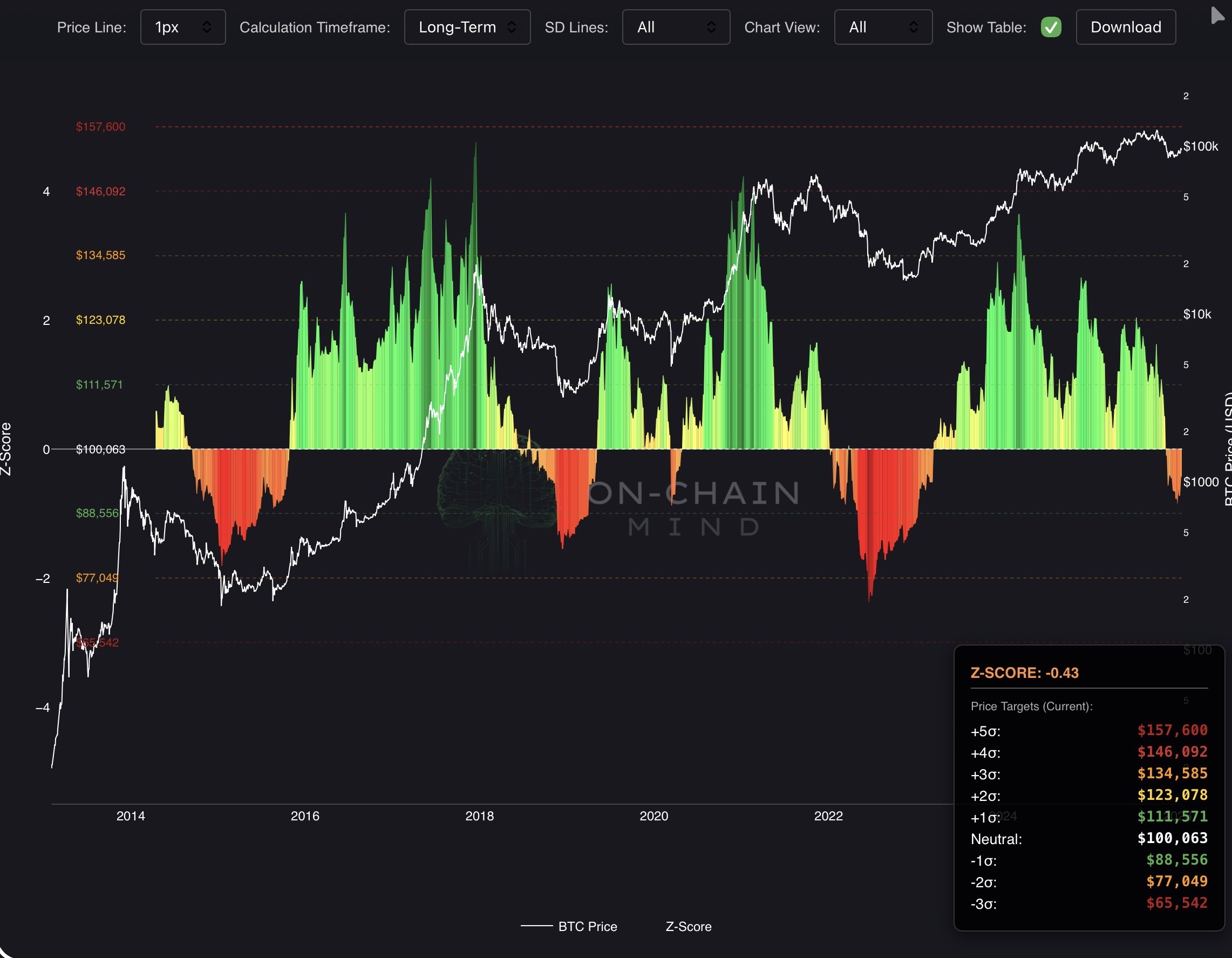
Indicator Overview
The Z-Score Probability Waves is a high-fidelity mean-reversion and trend-extension metric designed to identify statistical price extremes. By using a Z-Score normalisation framework and calculating the number of standard deviations the current price has strayed from its rolling average, the indicator quantifies how "overbought" or "oversold" the asset is relative to its own recent history.
The visual core of this tool is the segmented, colour-mapped area gradient that visualises the intensity of price expansion. Unlike traditional oscillators that use fixed boundaries, these waves expand and contract based on actual market volatility. This allows traders to distinguish between standard price action and "black swan" extensions, helping to identify structural pivot points where price is statistically likely to revert to the mean.
Dual-Ticker Comparison Logic
The ‘Crypto’ fields allow the indicator to operate in both absolute price and relative performance modes, making it suitable for outright positioning or pair-based allocation decisions.
Single Crypto Analysis: If Crypto 2 is left blank, the indicator measures Crypto 1 against US Dollars. This mode is designed to identify statistically stretched rallies, deep mean-reversion zones, and long-term accumulation conditions where price trades multiple standard deviations below its historical average.
Relative Strength and Ratios: When both fields are populated, the indicator automatically constructs a ratio of Crypto 1 divided by Crypto 2, such as ETH/BTC. The Z-score is then calculated on the ratio itself, isolating relative performance and stripping out broad market beta. This enables precise identification of overperformance, underperformance, and regime shifts between assets without relying on narrative comparison.
How To Use
Traders can use the Z-Score Probability Waves to spot historical exhaustion levels and time entries or exits based on statistical probability.
• Volatility-Adjusted Waves: The area transitions through a spectrum of deep reds to neon greens. Deep Red segments signify significant downside extension (statistical "undervaluation"), while Bright Green segments signal aggressive upside expansion where price is stretching far above its mean.
• The σ (Sigma) Tiers: The horizontal dashed lines represent Standard Deviation levels (1σ to 5σ). Statistically, price spends the majority of its time within 2σ of the mean. Moves into the 3σ, 4σ and 5σ zones represent extreme outliers that historically precede major trend reversals or significant cooling-off periods.
• Short-Term vs. Long-Term: The calculation timeframe toggle adjusts the sensitivity of the math. Short-Term view captures local volatility and is ideal for identifying swing-trading exhaustion. Long-Term provides a macro cycle trading perspective, filtering out noise to show where Bitcoin sits in its multi-year market cycles.
• Neutral Equilibrium: The white zero-line represents the rolling mean. This serves as the "gravitational center" of the indicator. Price will frequently return to this level after an extension into the upper or lower waves.