
BTC vs. Major Assets Volatility
onchainmind.io
© 2025 On-Chain Mind. All rights reserved.
Description:
Premium Indicator
Premium Indicator
Indicator Overview
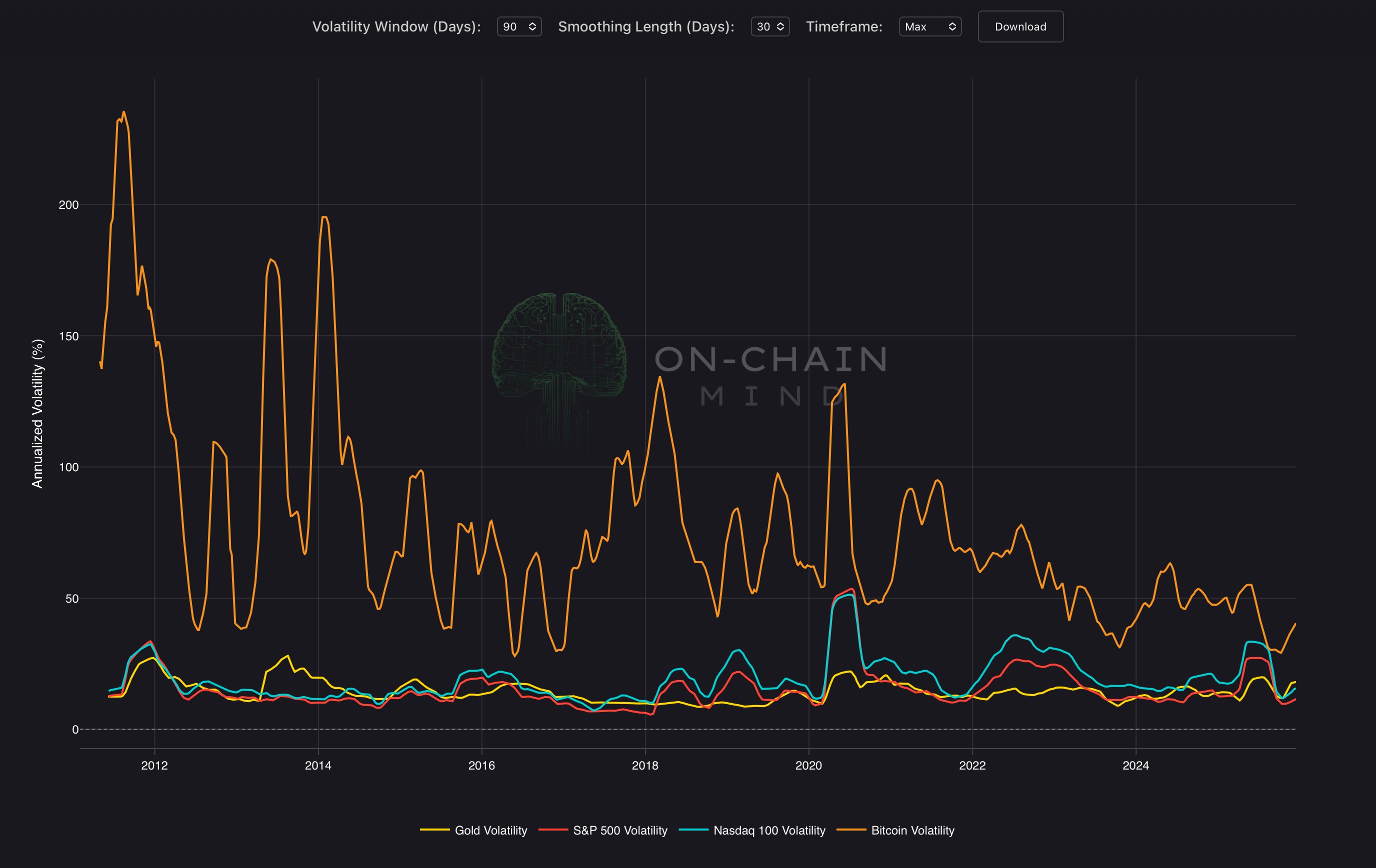
The BTC vs. Major Assets Volatility indicator compares Bitcoin’s annualised volatility against Gold, the S&P 500, and the Nasdaq 100 using rolling log-return standard deviation, properly annualised and smoothed to isolate regime-level signals rather than noise.
By placing all major risk benchmarks on a single volatility framework, this indicator reveals when Bitcoin is behaving as an extreme high-beta asset, when it is converging toward traditional markets, and when macro risk is being repriced across asset classes simultaneously.
How To Use
Rising Bitcoin volatility relative to equities and gold signals speculative expansion, leverage re-entry, and regime shifts toward reflexive upside or downside, conditions where trend strength increases but timing mistakes get punished. These spikes often precede major BTC breakouts or violent drawdowns, making them ideal for tightening risk management and scaling exposure deliberately rather than chasing price.
Falling Bitcoin volatility, especially when it compresses toward equity or gold levels, reflects maturation, exhaustion of sellers, and late-cycle consolidation phases that historically precede sustained directional moves.
Cross-asset volatility convergence is a macro warning: when BTC, equities, and gold all rise together, liquidity stress or systemic repricing is underway. Divergences matter most, Bitcoin volatility expanding while equities remain suppressed signals crypto-specific excess and tops risk; suppressed BTC volatility while equities spike often precedes Bitcoin strength as capital rotates back into asymmetric assets.
Copyright © 2025 On-Chain Mind