

ON-CHAIN METRIC
Dominance
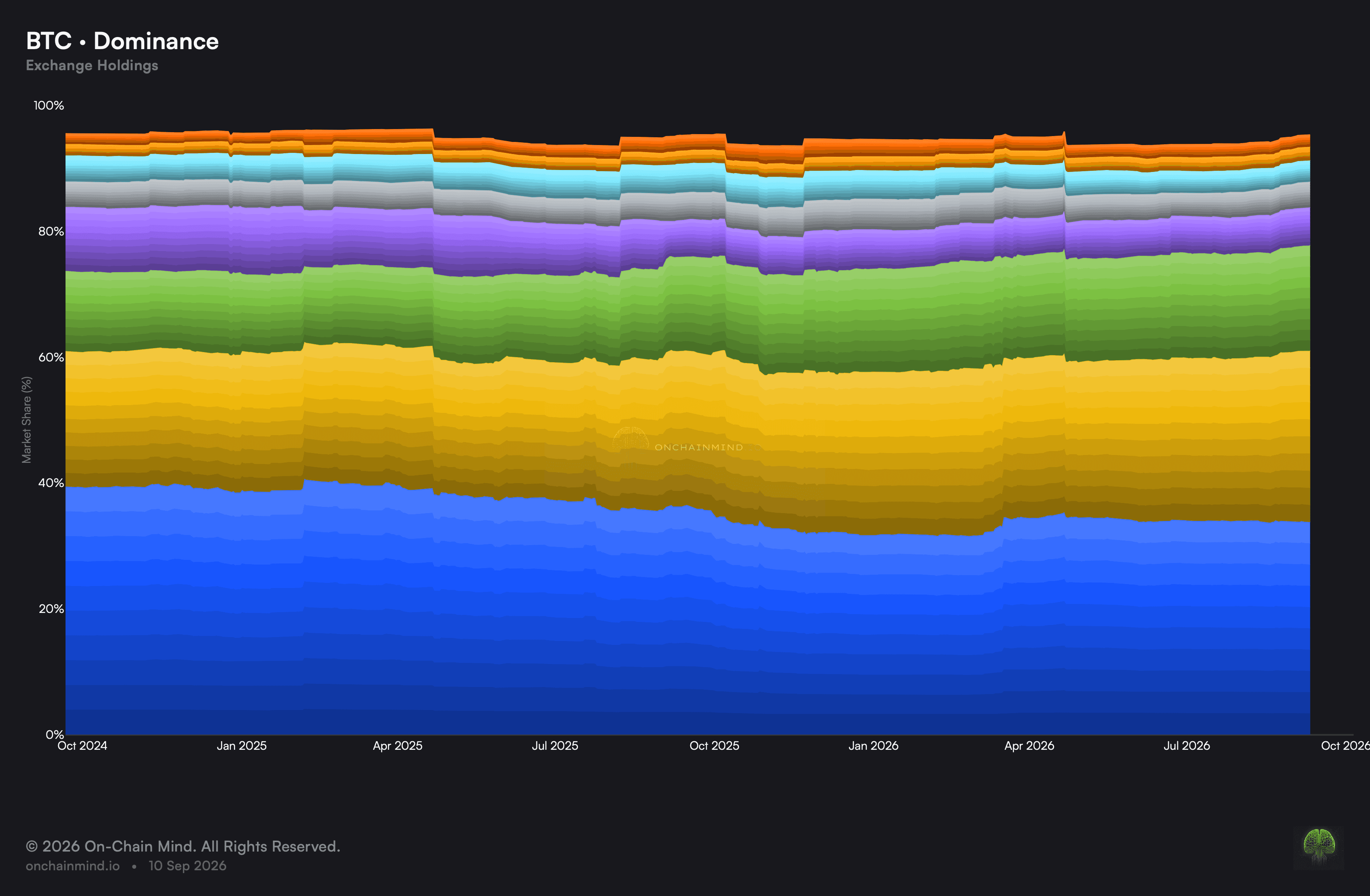
Each venue’s share of the coin held on exchanges, read as a question about custody.
Open the Exchange Holdings dashboard
This is not a flow view. It asks how the coin already on exchanges is distributed between them, which is a question about who is holding it rather than about anyone buying or selling.
The reason is dull and thoroughly documented. More money has been lost in this market to venues collapsing than to anything else, and what this measures is how much would be caught up in the next one.
What it actually measures
Concentration is the whole of the reading. Supply gathering onto fewer venues raises what a single failure would cost, and supply spreading across more of them lowers it, entirely regardless of what the overall total happens to be doing.
A shift here involves no trading at all. Coin moving from one exchange to another changes every share on the chart while nobody has bought or sold anything.
Changes here tend to arrive as events rather than as drift. A fee change, a new listing, a shift in regional access or a custody migration moves the picture in a single step and then leaves it there.
A concentration reading is a question about one operator’s solvency
Most exchange metrics are read as market signals: coin arriving means selling, coin leaving means holding. This one is not a market signal at all.
What it asserts is how much of the readily tradeable coin now depends on one firm’s books staying sound. That wager has gone wrong often enough to deserve a view of its own, and it bears on nothing at all about where price heads next.
What it does not tell you
It rests on attribution being right. Coin assigned to the wrong venue distorts two shares at the same time, one too high and one too low, and attribution is weakest for the smaller exchanges.
Share is not solvency. A venue holding a large share may be entirely sound and a small one may not be, so what is measured here is how much is exposed rather than how likely any of it is to be lost.
Venues that cannot be observed are missing from both sides of the calculation, so every share here is a share of what is visible rather than of everything that exists.
How to read it
Concentrating. Supply is gathering onto fewer venues, which raises what a single failure would cost.
Mix stable. No meaningful migration between venues.
Spreading. Supply is distributing across more venues.
On the Exchange Holdings dashboard, Dominance runs next to Flow Matrix, Reserves and Balances.
Common questions
Why should anyone care where the coin sits?
Because venues collapsing has cost this market more than anything else. What is measured here is how much of the tradeable coin now depends on one operator staying solvent.
Does a shift mean coins were sold?
No. Moving coin from one venue to another redraws every share here while nobody has traded anything, and that is exactly why this reads as a question about custody instead of about flow.
What moves the shares around?
Fee changes, a new listing, a change in regional access or a custody migration. They arrive as discrete events rather than as gradual drift.
Is a large share the same as a large risk?
No, and the distinction is the whole point. A venue holding a large share may be perfectly sound. What is measured here is how much would be at stake if it were not, never how likely that is.
What falls outside it?
Anything held at a venue the dashboard cannot observe, which is absent from both sides of the sum. Every share here is a share of what is visible rather than of everything that exists.
ON-CHAIN METRIC
Dominance
Each venue’s share of the coin held on exchanges, read as a question about custody.
Open the Exchange Holdings dashboard
This is not a flow view. It asks how the coin already on exchanges is distributed between them, which is a question about who is holding it rather than about anyone buying or selling.
The reason is dull and thoroughly documented. More money has been lost in this market to venues collapsing than to anything else, and what this measures is how much would be caught up in the next one.
What it actually measures
Concentration is the whole of the reading. Supply gathering onto fewer venues raises what a single failure would cost, and supply spreading across more of them lowers it, entirely regardless of what the overall total happens to be doing.
A shift here involves no trading at all. Coin moving from one exchange to another changes every share on the chart while nobody has bought or sold anything.
Changes here tend to arrive as events rather than as drift. A fee change, a new listing, a shift in regional access or a custody migration moves the picture in a single step and then leaves it there.
A concentration reading is a question about one operator’s solvency
Most exchange metrics are read as market signals: coin arriving means selling, coin leaving means holding. This one is not a market signal at all.
What it asserts is how much of the readily tradeable coin now depends on one firm’s books staying sound. That wager has gone wrong often enough to deserve a view of its own, and it bears on nothing at all about where price heads next.
What it does not tell you
It rests on attribution being right. Coin assigned to the wrong venue distorts two shares at the same time, one too high and one too low, and attribution is weakest for the smaller exchanges.
Share is not solvency. A venue holding a large share may be entirely sound and a small one may not be, so what is measured here is how much is exposed rather than how likely any of it is to be lost.
Venues that cannot be observed are missing from both sides of the calculation, so every share here is a share of what is visible rather than of everything that exists.
How to read it
Concentrating. Supply is gathering onto fewer venues, which raises what a single failure would cost.
Mix stable. No meaningful migration between venues.
Spreading. Supply is distributing across more venues.
On the Exchange Holdings dashboard, Dominance runs next to Flow Matrix, Reserves and Balances.
Common questions
Why should anyone care where the coin sits?
Because venues collapsing has cost this market more than anything else. What is measured here is how much of the tradeable coin now depends on one operator staying solvent.
Does a shift mean coins were sold?
No. Moving coin from one venue to another redraws every share here while nobody has traded anything, and that is exactly why this reads as a question about custody instead of about flow.
What moves the shares around?
Fee changes, a new listing, a change in regional access or a custody migration. They arrive as discrete events rather than as gradual drift.
Is a large share the same as a large risk?
No, and the distinction is the whole point. A venue holding a large share may be perfectly sound. What is measured here is how much would be at stake if it were not, never how likely that is.
What falls outside it?
Anything held at a venue the dashboard cannot observe, which is absent from both sides of the sum. Every share here is a share of what is visible rather than of everything that exists.