
16.17%.
That is the share of Bitcoin’s circulating supply now sitting in identifiable institutional custody.
A few years ago, that number was effectively zero. A few years from now, it will almost certainly be higher.
What we are living through is the emergence of a new market structure: what I'm calling the institutional barbell.
In this article, I want to walk you through the 3.24 million BTC now held by visible institutional entities, why this stack is equivalent to almost 20 years of current new issuance, and what it means for Bitcoin’s evolution from a risk asset people rent, to a reserve asset people fight to own.
Let’s get into it.
Key insights
3.24 Million Coins: Visible institutional custody now dwarfs post-halving issuance by an order of magnitude, and that ratio matters more than you think.
The Institutional Barbell: ETFs, corporate treasuries, and sovereign wallets are not a unified group. Each plays a distinct game-theoretic role.
ETF Resilience in Drawdown: Holdings have barely flinched despite the price action, and that tells us a lot about the new marginal buyer.
Entering A New Era: Price discovery is increasingly shaped by locked-up supply, passive vehicles and low-time-preference capital.
The Institutional Barbell
Let us start with the headline figure, because the scale deserves to be sat with for a moment.
Approximately 3.24 million BTC are currently held in identifiable institutional custody. That is 16.17% of the roughly 20.03 million BTC circulating supply, which itself represents over 95% of the 21 million that will ever be mined.
That number becomes even more important when you compare it to new supply. Post-2024-halving annual issuance now sits at around 164,000 BTC, which means the visible institutional stack is equivalent to almost 20 years of current new Bitcoin issuance.
Another way to frame it is this: if we crudely annualise today’s visible institutional stack from the point Strategy began accumulating Bitcoin in 2020, it works out to roughly 560,000 BTC per year, or around 3.4x current post-halving annual issuance.
That is not a perfect measure, because ETFs, corporates and sovereign wallets accumulated through very different mechanisms, but it gives us a useful sense of the scale of this structural supply sink.
The breakdown is worth committing to memory because the composition tells the story:
ETFs hold 1.39M BTC, accounting for 43% of the institutional snapshot.
Corporations hold 1.23M BTC, accounting for 38%, with Strategy alone responsible for 818K of those coins.
Sovereigns hold 619K BTC, accounting for 19%.
But these buckets should not be lumped together as one simple story of “institutional buying”. That misses the point entirely. Each cohort behaves differently under stress, responds to different incentives, and contributes differently to price discovery.
The interesting question is not just how much Bitcoin they hold. It is how these cohorts interact, and what their combined behaviour does to the liquid float.
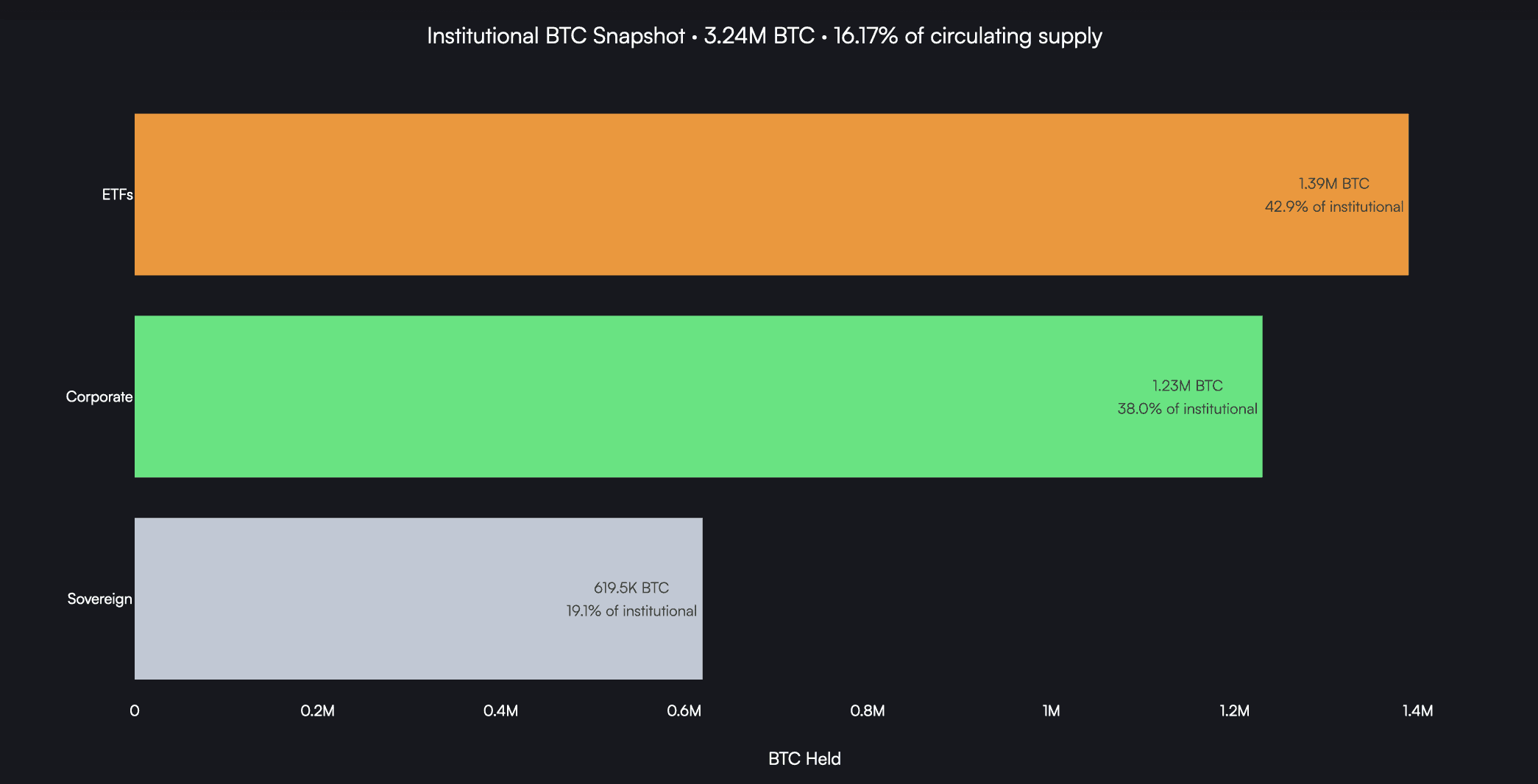
View live in OCM Studio: Institutional BTC Snapshot
ETFs: The Liquidity Engine
The ETF complex has done something quietly remarkable. Recent flow data shows 90-day net inflows of approximately +$2.46 billion, even through a choppy period in Bitcoin’s price.
That matters because ETF demand is not just passive noise. It connects traditional finance demand directly into the spot Bitcoin market.
The plumbing is important. When investors buy Bitcoin ETF shares and demand rises at the fund level, authorised participants help create new shares to keep the ETF trading efficiently. Those shares need to be backed by real Bitcoin exposure, which means actual BTC has to be sourced from the market.
In plain English: strong ETF demand has become a mechanical buyer of Bitcoin.
The more interesting signal, though, is what has happened during the drawdown. Bitcoin is around 35% below its all-time high, yet ETF-held BTC has only fallen from roughly 1.38 million to 1.36 million coins. That is a decline of just 1.45% in BTC terms, while the ETF share of total supply has only slipped from about 7% to 6.8%.
That is not fragile capital. If ETF buyers were simply short-term tourists, we would expect a much larger unwind. Instead, by any reasonable definition, this is sticky capital. And it suggests that a meaningful portion of ETF ownership is treating Bitcoin as a serious portfolio allocation.
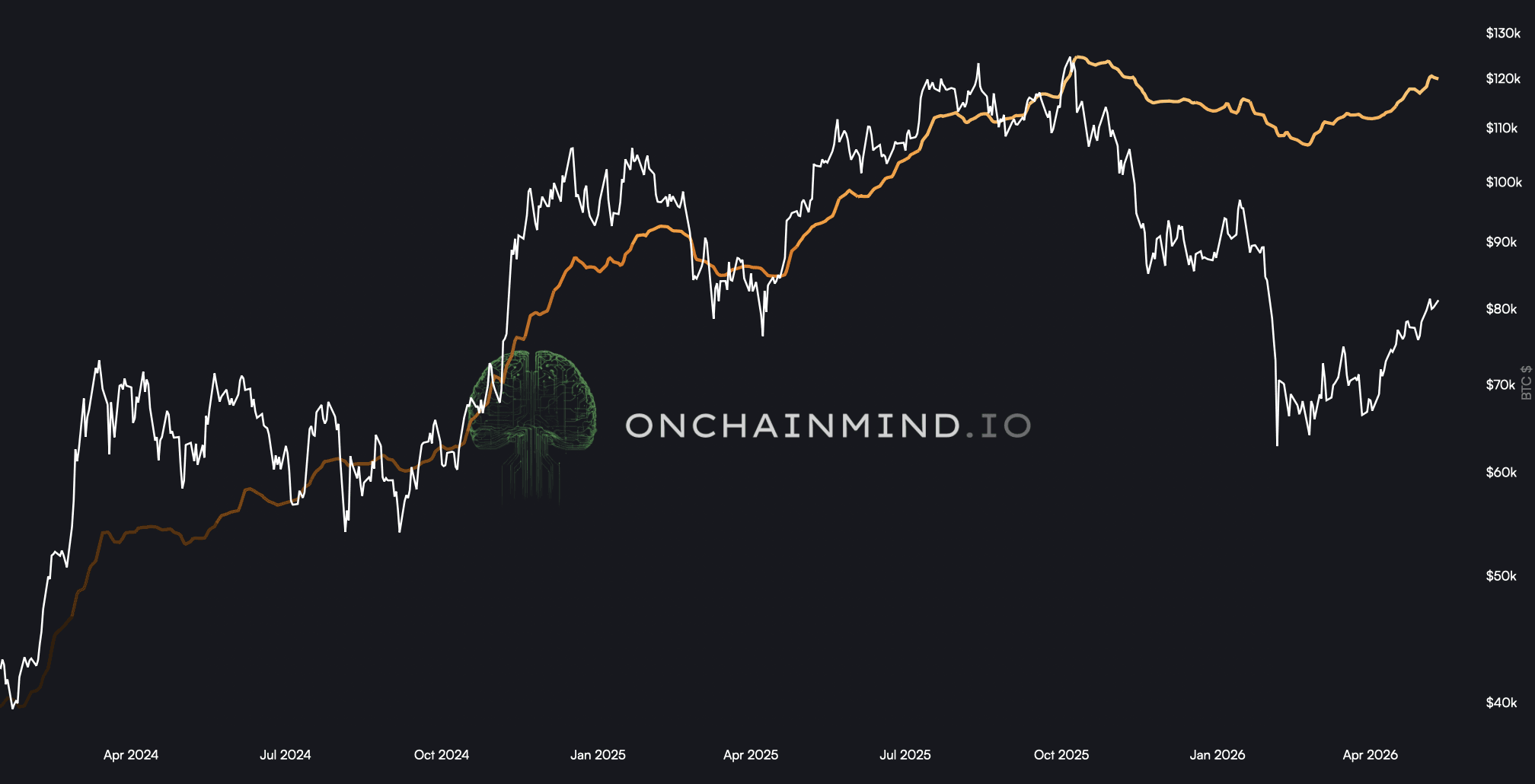
View live in OCM Studio: ETFs - BTC Held
Corporate Treasuries: The Conviction Filter
Corporate treasuries are a different beast entirely.
Continue reading with OCM Premium
You have been reading the free preview of this article. The rest of it (about 1,200 more words and 1 more chart) is for OCM Premium members. See OCM Premium plans.