
For months, it felt as though MSTR had lost its magic.
The stock that once seemed incapable of stopping had stalled, underperformed expectations, and spent nearly half a year trading at a discount to the value of the Bitcoin it held. Many investors started questioning whether the trade was broken, whether the premium was gone for good, and whether the days of MSTR dramatically outperforming Bitcoin were behind us.
Then came the latest purchase.
MSTR added another 34,164 Bitcoin, worth more than $2.5 billion. That’s the 3rd largest purchase in the company’s entire history, and it’s happened at a moment when almost nobody was paying attention.
That is what makes this so interesting. Historically, MSTR has expanded its balance sheet most aggressively during strong Bitcoin uptrends, while periods of weakness have almost always led to a sharp slowdown in purchases. This time is different. Despite far less favourable market conditions, the company has continued acquiring Bitcoin at an extraordinary pace.
Something has changed.
Let’s get into it.
Key insights
The STRC Engine: Strategy’s latest financing vehicle has quietly changed how and when balance sheet expansion happens, decoupling it from pure price momentum.
Volatility vs. Return Asymmetry: MSTR trades at roughly 1.6x bitcoin’s volatility but has delivered nearly 2x the total return. We unpack whether that premium is earned or borrowed.
The Satoshi Standard: Most people ignore it. But the consistent reduction in shares per Bitcoin is actually the ultimate success metric.
The Holding Period Effect: MSTR becomes a very different investment once you stop thinking in months. The numbers over multi-year horizons are genuinely staggering.
A Purchase That Shouldn’t Have Happened (Historically Speaking)
Before we dive in, I’ve just launched a brand-new DAT (Digital Asset Treasury) dashboard where you can analyse everything about MSTR, all Bitcoin treasuries, and now sovereign treasuries, alongside a sprinkling of treasury data for Ethereum and Solana treasury companies too. It’s a massive upgrade from anything we’ve had before, and I hope you find it as useful as I do.
Let’s start with what makes this latest buy so unusual. The 34,164 BTC acquisition slots in as the third-largest single purchase Strategy has ever made. The only two buys that eclipsed it were the 55,500 BTC and 51,780 BTC acquisitions in November 2024, right at the absolute apex of MSTR euphoria, when the mNAV was stretched to extremes and the equity premium was doing all the heavy lifting.
That’s the historical pattern worth internalising. Strategy’s balance sheet expansions have almost always come during aggressive uptrends. When bitcoin is ripping and MSTR is trading at a significant premium to its treasury value, the company can issue equity or convertible debt at favourable terms and convert that capital into Satoshis. When price action goes sideways or negative, the accumulation slows dramatically because the cost of capital becomes punishing.
So why is this latest buy happening now, during a period that emphatically is not euphoric? The answer, in large part, is STRC.
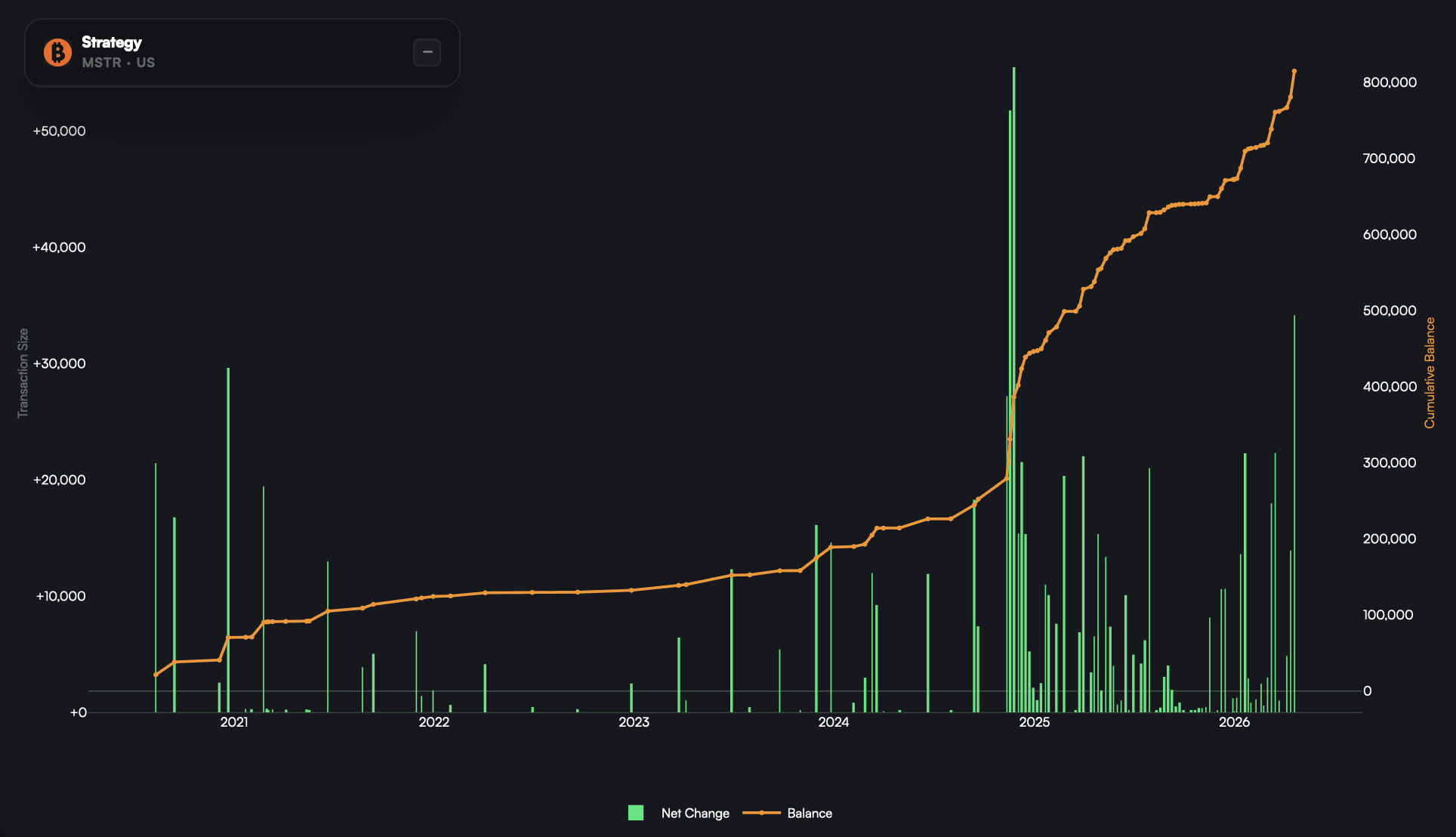
View live in OCM Studio: MSTR's Bitcoin Purchase History
What STRC Is Actually Doing
STRC is effectively acting as a new source of capital formation for MSTR.
It is Strategy’s most successful perpetual preferred stock offering, and it represents a genuinely clever piece of financial engineering.
At a technical level, rather than relying exclusively on at-the-market common equity issuance (which compresses when MSTR trades near or below NAV) or convertible debt (which has its own timing constraints), STRC offers investors a perpetual preferred instrument with a variable dividend rate.
Here’s the key mechanic: the dividend rate on STRC is designed to adjust based on market demand, effectively allowing Strategy to tap debt-like capital at rates that reflect current conditions rather than being locked into fixed-income instruments set at inopportune moments.
Because STRC investors are buying a yield product rather than an equity-linked one, their demand isn’t gated by the mNAV being above 1.
They want yield. Strategy wants Bitcoin. The dividend stream acts as a sort of financial bridge.
This is genuinely important because it means Strategy has, for the first time, built a financing channel that can keep turning even when the common stock is trading at a discount to its underlying BTC holdings.
Previously, MSTR’s ability to buy more Bitcoin was heavily linked to whether investors were willing to pay a very large premium over the underlying value of the Bitcoin on its balance sheet. If that premium disappeared, the engine stalled.
STRC changes that dynamic.
This new-found bid is what has enabled this latest $2.5 billion purchase to occur in an environment that historically would have forced the company into pause mode. It’s a structural evolution of the playbook, and it deserves more attention than it’s getting.
The Numbers Are Getting Crazy
Strategy now holds 815,063 BTC at an average cost basis of roughly $75,000 per coin. That represents over 3.8% of the total Bitcoin supply that will ever exist, which is already a figure that demands a moment of reflection.
But it gets more remarkable: of all corporations and sovereign nations currently holding bitcoin in some form, Strategy alone accounts for 44% of that entire pool. One company.
If you zoom out and think about what that means in terms of long-term positioning, the concentration is genuinely staggering. No other entity, public or sovereign, comes anywhere close.
The Two Metrics You Should Actually Care About
Now let’s get to what really matters if you’re holding MSTR for price appreciation rather than as a short-term trade. Outside of bitcoin’s own technical price action (which MSTR follows to a leveraged degree), there are precisely two metrics you should be watching. Everything else is noise dressed up as analysis.
mNAV
The mNAV, or market-to-net-asset-value ratio, tells you what the market is paying for MSTR’s Bitcoin relative to its actual value. An mNAV of 1.0 means the stock is priced at parity with its Bitcoin treasury. An mNAV of 2.0 means you’re paying twice what the underlying Bitcoin is worth, on the expectation that the company’s ability to accumulate more Satoshis per Share justifies the premium.
For close to 6 months, MSTR’s mNAV sat in sub-1 territory, meaning the stock was trading at a discount to the Bitcoin it owned. That has now basically returned to break-even, which is a meaningful shift in the regime.
The critical lesson though is this: being below 1 does not mean the stock cannot go lower. If Bitcoin itself draws down, MSTR will still follow it down even at compressed mNAV levels. The mNAV tells you about the equity premium, not about Bitcoin’s own trajectory.
If you’re using MSTR as a leveraged Bitcoin vehicle, the operational rule is straightforward: you want to accumulate when mNAV is low or even sub-1, and you want to distribute when it stretches into the 2 to 3+ euphoric zone. That’s the playbook. It’s not complicated, but it does require patience and the emotional discipline to buy when the crowd has given up on the story.
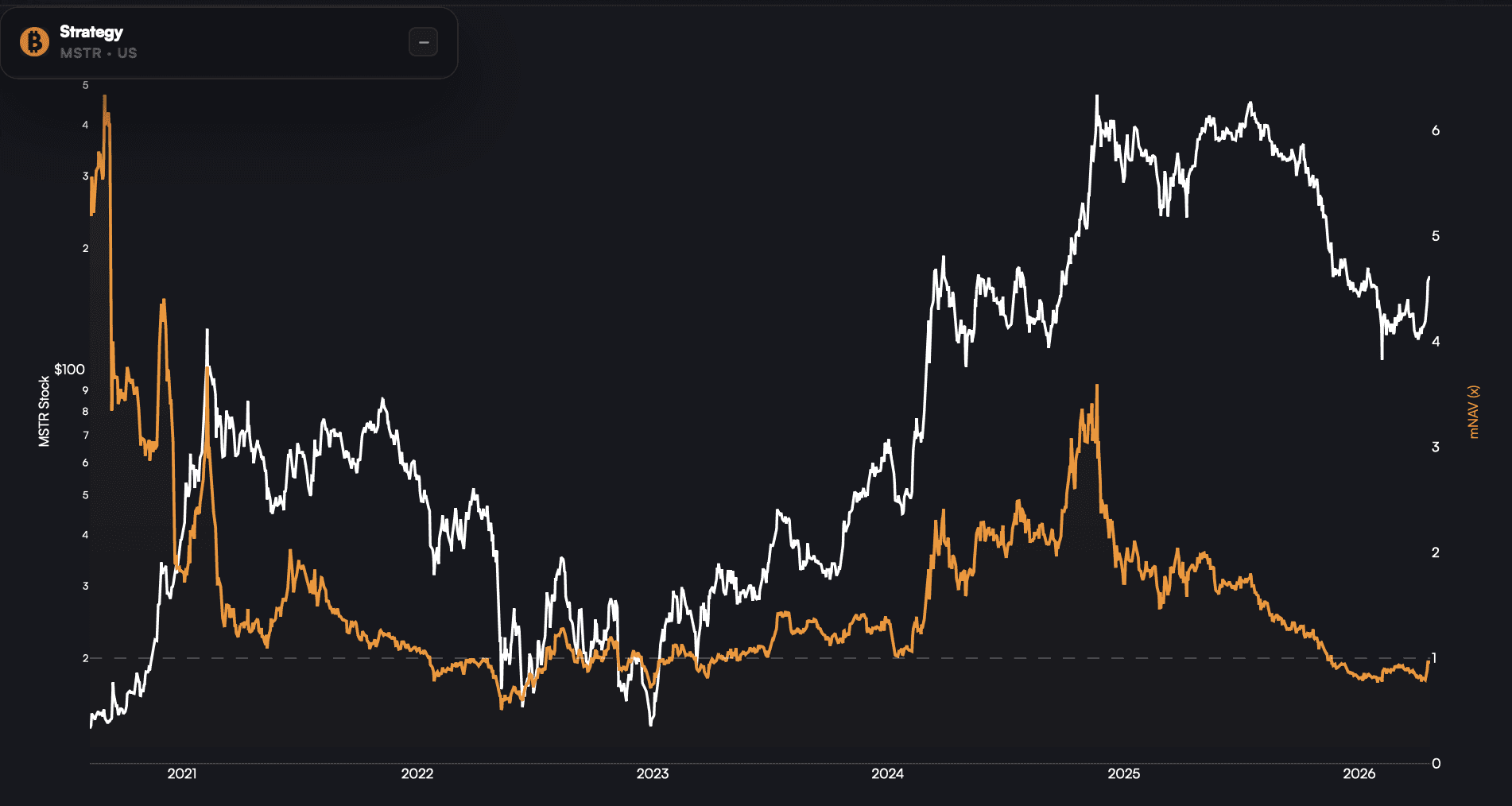
View live in OCM Studio: MSTR's mNAV
Satoshis per Share
This is the measure of whether the strategy itself is actually working, independent of price. If Strategy is issuing shares to buy Bitcoin, the relevant question for any shareholder is whether each share you own is backed by more Satoshis today than it was yesterday. If the answer is yes, the strategy is creating value. If the answer is no, it’s diluting you.
The data here is emphatic. Satoshis per Share have grown 9.5% year-on-year, and this growth has been positive in every single year since inception, including bear market years (albeit at lower positive numbers during those periods).

View live in OCM Studio: Satoshis per Share Growth over time
That last point is worth sitting with. Even during 2022, when bitcoin fell over 75% from its highs and most Bitcoin-adjacent equities were getting destroyed, the underlying mechanic of accumulating more BTC per share continued to function. That’s the signal that the engine is genuinely productive rather than merely reactive.
Another way to frame this is the inverse: how many MSTR shares do you need to own to back one full Bitcoin?
In 2020 it was 1,767 shares
In 2021, 1,200 shares
In 2022, 1,178 shares
In 2023, 1,098 shares
In 2024, 631 shares
In 2025, 513 shares
As of 2026, 468 shares
That trajectory is the entire thesis in one sequence. Every share you buy today covers more Bitcoin than the same share did a year ago, two years ago, or five years ago. If this trend continues, the compounding effect on long-term holders is profound. That’s the point.
Return, Volatility, and the Current Setup
A lot of holders have been vocally disappointed with MSTR’s recent price action, and some of that frustration is understandable. But the longer-term context tells a more nuanced story.
Continue reading with OCM Premium
You have been reading the free preview of this article. The rest of it (about 900 more words and 5 more charts) is for OCM Premium members. See OCM Premium plans.