
Picture this. You put $1,000 into Bitcoin in early 2013 and then do absolutely nothing for 13 years.
You sit through Mt. Gox, the 2018 winter, COVID, the 2022 collapse. Today, that $1,000 is worth roughly $3.89 million.
Now run the same scenario with one small change: you happened to be out of the market for just 10 specific days out of nearly 5,000. Your portfolio is now worth about $355,000.
You have lost 91% of your wealth.
Not because you sold the bottom. Simply because you blinked at the wrong moment. This is the mathematical reality I want to walk you through, and I think it matters more in 2026 than it ever has before.
Let’s get into it.
Key insights
The 91% Penalty: Missing just 10 trading days out of nearly 5,000 strips away 91% of Bitcoin’s long-term returns.
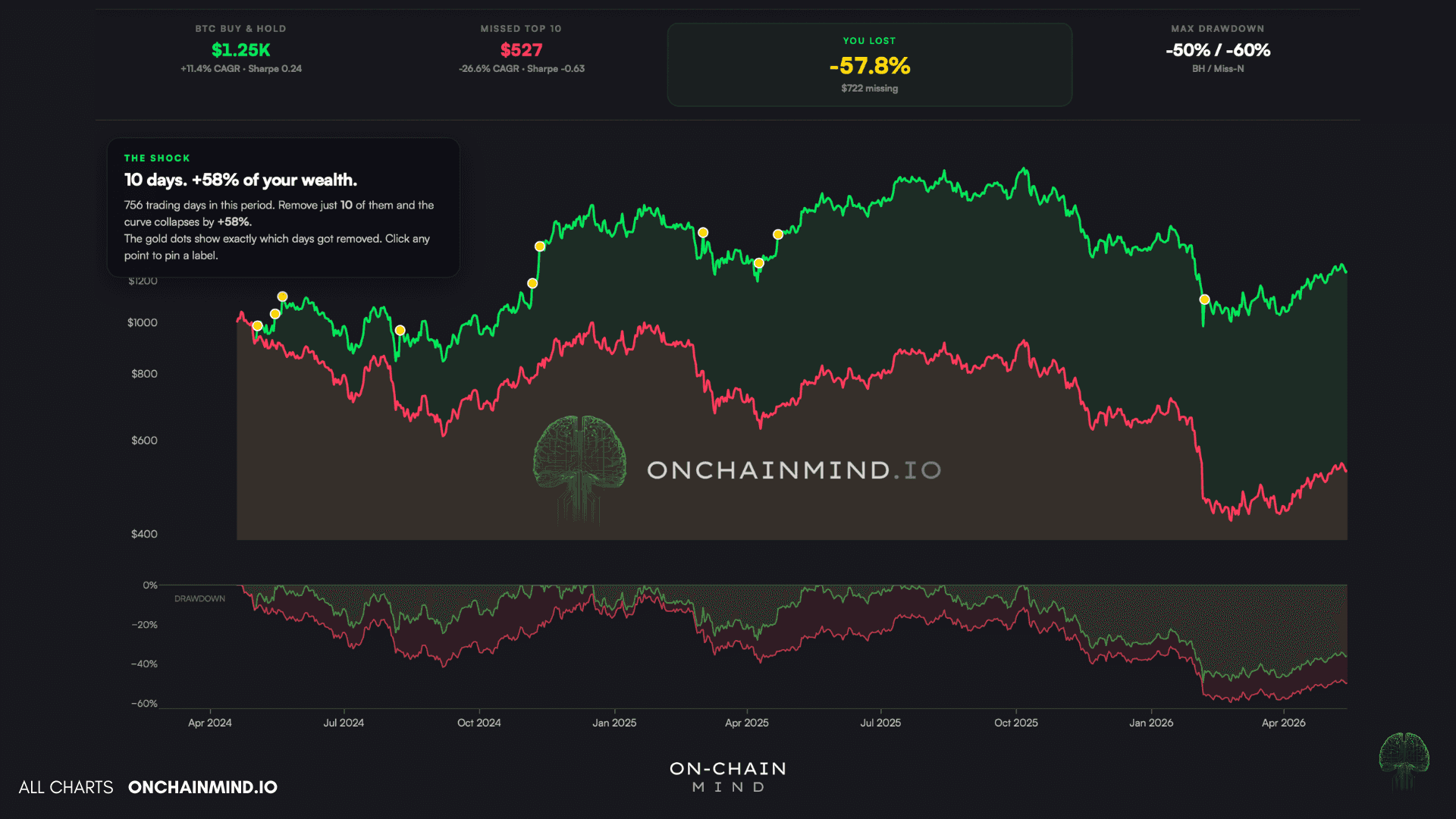
This Is Not Ancient History: Even in the current post-halving cycle, missing the 10 best days has already cost timers 58% of their wealth.
The Clustering Effect: Half of Bitcoin’s 10 best days occur within a week of one of its worst, making “sit out the bad bits” a fantasy.
Crypto Is Unforgiving: The more violent the asset, the more concentrated its returns, and crypto punishes absence harder than anything else.
The Statistic That Should Stop You In Your Tracks
You have almost certainly heard some version of the “miss the 10 best days” stat before. It is a finance cliché. But it is almost always shown for the S&P 500, almost always as a single chart with a single number, and almost always without any real exploration of what it actually means.
From 2013 to today, $1,000 in Bitcoin under buy-and-hold compounds at an 86% CAGR with a Sharpe Ratio of 1.12. Strip out the 10 best single-day returns, days where you happened to be sitting in cash earning nothing, and your CAGR collapses to 55%. Your Sharpe drops to 0.76.
So this is not just leaving money on the table. The timer made worse risk-adjusted returns too. They took on the volatility, the drawdowns, the sleepless nights, and got punished for it.
It gets worse if you push further. Miss the 50 best days, roughly 1% of all trading days Bitcoin has ever had, and you end with about $1,530. 13 years of “being in Bitcoin” turning $1,000 into a return that doesn’t even beat inflation. That has to be one of the worst possible ways to own this asset.
The first objection I’ve heard is that this only works because of the explosive early years. Surely the modern Bitcoin market behaves differently? It does not. If anything, the math has become more brutal.
Look at the post-2024 halving period alone below, which is ~756 trading days. Buy and hold turns $1,000 into around $1,250. But miss the 10 best days and you end at about $520. You took an asset that gained 25% over the period and somehow ended up down 47%. This is not 2013 doing the heavy lifting. This is the cycle we’re all trading right now.
“Just Avoid the Bad Days”
The natural human response is: “Fine, but the worst days are usually bunched up next to the best ones, so I’ll just sit out the bad windows and skip both”. It sounds reasonable. It is also where the fantasy begins.
When you plot every day of Bitcoin’s history with the 10 best as green triangles and the 10 worst as red, the clustering is impossible to miss. The current cycle shows it perfectly.

A -14% day on 5th February sits immediately next to a +12% rip the very next session. The single best day and one of the single worst days of the current cycle, back to back.
That is not a coincidence. It is actually very common market structure. In fact, across Bitcoin’s entire history, half of its 10 best days happened within a week of one of its worst days.
Best and worst are not random isolated events. They are paired and live inside the same volatile windows. When Bitcoin crashes 20-30%, the bounce is usually sitting right next to the crash.
You cannot have the bounce without the crash.
This is why “sit out the rough patches” looks elegant in a spreadsheet and falls apart in real life. Avoiding the bad days means sitting out the recovery too, because the recovery is the day after, sometimes the same day, and the people who sold the panic almost never have the conviction to buy the rip 24 hours later.
The God-Tier Counterfactual
Consider three scenarios side by side:
Miss the 10 best
Miss the 10 worst
Miss 10 of each
Across the full history, missing the 10 worst days alone turns $1,000 into $62.8 million. Roughly 15 times buy-and-hold. Sounds incredible, because it is, but no human can do this. This is the upper bound of perfect god-like timing, and we know hindsight is 20:20.
What is actually achievable, if anything, is missing a mixture of good and bad days. Across the full history, missing 10 of each ends at $5.74 million, about 47% above buy and hold.
So historically the math did slightly favour the careful timer, because Bitcoin’s early-cycle worst days were so violently bad that avoiding them produced a real compounding edge.
In the current cycle, this has flipped. In the post-2024 halving window, missing 10 of each ends at about $1,130, underperforming buy and hold by around 10%. Even with perfect knowledge of which 10 days were worst, knowledge no one actually has, you would still underperform if you also missed the 10 best.
In today’s market, the best days have become more impactful per day than the worst days. The modern market punishes timing harder than history alone suggests.

The Concentration Problem Is Getting Worse
The fair next objection is that nobody actually plans to miss the 10 best days specifically.
People miss random days for ordinary reasons, like a holiday abroad, a nervous week where they decide to step back, or a stretch of waiting for a better entry that never quite arrives. So let’s model exactly that.
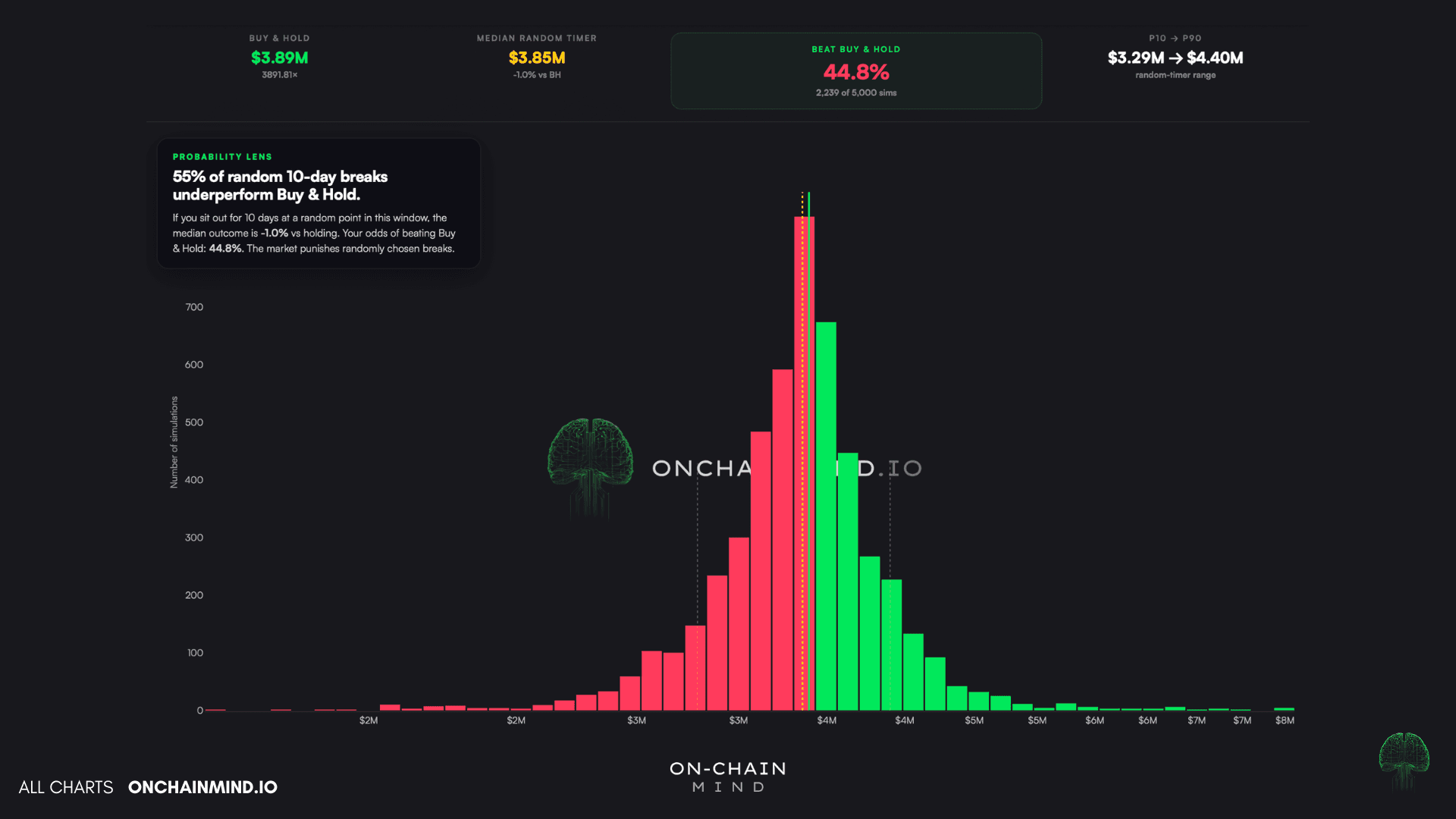
Running 5,000 Monte Carlo simulations where you sit out for one random 10-day window across history, the median outcome lands at $3.85 million, almost identical to the $3.89 million from buy and hold.
Roughly 45% of simulations beat buy and hold, while about 55% underperformed.
So being out of the market creates uncompensated timing risk. You might get lucky and dodge a soft patch, but you might equally miss one of the days driving a huge share of the return, and the distribution of outcomes makes it clear that absence is a coin flip with a meaningful tail risk attached.
How Bitcoin Compares to Everything Else
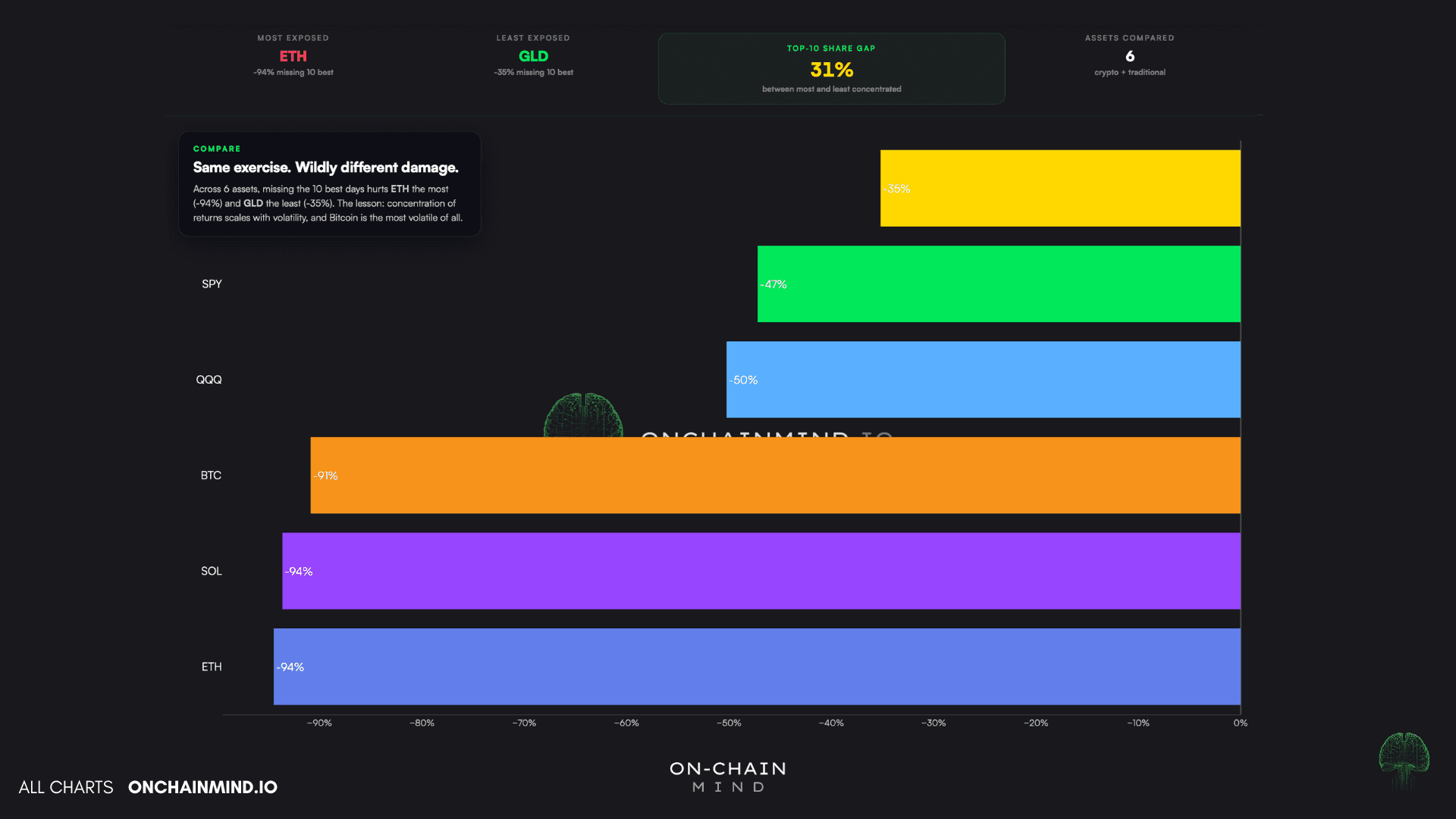
Running the same exercise across 6 major assets produces wildly different damage.
Gold is the most forgiving of the bunch, with missing its 10 best days costing around 35%, which is still a serious haircut but the gentlest of the group. The S&P 500 loses about 47% and the Nasdaq 100 loses around 50%, so even traditional equity indices are not as benign as people often assume.
Then you step into crypto and the numbers become genuinely brutal. Bitcoin loses 91%, while Ethereum and Solana both lose around 94%.
The pattern is unmistakable: the concentration of returns scales directly with the volatility of the asset.
My Take After Crushing the Data
I have spent a lot of time sitting with this data (trust me!) and the lesson is pretty clear.
Bitcoin does not reward comfort, it rewards presence. Most investors, myself included at various points, dramatically underestimate how much of their long-term return is determined by whether they were simply still there when the market decided to move.
What surprised me most is that the timing penalty is not fading as Bitcoin matures. I half-expected to find a more forgiving, more efficient market, but the opposite is true. The current cycle is the most concentrated return regime Bitcoin has ever produced, and the gap between participation and absence has widened rather than narrowed.
I am also not saying you should never trade. I actively trade a percentage of my portfolio, and I have no issue with that because it is done with the right tools and with discipline. But selling your entire stack because you have convinced yourself you can perfectly sidestep the next leg down and buy back before the recovery is, historically, one of the most expensive mistakes you can make in this asset.
The crash and the recovery are usually the same event, and you do not get to choose one without accepting the other.
Bitcoin’s biggest up days do not arrive when everything feels safe and obvious. They arrive in the same violent windows as the worst days, often within hours and days of one another. The market does not hand you the bounce without first testing whether you can sit through the crash, and that is the price of admission.
So if this piece feels overwhelming, the lesson is actually very simple:
You do not need to catch every move
You do not need to outsmart everyone else
And you certainly do not need to be a timing genius
You just need to understand what you own and be around for when the market moves. Because in Bitcoin, missing a handful of days can cost you almost everything, and the cost of that mistake is only getting larger.