
In May, Strategy sold Bitcoin.
Not for a tax loss, and not to tidy the balance sheet. In its own filing, the company said the proceeds were expected to fund distributions on its preferred stock. By August, 6,948 BTC had gone out the door.
This is the company whose entire identity is to stack and keep as much Bitcoin as possible.
Most people missed it, because they were watching the common stock fall below $85 and arguing about mNAV. The actual story was underneath, in a capital structure that is getting so layered that almost nobody can tell you when it breaks.
So I built 8 new views into the DATs dashboard to answer exactly that, several of which, as far as I can tell, have never been built before.
The data shows we already ran the stress test this year. In June, Strategy came far closer to real trouble than its share price let on.
Let's get into it.
Key insights
The Bill Is Real: Strategy now owes $1.53B a year in dividends and interest, and one preferred, STRC, makes up two thirds of it.
June Was the Stress Test: A 20% yield, a 25% slide below par and just 6.1 months of cash left. Strategy sold Bitcoin to pay holders.
The Breaking Points: There are three Bitcoin prices where Strategy's coverage starts to crack, and the first is much closer than most people think.
The Market Hasn't Forgiven June: The junior preferreds still charge for more Bitcoin volatility than Bitcoin actually delivers.
Why Everyone Gets Tripped Up
I'll be honest, this one took me a while to get my head around. So stick with me, and I'll explain it as simply as I can, one layer at a time. Then I'll show you the exact Bitcoin prices where this whole structure starts to crack, and the one I'm watching most closely.
Simply put, Strategy is no longer a company with some Bitcoin and some debt. It's a queue.
When you own MSTR stock, you're actually standing at the back of a six-person queue, and everyone ahead of you gets paid first:
The convertible notes ($6.71B). Basically loans, and most of them pay no interest.
STRF, which pays a fixed 10%. It's the most senior preferred, so it's the safest.
STRC, whose rate Strategy resets every month to try and keep the price near $100.
STRE, the same idea as STRF but in euros.
STRK, which pays 8% and can be swapped for a tenth of an MSTR share.
STRD, which pays 10%, but only if the board decides to pay it. It's last in line before you.
Add it all up and about $20.3B of claims stands between you and the Bitcoin. Of that, $13.55B is preferred stock. It never has to be repaid, but it pays out every month or quarter whatever Bitcoin is doing.
The Bill
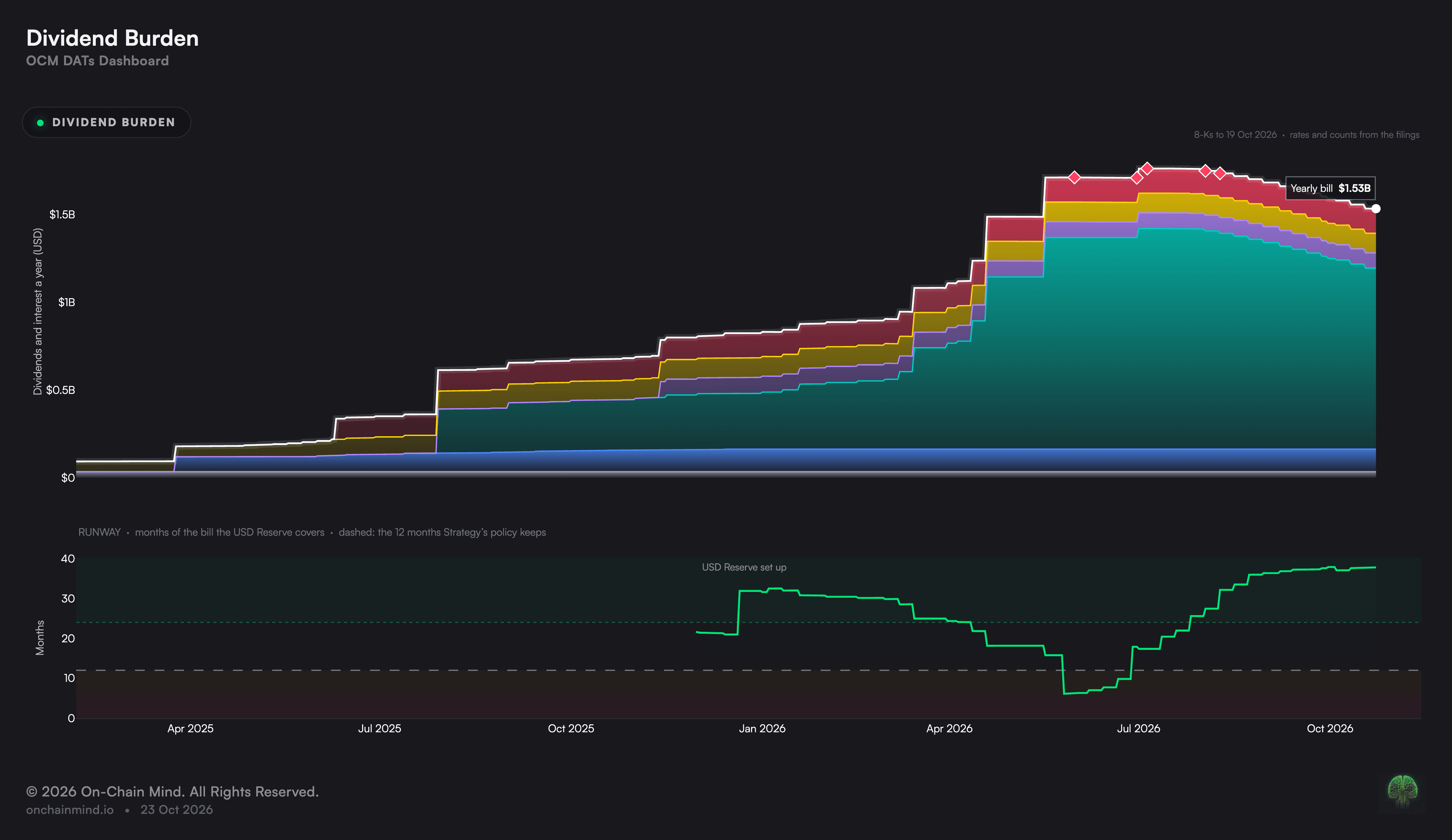
The first new view we’re going to look at is the Dividend Burden. It adds up what Strategy owes in a year across every layer, and sets that against the cash it keeps in reserve to pay it.
On 1st January, the yearly bill was $832M. It peaked at $1.76B in July. Today it's at $1.53B.
Two things really pushed it up:
More STRC: Strategy sold $7.0B of it between March and May alone.
A higher rate: STRC launched at 9%. To keep its price near $100, Strategy has raised the rate 8 times, to 12%. It has never cut it.
STRC alone now costs $1.03B a year, which is 67% of the whole bill. The interest on the old convertible loans, which the bears obsessed over for years, is just $34.6M. STRC is a completely different animal.
Here's the number that stopped me. At today's Bitcoin price, the yearly bill works out to 18,818 BTC. In the whole of the 2022 bear market, Strategy bought 18,459 BTC.
So every year, Strategy now owes more Bitcoin than it bought in that entire bear market. As soon as I figured that out, I needed to dig further.
View live in OCM Studio: Dividend Burden
This is why I've been saying the same thing on repeat recently:
Michael Saylor is going to be his own downfall. The MSTR flywheel that worked in the past survived the most brutal Bitcoin drawdowns and came out the other side. Getting too clever with all these different preferreds could end up costing them the entire operation, even if they accumulate more Bitcoin during a bear market than they ever have before.
That last part has already happened. From just before the October 2025 top to the June low, Strategy added 205,971 BTC. That's more than 11x what it bought in the whole 2022 bear. On buying alone, no one has ever had a bear market like it.
But the old flywheel survived 2022 because nothing in it charged rent. You could wait out a 77% drawdown, because waiting was free. It isn't free any more. There's now a $1.5B meter running whether Bitcoin is at $120,000 or $50,000.
A Near Miss
A lot has happened this year, and most of it slipped past without anyone connecting the dots. Here's the story in five steps:
January to May: the engine roars. STRC buyers want yield, not a premium on the stock, so Strategy kept raising money even while MSTR traded below the value of its Bitcoin. Holdings rose from 672,502 to 843,738 BTC. I called this a “structural evolution of the playbook” back in April, and it was.
Late May: the cushion goes. After spending $1.5B buying back convertible notes, the cash reserve fell to $871M. That's just 6.1 months of runway, when Strategy's own policy is 12. The first Bitcoin sale landed the same week.
June: the market notices. Bitcoin slid to $58.5K. STRC, a product built never to leave $100, closed at $74.57. STRD's yield hit 20%. Our Credit Model put the odds of STRD losing money at roughly one in five.
July onwards: the repair. Strategy stopped selling preferreds, sold 6,948 BTC between May and August and raised STRC's rate to 12%. It also rebuilt the cash reserve to $5.10B, and the Bitcoin sales covered only about a tenth of that.
The clean-up: buying STRC back. Strategy has retired 18.9M shares for $1.84B, at an average of $97.20. That's clever, because every share bought under $100 removes a full $100 of what Strategy owes. Preferreds outstanding have fallen from $15.4B to $13.5B.

View live in OCM Studio: STRC Peg
The Part They Got Right
Credit where it's due: the repair worked, and the new views show it clearly.
Coverage is back to 3.64x. The dashboard calls that Adequate, up from a low of 2.34x in June.
The cash reserve covers 37.8 months of the bill. That's Funded, and a long way from 6.1 months in May.
STRC is back at par. Its average price this month is $99.24.
In July I told you that converts heal and preferreds don't, and that every new one welds another rung onto the floor beneath you. That needs updating. Preferreds can heal, but only if the company pays to retire them, and this is the first time the floor has meaningfully come back down.
And if you followed me into MSTR at $85 in June, it’s trading at $145 today.
So no, this isn't a collapse piece. But look at what the repair cost. June's Bitcoin buying was funded with stock sold at a deep discount, and Strategy sold Bitcoin again. In 2022 it was 704 coins, sold for tax purposes and bought back within days. This time it was 6,948 BTC to help pay its dividends. The old flywheel never had to do that.
That's the real question for the next down market. Not whether Strategy survived June, but how much further Bitcoin has to fall before it happens again.
Below, I'll show you the exact price where each layer of the queue goes underwater, the three levels I'm watching, and the signal from our Credit Model that says the market still hasn't forgiven June.
How Far Bitcoin Has to Fall
Continue reading with OCM Premium
You have been reading the free preview of this article. The full analysis continues with 9 more sections, charts and takeaways. Read the full article or see OCM Premium plans.