
Something broke this year.
The companies that secure the entire Bitcoin network are earning roughly 50% less than they were 12 months ago, and yet a few of their stocks have quietly gone up several hundred percent.
Those two facts should not be able to coexist.
Underneath that contradiction sits everything that matters right now: a hash rate bleeding out of the network, an AI exodus rewriting what these companies even are, and a handful of signals buried so deep in their buy zone that history says the floor is nearer than it looks.
Let’s get into it.
Key insights
A Genuine Hash Rate Bear Market: The network's computing power has fallen nearly 20% from its peak, a rare and structurally important drawdown.
The AI Exodus: Miners are redirecting hardware towards AI, lifting share prices even as their Bitcoin revenue collapses beneath them.
Mining at a Loss: The average miner now produces Bitcoin below cost, and every prior time that happened it flagged a floor.
The Puell Multiple in the Buy Zone: Miner earnings sit in their 17th percentile, a level that has historically marked generational buying opportunities.
A Hashrate Drop Worth Taking Seriously
Let us start with the hashrate, because this is where the stress shows up first.
This is the total computing power miners throw at Bitcoin every second, essentially the raw horsepower securing the network. The rule is simple: more hash rate means more security, because attacking the chain would mean out-muscling the entire global fleet of miners at once.
And right now we are in a genuine hashrate bear market. The metric has drawn down roughly 18% from its all-time high, with the deepest point close to 20%. For something that spends almost its whole life grinding up and to the right, that matters.

View live in OCM Studio: Hashrate ATH drawdown
It has only fallen like this a handful of times:
The China mining ban — when half the network was unplugged and relocated almost overnight
The 2018 bear market — when the final price crash dragged miners below break-even
The halving events — where the block reward is cut in half and the cost to produce a coin doubles
This time the shape is different, a long grinding decline rather than a sharp shock, but the biggest drawdowns have still lined up almost perfectly with the biggest sell-offs in price.
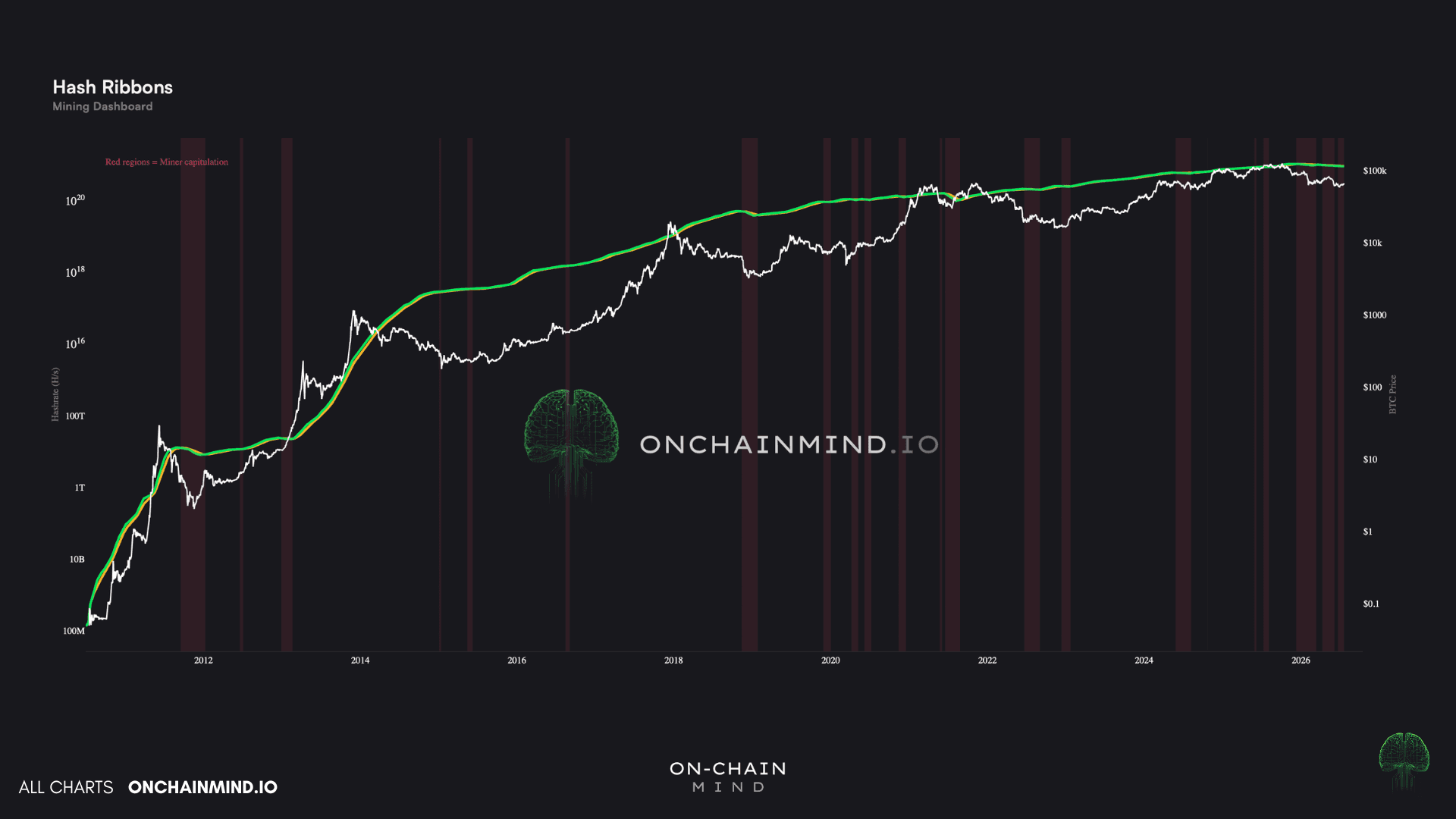
You can watch this play out through the Hash Ribbons, which track the 30-day and 60-day moving averages of the hash rate.
When the fast line crosses below the slow one, it warns that miners are switching off their rigs. The real signal, though, is not when it starts but when it stops, because that is the moment hash rate stops falling and miners return.
View live in OCM Studio: Hash Ribbons
That has historically been one of the best entry signals into Bitcoin we have. But this time, we have seen the largest cluster of these signals on record, three back to back, something never witnessed before.
And that is exactly why I cannot lean on it the way I once would have. A signal that normally marks a local bottom is firing over and over, which tells me the drawdown is still too ropey to trust.
The AI Exodus
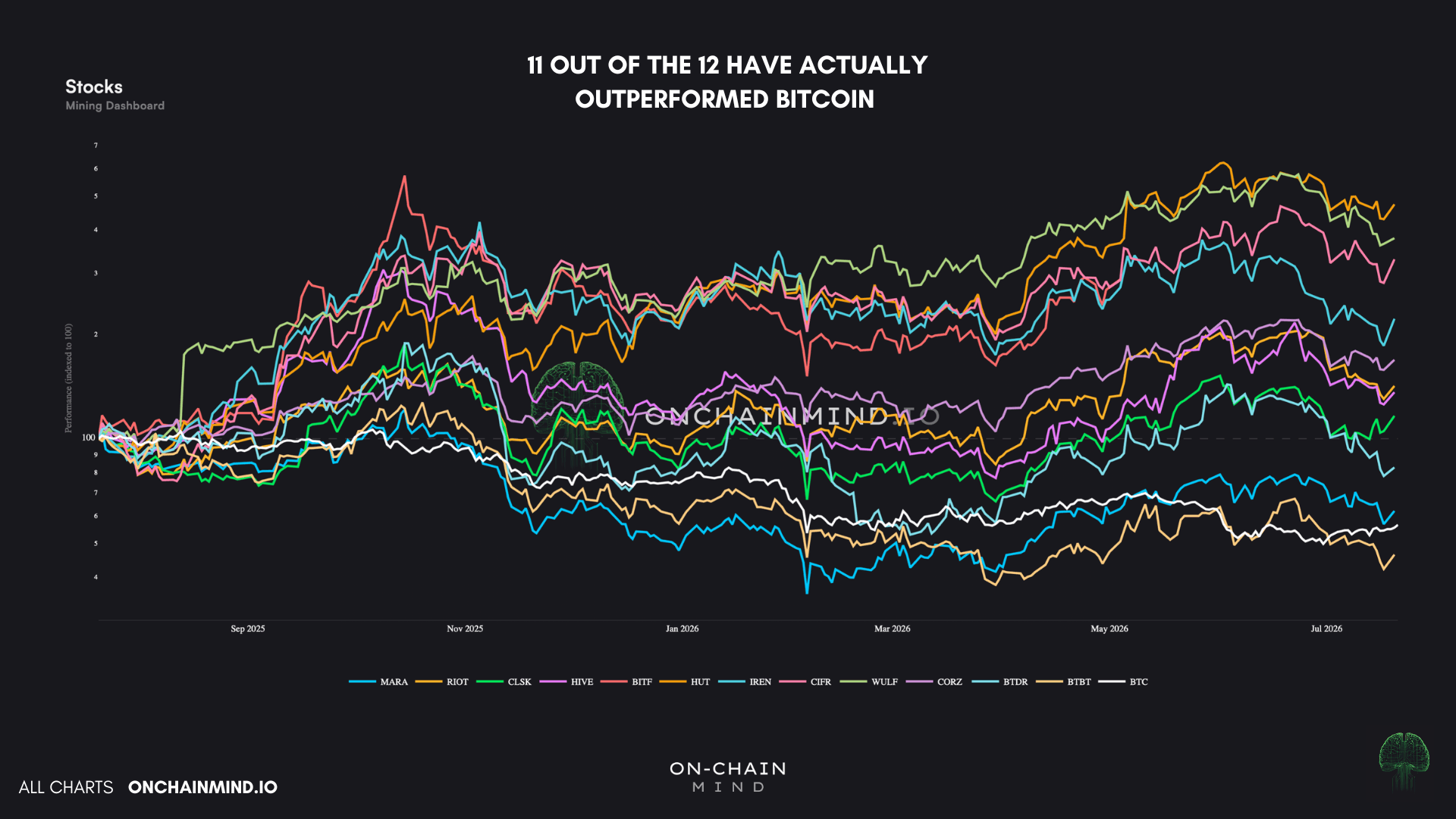
Here is where the story turns strange. Plot the top 12 Bitcoin mining stocks against Bitcoin itself, and since their respective listings only 2 of the 12 have outperformed the asset they are built around.
It raises an obvious question: why own the miners at all when you could simply hold the real thing and do better?

View live in OCM Studio: Mining Stocks from inception
Now shrink the window to the past 12 months and the entire picture inverts. Over the last year, 11 of the 12 have outperformed Bitcoin, from around plus 6% on MARA to a staggering plus 417% on HUT.
View live in OCM Studio: Mining Stocks from 1y ago
The reason runs in both directions: these companies are pivoting to AI, and the market adores it. They are quietly stepping away from Bitcoin, which for the long-term health of the network is not a good thing at all.
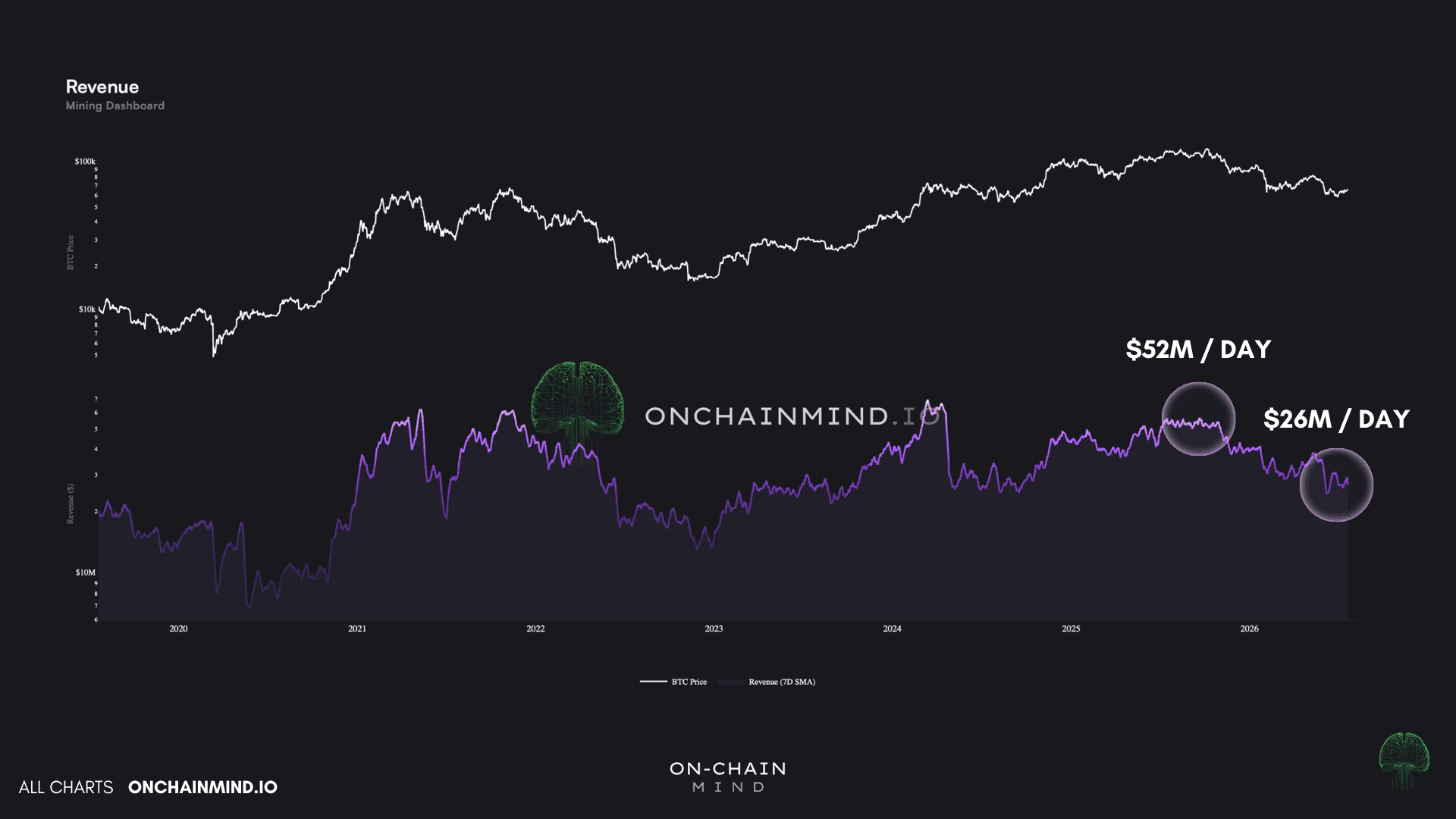
The clearest evidence sits in the revenue. Daily mining revenue has fallen from roughly $52 million at October's price peak to about $26 million today, an almost exact 50% haircut, and it is still down around 11% in the past month alone.
View live in OCM Studio: Daily mining revenue
Yet the share prices keep climbing. Sit with that for a moment: the market is no longer valuing most of these companies on their Bitcoin mining businesses at all.
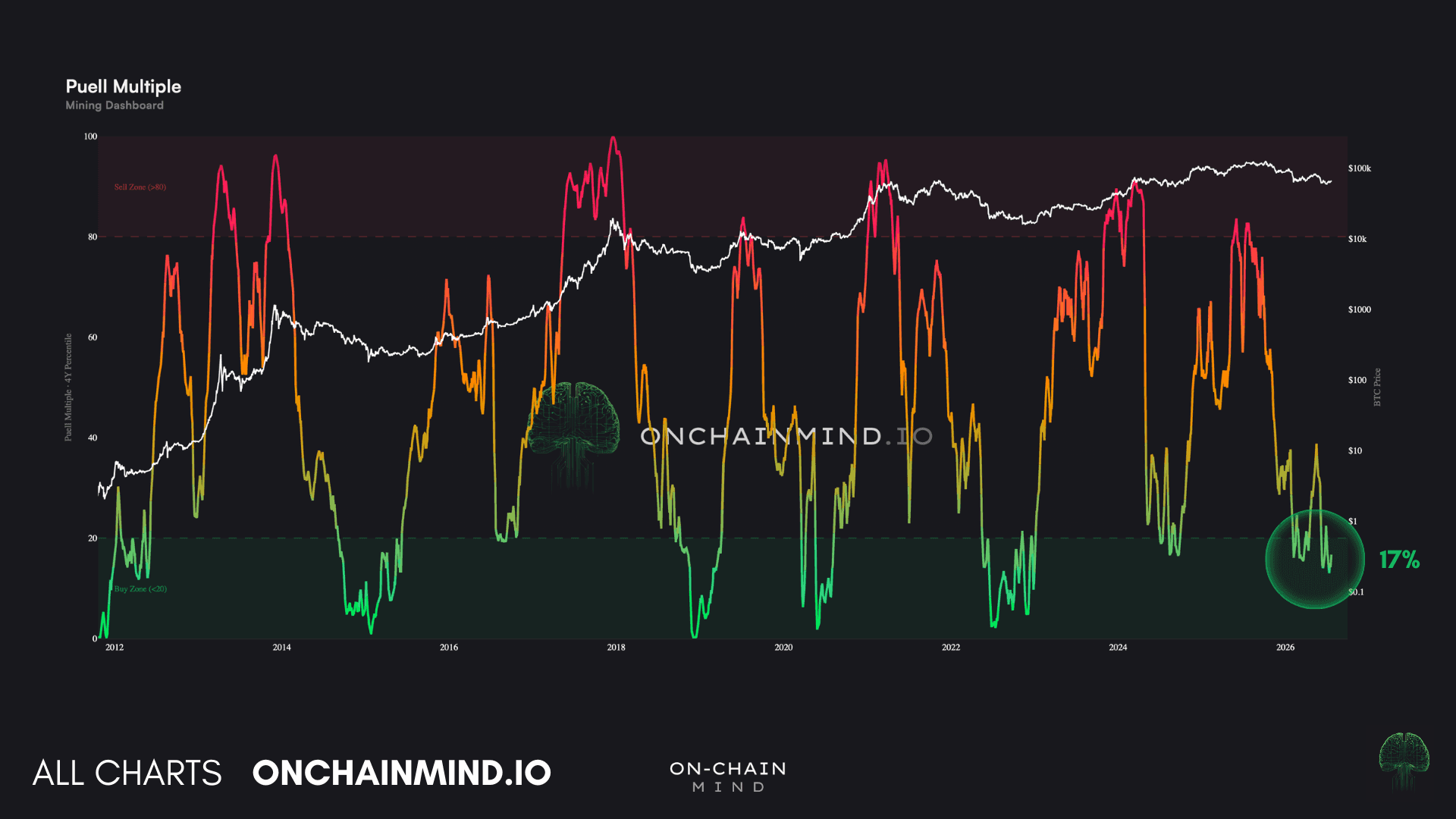
And for me, when measuring that earnings stress, nothing beats the Puell Multiple, which compares the daily value of newly issued Bitcoin to its own yearly average. When it is high, miners are earning far more than usual and are tempted to sell into strength; when it is low, that pressure naturally dries up.
View live in OCM Studio: Puell Multiple (percentile)
I’ve rescaled it here as a percentile, which makes it much easier to read across cycles. Anything below 20% has historically marked generational buying opportunities. Today it sits near 17%, telling us that, purely from a miner's earnings perspective, Bitcoin is deeply undervalued.
The Cost of Production Floor
The final number miners reckon with every day is the cost of production, and there are some genuinely dodgy versions of this figure floating around.
Here is how I do it properly:
Start with the energy needed to mine a single block using the efficiencies of current 2026 ASIC hardware
Convert that into dollars using industrial electricity prices
Then, because the block subsidy pays 3.125 Bitcoin per block, work backwards to the cost of each individual coin
I apply an overhead multiplier on top of that raw power cost for the ongoing capex, cooling, staff and the rest of the operating stack
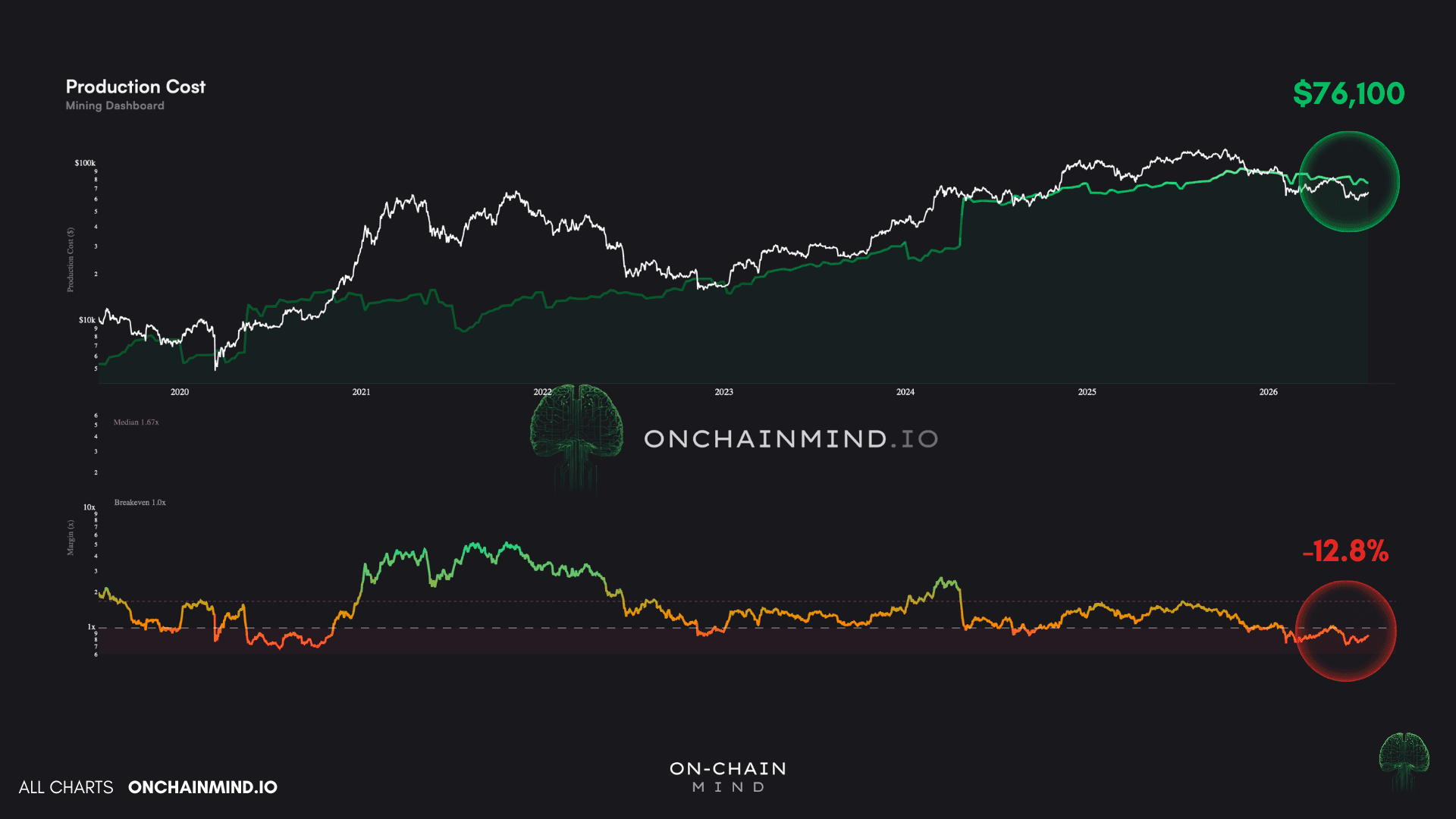
Do all of that and the average cost to mine a single Bitcoin lands around $76,100.
With spot near $66,000, the typical miner is operating at roughly a 12.8% loss. Unprofitable operators are eventually forced to sell their treasury reserves just to keep the lights on. So as more rigs shut off, more hashrate drops away.
View live in OCM Studio: Cost of Production
This is where Bitcoin's self-healing mechanism matters. As miners switch off, the difficulty adjustment ratchets down, which lowers the cost of production for everyone still standing. The network rebalances itself, and the feared death spiral never arrives.
And here is the part worth burning into memory. Every previous time price has slipped below the cost of production, it has not marked the end of anything. It has marked another remarkable opportunity for anyone simply holding spot and willing to wait.
The Fee Problem Nobody Is Talking About
There is one last warning sign that deserves its own flag, and it is one of the more overlooked stories in Bitcoin right now.
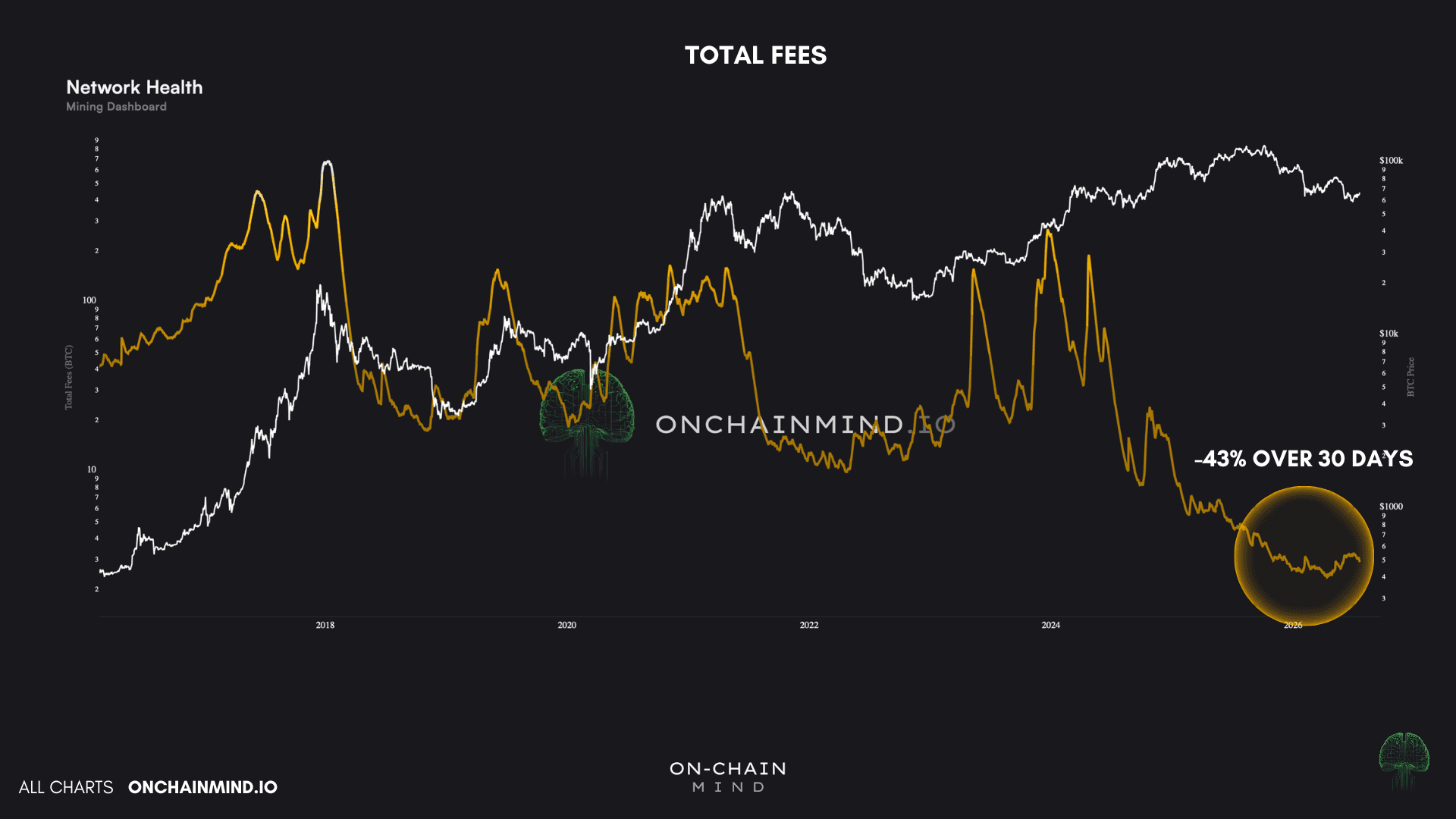
Of that $26 million in daily mining revenue, less than 1% is coming from transaction fees. To be precise, just 0.7%.
Almost everything miners earn today is the block subsidy, the freshly issued Bitcoin handed out with each block, rather than the fees the rest of us pay to transact.
Fees are really a measure of competition for block space. When the network is busy and everyone is scrambling to get their transaction into the next block, fees rise. When interest fades, they collapse, and since the rally to $100,000 they have fallen off a cliff, down 43% in the last month alone.
View live in OCM Studio: Total Fees
It sounds scary at first, but it is pretty normal for a bear market, when on-chain activity always thins out.
But it matters more than it looks, because it leaves miners leaning almost entirely on the block subsidy to survive. And that subsidy is not permanent. It halves every 4 years by design, which means fees are the revenue stream that has to grow into the gap over time.
Watching them wither like this is not a crisis today, but it is a quiet reminder of the long-term question mining still has to answer.
My Two Sats
I know this piece reads like doom and gloom, but trust me, this conversation has happened every bear market to some degree.
Some miners are stepping away from Bitcoin, and the ones still mining are earning meaningfully less than a year ago. Both are true. But the cure for miner stress, in every cycle without exception, has been the eventual end of the bear market.
Every cycle the old, inefficient operators get flushed out and forced to upgrade just to compete. There is nothing unique about this one in that sense.
What is new is the exit door.
For the first time, miners have somewhere else to point their hardware while price is weak, and that somewhere is AI. It is a big part of why this drawdown has been so long and grinding, because miners are no longer trapped with what they have. I do not think that fully reverses until the price does.
But here is the detail I keep returning to. Despite every bearish metric on the board, the hashrate is still higher today than it was a year ago, when price was far higher too. Miners are earning less, the economics are rough, and yet Bitcoin itself is more secure than it was this time last year.
So how am I playing it? Well for starters, I am not rushing to buy the second the Hash Ribbons stop printing, because recently that has proved to be worth a small pump followed by another leg straight back down.
I want to see an extended stretch of clear signals before I trust that network health is truly back. But a Puell Multiple in the buy zone, and a price sitting below the cost of production, are exactly the readings that in every prior cycle I have been very glad I paid attention to.
Because that is the thing about mining. It is brutal, it is cyclical, and it always looks its darkest right before it turns.
Today’s forced sellers become tomorrow’s desperate buyers as they plug back in, and by that point, the easy money has already been made by everyone who moved while it still felt wrong.