
ON-CHAIN METRIC
Hashrate
How much computing work is the Bitcoin network estimated to perform each second?
Open the Mining & Network dashboard
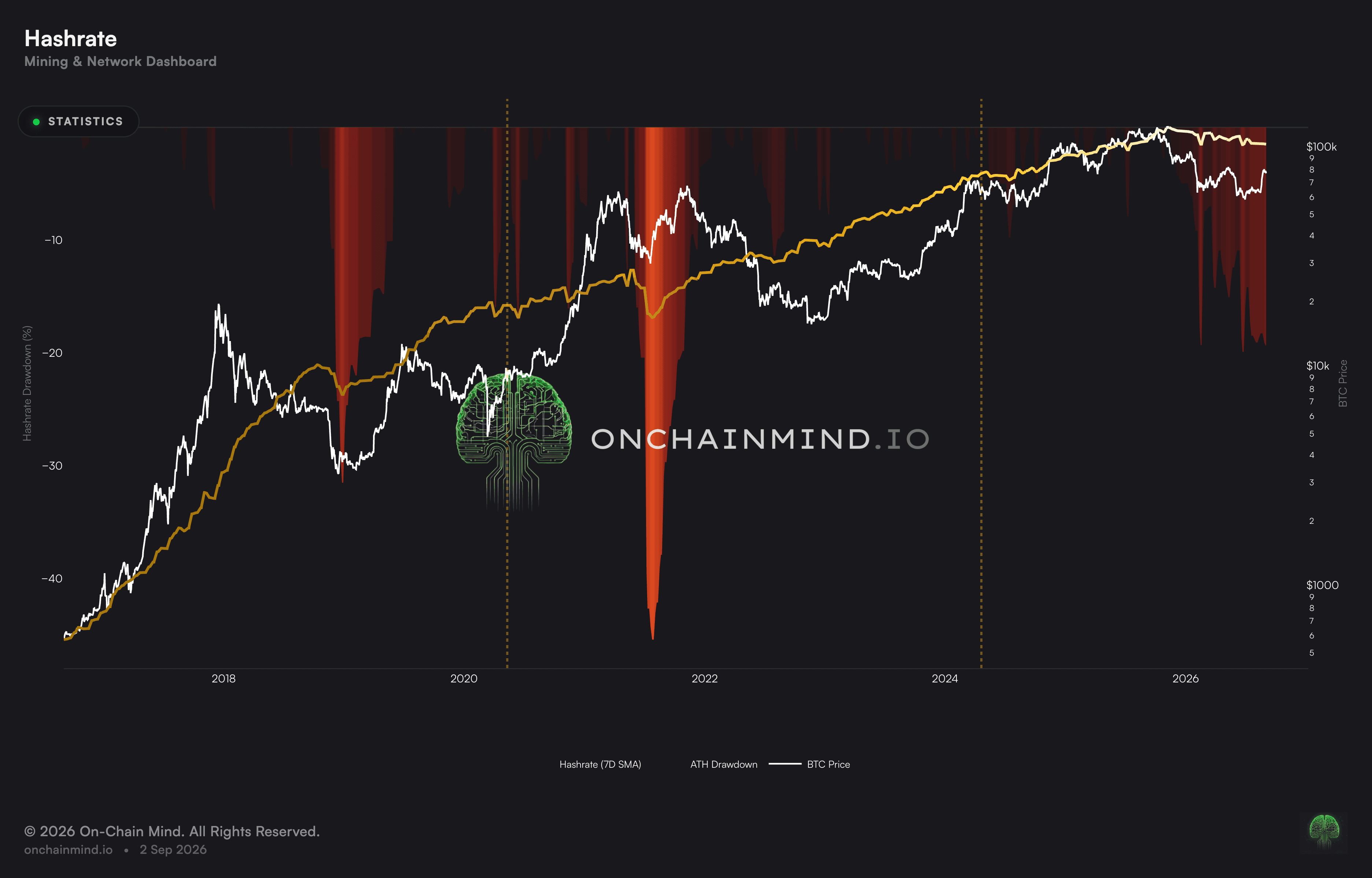
Bitcoin hashrate is an estimate of how many SHA-256 hashes miners perform each second. It describes estimated computational work, not a count of machines, capital invested or energy consumed.
Hashrate cannot be observed from the chain. Analysts infer it from mining difficulty and the rate at which blocks were found over a chosen window.
Why hashrate is an estimate
Block discovery is random. A fast run of blocks makes short-window hashrate look higher; a slow run makes it look lower even if the underlying fleet did not change.
Longer windows reduce that noise but react more slowly. Providers can therefore show different values while using the same blockchain data.
What drives hashrate
Price and fees influence miner revenue, but hardware efficiency, energy cost, curtailment, regulation, deployment delays and seasonal conditions also matter. Hashrate often follows changes in mining economics, though the relationship is not a fixed one-way lag.
A sharp fall can indicate economic stress, but it can also reflect outages, relocation or policy. Cause has to come from outside the series.
What hashrate says about security
More network hashrate generally raises the computational cost of overpowering the chain at that moment. Security also depends on access to hardware and energy, mining-pool concentration and network topology, so one number is not the whole defence model.
For miner economics, compare hashrate with hashprice, fees and difficulty. Rising competition against flat revenue compresses revenue per unit of work.
How to read it
Rapid expansion. Estimated computing power is growing quickly over the selected window.
Steady growth. The longer-term network estimate is rising.
Flat. The smoothed estimate is broadly stable; shorter changes may still be hidden.
Contraction. Estimated computing power is falling; check whether the cause is economic or operational.
Hashrate updates daily inside the Mining & Network dashboard, alongside difficulty, hashprice and miner-stress views.
Related metrics: Mining Difficulty, Hash Ribbons and Hashprice.
Common questions
Is hashrate measured directly?
No. It is inferred from difficulty and observed block production over a selected window.
Does rising hashrate predict price?
Not reliably. Mining capacity responds to revenue, cost, hardware and policy, often with deployment lags.
Why do providers disagree?
They can use different estimation windows and smoothing methods for the same random block-arrival process.
How does it relate to difficulty?
Difficulty is the protocol’s current proof-of-work target setting. Hashrate is an estimate inferred partly from that setting and realised block times.
Is more hashrate always better?
It generally raises attack cost, but concentration and access to mining resources still matter. For individual miners, more network hashrate also means more competition.
ON-CHAIN METRIC
Hashrate
How much computing work is the Bitcoin network estimated to perform each second?
Open the Mining & Network dashboard
Bitcoin hashrate is an estimate of how many SHA-256 hashes miners perform each second. It describes estimated computational work, not a count of machines, capital invested or energy consumed.
Hashrate cannot be observed from the chain. Analysts infer it from mining difficulty and the rate at which blocks were found over a chosen window.
Why hashrate is an estimate
Block discovery is random. A fast run of blocks makes short-window hashrate look higher; a slow run makes it look lower even if the underlying fleet did not change.
Longer windows reduce that noise but react more slowly. Providers can therefore show different values while using the same blockchain data.
What drives hashrate
Price and fees influence miner revenue, but hardware efficiency, energy cost, curtailment, regulation, deployment delays and seasonal conditions also matter. Hashrate often follows changes in mining economics, though the relationship is not a fixed one-way lag.
A sharp fall can indicate economic stress, but it can also reflect outages, relocation or policy. Cause has to come from outside the series.
What hashrate says about security
More network hashrate generally raises the computational cost of overpowering the chain at that moment. Security also depends on access to hardware and energy, mining-pool concentration and network topology, so one number is not the whole defence model.
For miner economics, compare hashrate with hashprice, fees and difficulty. Rising competition against flat revenue compresses revenue per unit of work.
How to read it
Rapid expansion. Estimated computing power is growing quickly over the selected window.
Steady growth. The longer-term network estimate is rising.
Flat. The smoothed estimate is broadly stable; shorter changes may still be hidden.
Contraction. Estimated computing power is falling; check whether the cause is economic or operational.
Hashrate updates daily inside the Mining & Network dashboard, alongside difficulty, hashprice and miner-stress views.
Related metrics: Mining Difficulty, Hash Ribbons and Hashprice.
Common questions
Is hashrate measured directly?
No. It is inferred from difficulty and observed block production over a selected window.
Does rising hashrate predict price?
Not reliably. Mining capacity responds to revenue, cost, hardware and policy, often with deployment lags.
Why do providers disagree?
They can use different estimation windows and smoothing methods for the same random block-arrival process.
How does it relate to difficulty?
Difficulty is the protocol’s current proof-of-work target setting. Hashrate is an estimate inferred partly from that setting and realised block times.
Is more hashrate always better?
It generally raises attack cost, but concentration and access to mining resources still matter. For individual miners, more network hashrate also means more competition.