

ON-CHAIN METRIC
Bitcoin Retail Holdings
What the smallest address cohorts are doing, ranked against their own history.
Open the Supply dashboard
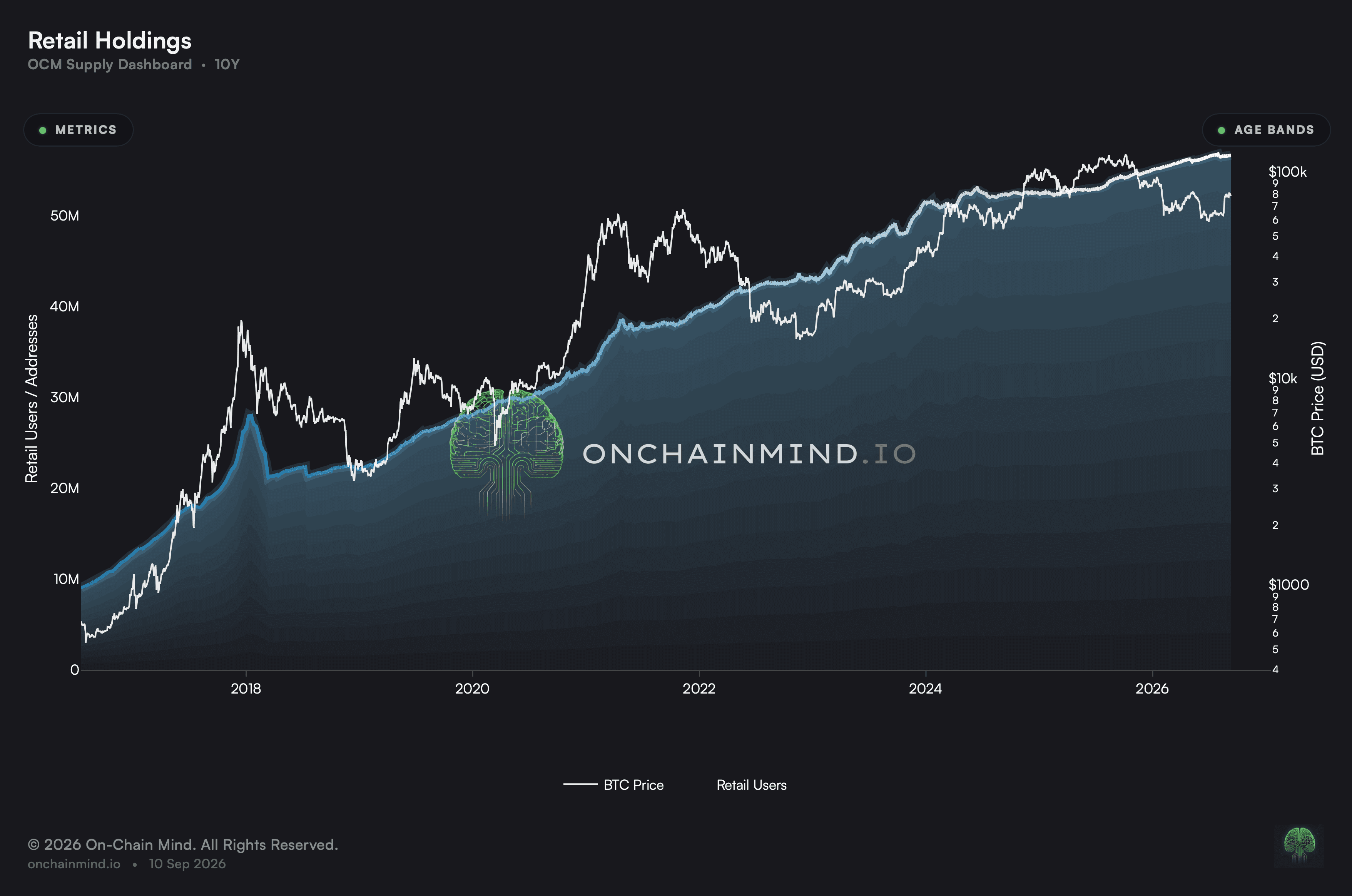
Retail Holdings follows the tiniest holders and condenses how involved they are into one scored figure. At the edges of a cycle, the little accounts have historically done the opposite of what the very large ones were doing.
That counter-movement is what makes the index worth watching, and it is also the thing most often described badly.
What it actually measures
The same brackets support three separate readings. The first tallies how many tiny accounts exist, the second reports how much coin they hold between them, and the third scores their involvement against the record. A tally climbing faster than the holdings means newcomers are turning up with modest sums.
Scoring happens against everything on record rather than the recent past alone, because a short reference point turns every dull stretch into an emergency. Using the whole archive is what lets a figure from an earlier cycle be weighed against one from today. The bill for that is patience: a genuinely new state of affairs takes years to look normal, so a lasting shift in involvement will keep reading as exceptional long after it has become the norm.
The claim that retail gets it wrong does not survive the data
The little accounts have gone on buying through several collapses and have been paid for it. A group that steps in when nobody else will and then sits tight is not behaving stupidly, whatever the received wisdom claims.
The observation the data actually supports is narrower and more useful: participation peaks late. Interest arrives after a move rather than before it, which makes an extreme in this index a statement about the stage of a cycle rather than a verdict on anybody’s judgement. Read that way it becomes a timing observation about attention rather than a moral one about intelligence, which is both fairer and considerably more useful.
What it does not tell you
Small addresses are the cohort most distorted by exchange bookkeeping. A venue restructuring its wallets can create or erase enormous numbers of small addresses without a single participant arriving or leaving.
Address count is also a poor proxy for people at this end of the range. Someone accumulating steadily generates new addresses without being a new participant, and the count cannot tell the two apart.
The cohort is also shrinking in relevance as more small holders move to custodians and funds. A participant buying through a broker never appears in any address band, so the measure is watching a narrowing slice of retail activity over time. That drift matters more with each cycle, and it argues for reading the trend within an era rather than across several.
How to read it
Retail Euphoria. An extreme, historically a late-cycle condition.
Retail Warming. Participation is picking up.
Retail Neutral. Ordinary small-holder activity.
Retail Cooling. Participation is fading.
Retail Apathy. Very little interest: historically the accumulation side.
Retail Holdings lives on the Supply dashboard among Wallet Distribution, Accumulation Trend and Institutional Holdings.
Common questions
What does the index measure?
How involved the tiniest holders are, scored against everything on record, so an unfamiliar figure can be placed as high, low or unremarkable.
What does each of the three settings report?
The first tallies how many tiny accounts exist, the second reports how much coin they hold between them, and the third scores their involvement against the record.
Is the retail-is-wrong framing fair?
It is lazier than the evidence warrants. The little accounts have gone on buying through several collapses and been paid for it. What is genuinely worth noting is that their involvement tends to peak late.
Why rank against all history?
Because a short reference point turns every dull stretch into an emergency. Using the whole archive lets a figure from an earlier cycle be weighed against one from today.
What distorts the cohort most?
Exchange bookkeeping. A venue restructuring its wallets can create or erase enormous numbers of small addresses with no participant arriving or leaving.
ON-CHAIN METRIC
Bitcoin Retail Holdings
What the smallest address cohorts are doing, ranked against their own history.
Open the Supply dashboard
Retail Holdings follows the tiniest holders and condenses how involved they are into one scored figure. At the edges of a cycle, the little accounts have historically done the opposite of what the very large ones were doing.
That counter-movement is what makes the index worth watching, and it is also the thing most often described badly.
What it actually measures
The same brackets support three separate readings. The first tallies how many tiny accounts exist, the second reports how much coin they hold between them, and the third scores their involvement against the record. A tally climbing faster than the holdings means newcomers are turning up with modest sums.
Scoring happens against everything on record rather than the recent past alone, because a short reference point turns every dull stretch into an emergency. Using the whole archive is what lets a figure from an earlier cycle be weighed against one from today. The bill for that is patience: a genuinely new state of affairs takes years to look normal, so a lasting shift in involvement will keep reading as exceptional long after it has become the norm.
The claim that retail gets it wrong does not survive the data
The little accounts have gone on buying through several collapses and have been paid for it. A group that steps in when nobody else will and then sits tight is not behaving stupidly, whatever the received wisdom claims.
The observation the data actually supports is narrower and more useful: participation peaks late. Interest arrives after a move rather than before it, which makes an extreme in this index a statement about the stage of a cycle rather than a verdict on anybody’s judgement. Read that way it becomes a timing observation about attention rather than a moral one about intelligence, which is both fairer and considerably more useful.
What it does not tell you
Small addresses are the cohort most distorted by exchange bookkeeping. A venue restructuring its wallets can create or erase enormous numbers of small addresses without a single participant arriving or leaving.
Address count is also a poor proxy for people at this end of the range. Someone accumulating steadily generates new addresses without being a new participant, and the count cannot tell the two apart.
The cohort is also shrinking in relevance as more small holders move to custodians and funds. A participant buying through a broker never appears in any address band, so the measure is watching a narrowing slice of retail activity over time. That drift matters more with each cycle, and it argues for reading the trend within an era rather than across several.
How to read it
Retail Euphoria. An extreme, historically a late-cycle condition.
Retail Warming. Participation is picking up.
Retail Neutral. Ordinary small-holder activity.
Retail Cooling. Participation is fading.
Retail Apathy. Very little interest: historically the accumulation side.
Retail Holdings lives on the Supply dashboard among Wallet Distribution, Accumulation Trend and Institutional Holdings.
Common questions
What does the index measure?
How involved the tiniest holders are, scored against everything on record, so an unfamiliar figure can be placed as high, low or unremarkable.
What does each of the three settings report?
The first tallies how many tiny accounts exist, the second reports how much coin they hold between them, and the third scores their involvement against the record.
Is the retail-is-wrong framing fair?
It is lazier than the evidence warrants. The little accounts have gone on buying through several collapses and been paid for it. What is genuinely worth noting is that their involvement tends to peak late.
Why rank against all history?
Because a short reference point turns every dull stretch into an emergency. Using the whole archive lets a figure from an earlier cycle be weighed against one from today.
What distorts the cohort most?
Exchange bookkeeping. A venue restructuring its wallets can create or erase enormous numbers of small addresses with no participant arriving or leaving.