

ON-CHAIN METRIC
Revived Supply
How much long-dormant Bitcoin has woken, separated by how long it slept.
Open the Dormancy dashboard
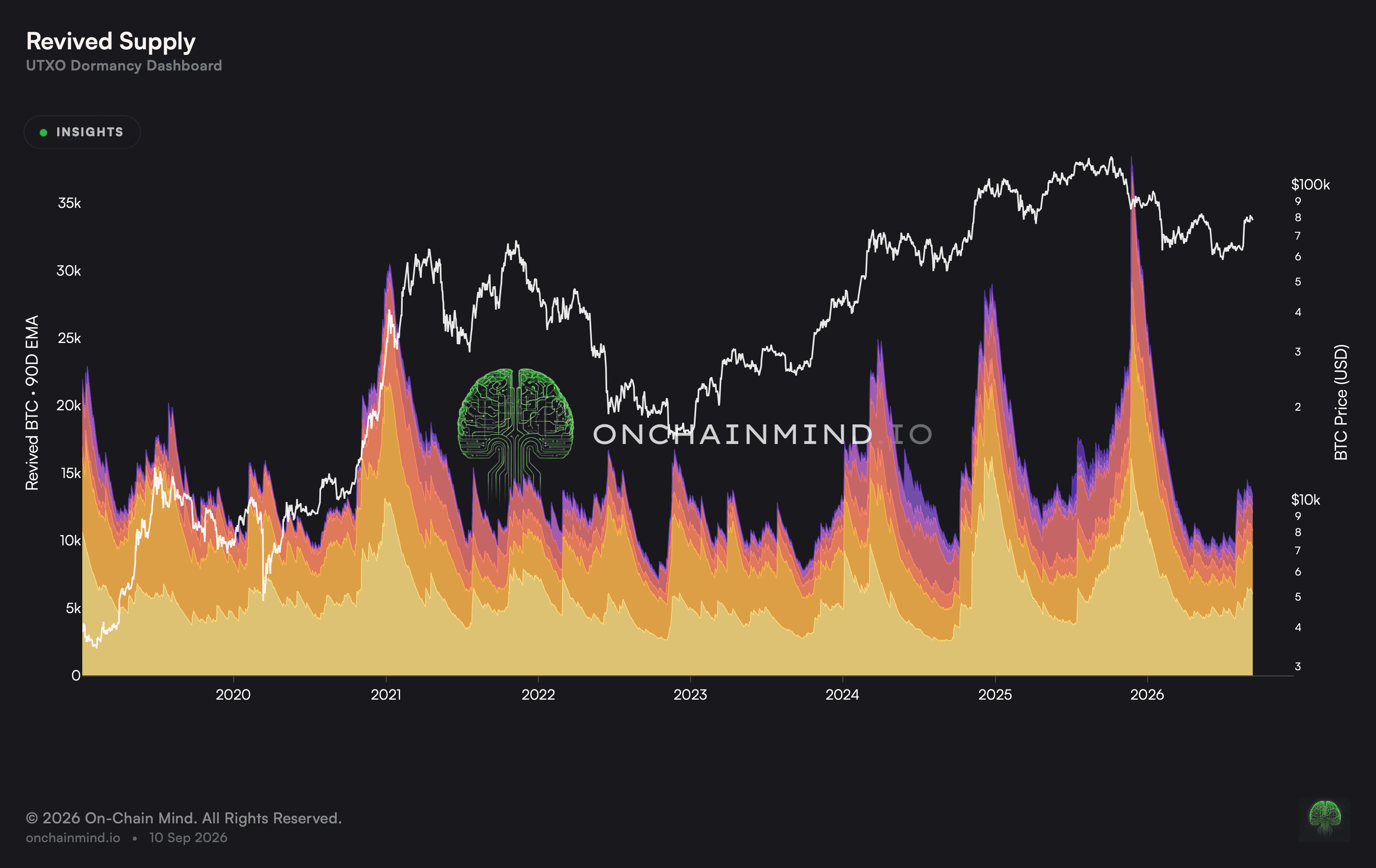
Revived Supply follows coins stirring after a long silence, sorted by the length of that silence. Something untouched since the early days and something parked for a year and a half have both stirred, and lumping the pair together is precisely the error this view was built to head off.
The bands are the metric. Almost everything worth knowing about revival is in which cohort moved, and almost none of it is in the headline figure.
What it actually measures
A coin is counted here when it moves after a long stretch of sitting still. Those movements are sorted by the length of the sleep, so the young cohorts and the multi-year ones are reported separately rather than added together.
Read across the bands, it answers something price cannot: whether supply arriving on the market comes from people who bought recently or from holders who sat through entire cycles. Those are different sellers, with different reasons and different amounts left to sell.
The aggregate hides the only part worth seeing
Revival happens constantly in the younger bands. Far more young coin exists than decade-old coin, so a single total is set by the young cohorts on almost every day of the year, and it moves when nothing unusual has happened at all.
The rare event, a veteran cohort stirring, is small in absolute terms and vanishes into that total. A chart showing one revived-supply line is showing the least informative version of the data. Read the oldest bands on their own and treat the aggregate as background.
Wake Rate: old bands wake at tiny shares, which is why ranking matters
Each cell asks what share of the coin sitting in one age band has woken. Because the answer is a share rather than an amount, a decade-old band and a much younger one can be compared directly even though one holds a small fraction of the coin the other does.
Ancient coin barely moves even during a genuine awakening, so on a raw share reading the oldest rows stay faint almost permanently. Anyone watching for a bright cell in the top row will wait years and then miss the event when it arrives.
Ranking each band against its own past is what fixes this. On that reading a cell lights only when that specific cohort’s pace is rare for that cohort, which turns a map you have to interpret into something closer to an alarm. The two readings answer different questions, and the ranked one is what flags an event.
Old Money: old coins moving is a prompt to look, never a conclusion
There are two things to look at here. The first is how much coin is parked in the most ancient bands, which is the standing pile. The second is what those bands released across a period you choose, which is the occurrence.
Custody migrations, wallet upgrades, exchange restructurings and estate transfers all move very old coins without a sale taking place. Each looks identical on the chain to a holder finally deciding to sell.
The value of the view is that it points at the small number of events worth investigating, out of an enormous volume of activity that is not. That is genuinely useful and it is a different job from telling you what happened. Treat a reading as a reason to go and find out.
What it does not tell you
Revival is not selling. A coin moving is a coin moving, and it can be a custody change, a wallet migration, an exchange reorganising cold storage or an heir taking control. The view establishes that attention is warranted, never that distribution occurred.
It also reports absolute amounts, which means the bands are not comparable with one another. A large figure from a young band and a small one from an old band can describe an ordinary week and a genuinely rare event, and nothing in the numbers themselves says which is which.
The view has nothing to say about what happens next either. A revived coin can be sold within the hour or sit still for another decade, and the record of its waking looks the same in both cases.
How to read it
Veteran awakening. Coins that have slept for years are stirring. Uncommon enough to deserve a look wherever it shows up.
Ordinary revival. The stirring is all in the recent cohorts, which goes on perpetually and amounts to ordinary churn.
Dormant. Hardly any of the seasoned supply is stirring.
Revived Supply has a panel of its own on the Dormancy dashboard, as do Wake Rate, Spent Age Spectrum and Coin Days Destroyed.
Common questions
What counts as revived?
Coins that lay untouched for a long stretch and have now stirred, sorted by the length of that stretch.
Why is the banding the whole point here?
Because the cohorts do not behave alike. Stirring among the most ancient coins is uncommon and consequential; stirring among recent ones is ordinary churn that happens continually.
Does revival mean selling?
No. Custody changes, wallet migrations and internal transfers all register here. Read it as a reason to look, not as confirmed distribution.
Why is the total less useful than the bands?
Because the young cohorts hold far more coin, so they set the total almost every day. The signal sits in cohorts too small to move it.
What should be read alongside the bands?
Wake Rate, which measures each band against the coin sitting in it, and Spent Age Spectrum, which shows the composition of what was actually spent.
What is a single square telling me?
A single cohort on a single day, showing what fraction of the coin parked there has stirred. Deeper colour means a bigger fraction, and a cohort that stayed wholly asleep is left empty.
Can a rare reading still be a small amount of coin?
Yes. The view reports pace, not size, which is exactly why Revived Supply sits beside it.
Does old supply moving mean selling?
No. Moving between custodians, upgrading a wallet and settling an estate all shift ancient coin without anybody selling anything. Take it as a reason to investigate, not as proof.
Why does the period setting matter so much?
Because the windows answer different questions. A move that shows on both the short and the long one is the one worth acting on.
ON-CHAIN METRIC
Revived Supply
How much long-dormant Bitcoin has woken, separated by how long it slept.
Open the Dormancy dashboard
Revived Supply follows coins stirring after a long silence, sorted by the length of that silence. Something untouched since the early days and something parked for a year and a half have both stirred, and lumping the pair together is precisely the error this view was built to head off.
The bands are the metric. Almost everything worth knowing about revival is in which cohort moved, and almost none of it is in the headline figure.
What it actually measures
A coin is counted here when it moves after a long stretch of sitting still. Those movements are sorted by the length of the sleep, so the young cohorts and the multi-year ones are reported separately rather than added together.
Read across the bands, it answers something price cannot: whether supply arriving on the market comes from people who bought recently or from holders who sat through entire cycles. Those are different sellers, with different reasons and different amounts left to sell.
The aggregate hides the only part worth seeing
Revival happens constantly in the younger bands. Far more young coin exists than decade-old coin, so a single total is set by the young cohorts on almost every day of the year, and it moves when nothing unusual has happened at all.
The rare event, a veteran cohort stirring, is small in absolute terms and vanishes into that total. A chart showing one revived-supply line is showing the least informative version of the data. Read the oldest bands on their own and treat the aggregate as background.
Wake Rate: old bands wake at tiny shares, which is why ranking matters
Each cell asks what share of the coin sitting in one age band has woken. Because the answer is a share rather than an amount, a decade-old band and a much younger one can be compared directly even though one holds a small fraction of the coin the other does.
Ancient coin barely moves even during a genuine awakening, so on a raw share reading the oldest rows stay faint almost permanently. Anyone watching for a bright cell in the top row will wait years and then miss the event when it arrives.
Ranking each band against its own past is what fixes this. On that reading a cell lights only when that specific cohort’s pace is rare for that cohort, which turns a map you have to interpret into something closer to an alarm. The two readings answer different questions, and the ranked one is what flags an event.
Old Money: old coins moving is a prompt to look, never a conclusion
There are two things to look at here. The first is how much coin is parked in the most ancient bands, which is the standing pile. The second is what those bands released across a period you choose, which is the occurrence.
Custody migrations, wallet upgrades, exchange restructurings and estate transfers all move very old coins without a sale taking place. Each looks identical on the chain to a holder finally deciding to sell.
The value of the view is that it points at the small number of events worth investigating, out of an enormous volume of activity that is not. That is genuinely useful and it is a different job from telling you what happened. Treat a reading as a reason to go and find out.
What it does not tell you
Revival is not selling. A coin moving is a coin moving, and it can be a custody change, a wallet migration, an exchange reorganising cold storage or an heir taking control. The view establishes that attention is warranted, never that distribution occurred.
It also reports absolute amounts, which means the bands are not comparable with one another. A large figure from a young band and a small one from an old band can describe an ordinary week and a genuinely rare event, and nothing in the numbers themselves says which is which.
The view has nothing to say about what happens next either. A revived coin can be sold within the hour or sit still for another decade, and the record of its waking looks the same in both cases.
How to read it
Veteran awakening. Coins that have slept for years are stirring. Uncommon enough to deserve a look wherever it shows up.
Ordinary revival. The stirring is all in the recent cohorts, which goes on perpetually and amounts to ordinary churn.
Dormant. Hardly any of the seasoned supply is stirring.
Revived Supply has a panel of its own on the Dormancy dashboard, as do Wake Rate, Spent Age Spectrum and Coin Days Destroyed.
Common questions
What counts as revived?
Coins that lay untouched for a long stretch and have now stirred, sorted by the length of that stretch.
Why is the banding the whole point here?
Because the cohorts do not behave alike. Stirring among the most ancient coins is uncommon and consequential; stirring among recent ones is ordinary churn that happens continually.
Does revival mean selling?
No. Custody changes, wallet migrations and internal transfers all register here. Read it as a reason to look, not as confirmed distribution.
Why is the total less useful than the bands?
Because the young cohorts hold far more coin, so they set the total almost every day. The signal sits in cohorts too small to move it.
What should be read alongside the bands?
Wake Rate, which measures each band against the coin sitting in it, and Spent Age Spectrum, which shows the composition of what was actually spent.
What is a single square telling me?
A single cohort on a single day, showing what fraction of the coin parked there has stirred. Deeper colour means a bigger fraction, and a cohort that stayed wholly asleep is left empty.
Can a rare reading still be a small amount of coin?
Yes. The view reports pace, not size, which is exactly why Revived Supply sits beside it.
Does old supply moving mean selling?
No. Moving between custodians, upgrading a wallet and settling an estate all shift ancient coin without anybody selling anything. Take it as a reason to investigate, not as proof.
Why does the period setting matter so much?
Because the windows answer different questions. A move that shows on both the short and the long one is the one worth acting on.