
Determining the likely severity and duration of this purge
Bitcoin has been under pressure for months, and not just a little. This is one of the most significant drawdowns we’ve seen in years.
For over 100 days, it has been trading well below what recent buyers have paid, putting the market’s most reactive investors under sustained stress.
This isn’t just about price falling. It’s about understanding who is in pain, for how long, and what that tells us about the cycle.
In this article, I break down the depth of this drawdown, explain why the time spent underwater matters as much as the severity, and show what my composite Bitcoin Ω-Score reveals about where risk and opportunity are forming right now.
Let’s get into it.
The Capitulation Threshold: Bitcoin has dipped into a zone that has historically marked deep pain for the most reactive investor cohort.
Time as the Final Catalyst: It’s not just how far price falls, but how long it stays there. We explore the key periods that have defined past cycle turning points.
Worst-Case Equilibrium Zones: History gives us clues on potential floors, showing where selling pressure tends to exhaust itself.
Ω-Score Compression: Our composite risk indicator is at historically low levels, but it’s the time spent in this zone that signals the real opportunity to scale in thoughtfully.
The Depth of Pain
When we talk about drawdowns in Bitcoin, most people think in simple percentage terms from the recent high. But that framing lacks context. It tells you how far price has fallen, not who is under pressure.
The short-term holder realised price solves that problem. And the cleanest way to measure that severity is through the Short-Term Holder (STH) Drawdown chart.
Let’s clarify what that means.
The short-term holder realised price represents the average on-chain cost basis of coins that have moved within the past 5 months. In other words, it reflects what the most recent and typically most reactive participants have paid for their Bitcoin.
This cohort behaves differently from long-term holders. They are more sensitive to volatility. They are more likely to sell when in pain. And they are often the source of capitulation events.
At present, the short-term holder realised price sits at approximately $89,000. That means anyone who has been dollar-cost averaging over the past 5 months likely has an average entry in that region.
Bitcoin is currently trading around 25% below that level.
Historically, once price falls more than 15% below the short-term holder realised price, we enter territory associated with some of the deepest capitulation events in Bitcoin’s history. These are not routine corrections. They are periods where reactive capital is under sustained stress, often triggering forced selling.
What makes the current situation noteworthy is not simply that we have crossed that threshold — it is the magnitude. A 25% drawdown from the short-term holder cost basis is significant by historical standards.
Historically, extreme drawdowns from the short-term holder realised price do not persist indefinitely. They tend to resolve in one of two ways:
A sharp reflexive rally, sometimes only temporarily.
A prolonged bleed that ends in a deeper capitulation event.
To contextualise the outer bounds of historical precedent, the most extreme capitulation phases have seen drawdowns approach 35% below the short-term holder realised price. If we were to model that same historical extreme today, using the current $89,000 cost basis, that would imply a potential equilibrium zone near $57,000.
This becomes a data-driven worst-case equilibrium zone for short-term pain. If the market were to reach that depth of stress, history suggests equilibrium would likely form somewhere in that region. That is where forced sellers have always exhausted themselves. Markets do not fall infinitely.
Notice what this does psychologically. When you start thinking in terms of historical boundaries, it changes how you approach volatility. Instead of fearing infinite downside, you now have a statistically informed worst-case band derived from actual historical behaviour.
Markets become less chaotic when bounded by data.
We are currently testing the limits of how much pain this newer cohort can endure before the final flush occurs.
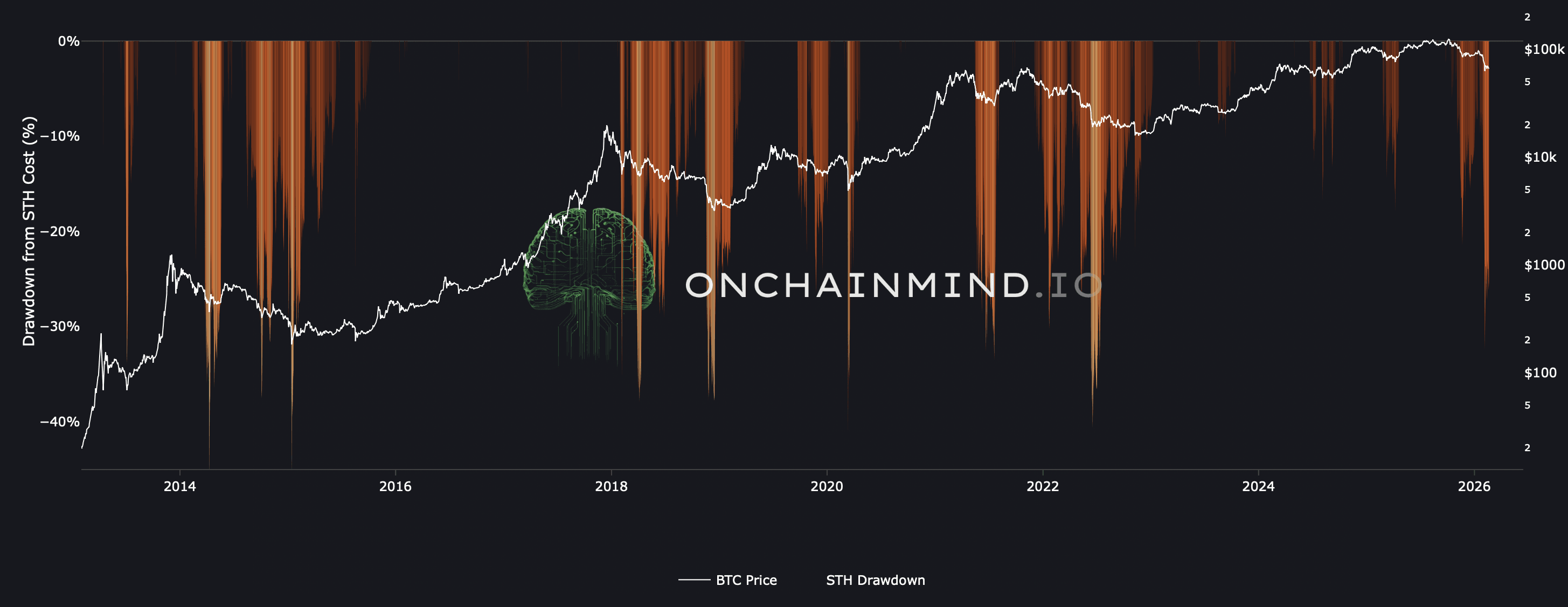
Bitcoin’s STH Drawdown
The Duration of Pain
Severity alone does not mark the end of a capitulation. Duration plays an equally important role.
This is where the Days Spent In Loss indicator becomes vital. Rather than measuring how far price has fallen beneath the reactive cohort’s cost basis, it measures how long it has remained there consecutively.
It does not measure how far price has fallen, but how long it has remained submerged. And in both markets and open water, survival is less about the depth you reach and more about how long you are forced to hold your breath beneath the surface.
When investors are underwater briefly, they tend to tolerate it. When they are underwater for months, behaviour changes. Confidence erodes. Narratives shift. Selling pressure compounds not because price is collapsing, but because patience is dissolving.
Historically, two duration thresholds have mattered:
~100 consecutive days — often aligns with localised capitulation and sharp relief rallies.
~200 consecutive days — has historically coincided with the most severe bear market exhaustion phases.
We have now surpassed the first threshold. The market has spent approximately 115 consecutive days trading below the short-term holder realised price. We have officially cleared the first hurdle of exhaustion.
Crossing the 100-day mark statistically increases the probability that we are entering the late stages of this stress cycle. However, history shows that some of the deepest capitulation phases extend toward the 200-day region before true structural recovery begins.
This leaves us at a fascinating crossroads.
We are either on the precipice of a sharp, V-shaped reversal as the market finally rejects these sub-cost-basis prices, or we are settling in for another ~85 days of grinding, sideways-to-down action.
If we are destined for that 200-day ultimate capitulation bottom, the calendar points us directly toward the middle of May before we see a sustained climb back into profitable territory for our most reactive cohort.
This is where macro context becomes relevant. Liquidity conditions, broader risk appetite, and structural technical momentum all influence whether we see a sharp reversal now or continued compression into early summer.
From a purely structural perspective, the current technical posture remains fragile. Momentum oscillators remain weak, trend structure has not yet decisively reversed, and downside volatility expansions have not fully exhausted.
For that reason, I lean towards the second scenario — a continued grind lower or sideways into late spring before a sustainable reversal emerges.
Capitulation is rarely a single dramatic event. It is a process. It grinds. It wears participants down. And it often resolves only once time has done the psychological damage that price alone cannot.
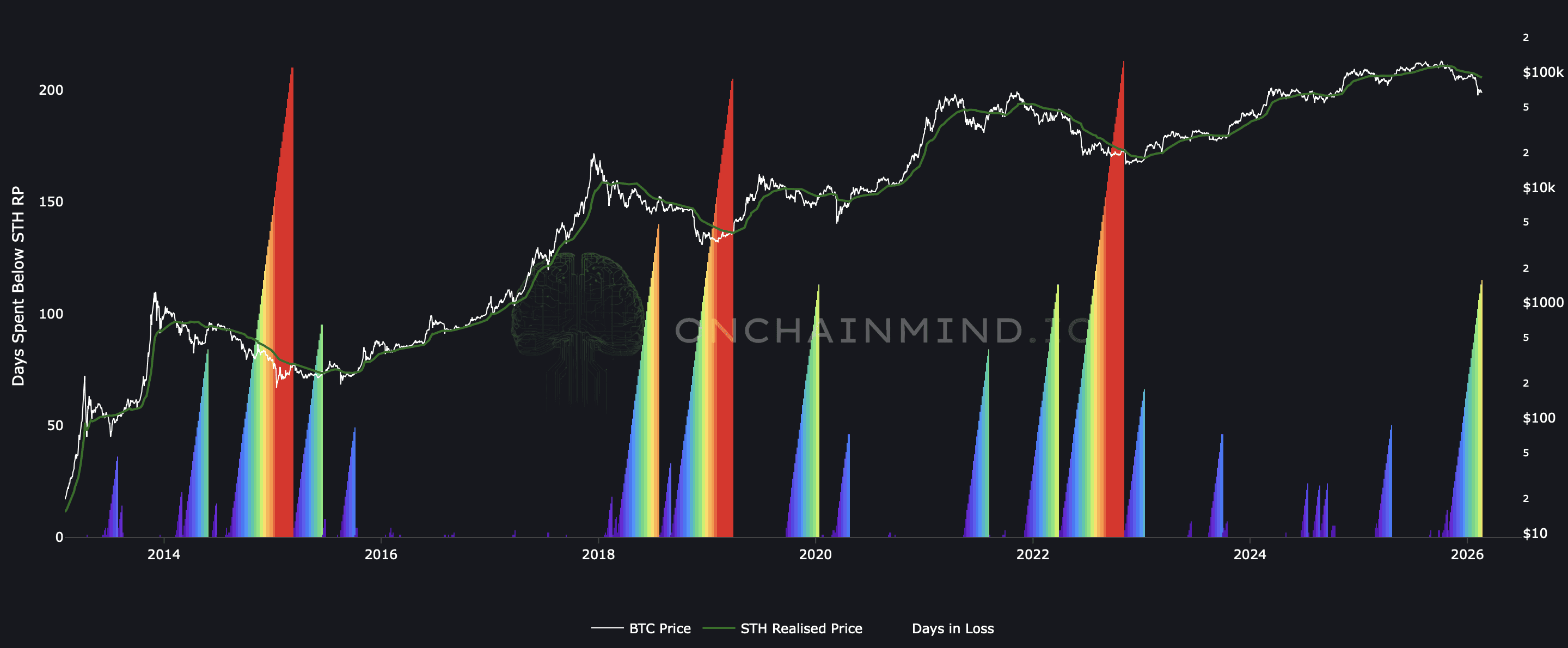
Bitcoin Days Spent In Loss
Composite Risk at Extreme Lows
To round out this technical picture, we must look at the Bitcoin Ω-Score.
This is an indicator I am particularly proud of, as it aggregates 10 distinct data components spanning on-chain metrics, technical analysis, and various macro cycle oscillators into a single, normalised 0-100% risk score.
To ensure it remains relevant as Bitcoin matures and the volatility dampening effect of institutional adoption takes hold, it utilises a 4-year rolling Z-score. This allows the indicator to calibrate itself against the evolving market conditions of each distinct market cycle.
The shift in the Ω-Score recently has been nothing short of violent. Just 30 days ago, the score sat at a relatively modest 27%. Today, it has plummeted to a mere 6.8%. This is the lowest risk reading we have seen in many years. When we drop down into these single-digit risk zones, it indicates that the price is completely depressed relative to its fundamental and technical value.
Historically, when the Ω-Score hits these levels, we tend to spend a few months building a final base layer. This is the period where price action feels heavy and uninspired, yet the underlying risk of significant further downside is statistically very low compared to the massive upside potential of a recovery.
It certainly does appear to be in the golden hour for long-term investors. Considering we have just dipped into these levels, it reinforces the scenario that we might bottom out and begin our ascent around May.
We have only recently entered extreme Omega compression. So if history rhymes, this suggests we may remain in this low-risk regime for some time before acceleration begins.
From a capital allocation standpoint, this is exactly where disciplined scaling starts to make sense, not because the price can’t fall further, but because the asymmetry is improving. When cyclical risk drops below 10%, history shows the next 12 to 24 months tend to skew positively.
This score is probably the most powerful cyclical DCA tool around; it tells you when to scale in aggressively while everyone else is running scared.
Volatility doesn’t disappear, it just becomes the way opportunity shifts to those who are willing to stay steady.
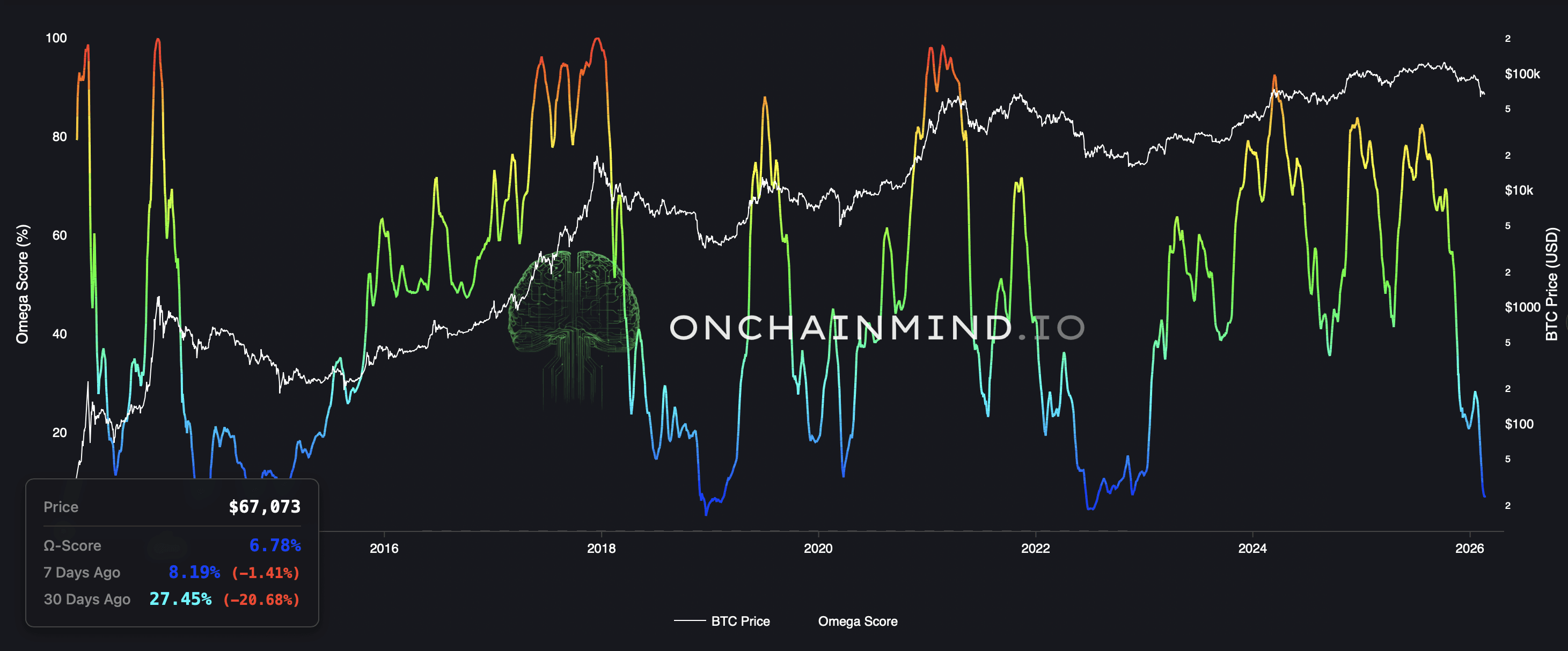
The Bitcoin Ω-Score
My Path Through the May Fog
The technical nature of the current price action is remarkably weak. Short-term holders are materially underwater. Duration below cost basis has surpassed the first historical capitulation threshold. Composite cyclical risk has compressed into some of the lowest levels of the current cycle.
While the "hopium" in the room wants an immediate reversal because we’ve hit that 115-day mark, my gut (and the data) is leaning toward a slightly longer road to recovery. I suspect we are looking at a May timeframe for a true trend shift. There is a specific kind of psychological exhaustion that happens when you stay in the red for over 100 days. Most people give up right around where we are now, convinced that the market is dead.
But for me, this is where the strategy gets aggressive. I love the position we are in because the data is screaming a massive opportunity while the sentiment is wholeheartedly defeated. The Ω-Score at 6.8% is a gift that doesn’t come along often. It validates the pain we are seeing in the STH Drawdown and the time we are seeing in the Days Spent In Loss. Everything is aligning to suggest we are in the final stages of a macro correction.
I am personally using this period to scale in more heavily. Yes, the price action is ugly, and yes, we are likely to see lower prices. But I would much rather be underwater for 3 months at these levels than miss the generational entry that these capitulation events provide.
The market is transferring wealth from the impatient to the patient, as it always does. We have survived the first 115 days of this test; whether there are 85 more or just 5, the end result remains the same.
We are currently buying the fear of those who bought the top. And historically, that is a winning trade.
I’ll catch you in the next one.
Cheers,