
ON-CHAIN METRIC
Liveliness
Is recent coin-day destruction high enough to lift Bitcoin’s cumulative Liveliness ratio?
Open the Dormancy dashboard
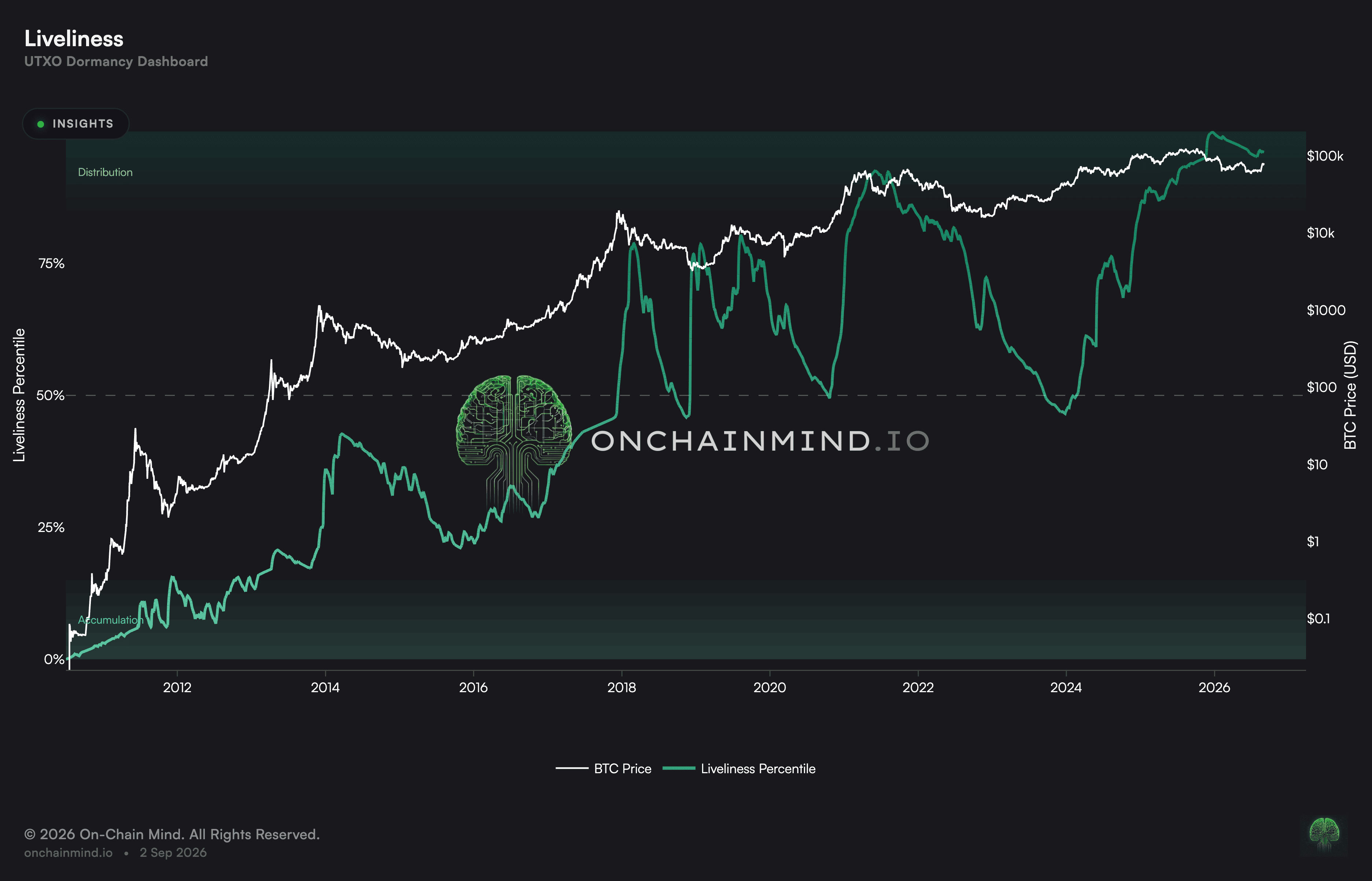
Bitcoin Liveliness is cumulative Coin Days Destroyed divided by all coin days created by the network. It ranges between 0 and 1 and tracks the balance between coin-day destruction and accumulation.
Analysts use its direction as a slow indicator of spending versus holding regimes. Those labels are interpretations of UTXO activity, not proof of investor intent.
How Liveliness is calculated
Formula. Cumulative Coin Days Destroyed ÷ Cumulative Coin Days Created.
Every unspent BTC accumulates 1 coin day per day. When an output is spent, its accumulated coin days are destroyed and counted in the numerator.
Why direction matters
Liveliness rises when current coin-day destruction is high relative to coin-day creation and above the cumulative relationship already embedded in the ratio. This is consistent with older supply becoming more active.
It falls when current destruction is low relative to creation and below that historical relationship, consistent with more supply remaining dormant. A flat line means the latest flow is close to the existing cumulative ratio.
What can distort the reading
The cumulative denominator makes the metric slow, but a sufficiently large and old output can still affect it. Self-transfers and custody activity can destroy coin days without an economic sale.
Entity-adjusted variants and transaction context can improve interpretation, but no method observes motive perfectly.
How to read it
Rising quickly. Current coin-day destruction is high relative to the cumulative history.
Rising. The balance leans towards spending of older outputs.
Flat. Current activity is close to the cumulative relationship already in the ratio.
Falling. The balance leans towards dormancy and coin-day accumulation.
Falling persistently. A longer holding regime under the model.
Liveliness updates inside the Dormancy dashboard, alongside Reserve Risk, Dormancy and CDD.
Related metrics: Vaultedness, Coin Days Destroyed and HODL Waves.
Common questions
What does Liveliness measure?
The share of all coin days ever created that have since been destroyed by spending.
What does a rising line mean?
Recent coin-day destruction is high enough relative to creation to lift the cumulative ratio, consistent with older outputs becoming more active.
Does falling Liveliness prove accumulation?
No. It indicates greater relative dormancy under the model. Lost coins and inactive operational wallets contribute too.
Can one transaction matter?
Yes, if the spent output is large and old enough, although the cumulative construction dampens most single events.
How should it be used?
As a slow regime filter alongside faster spending, price and volume measures, not as a day-trading signal.
ON-CHAIN METRIC
Liveliness
Is recent coin-day destruction high enough to lift Bitcoin’s cumulative Liveliness ratio?
Open the Dormancy dashboard
Bitcoin Liveliness is cumulative Coin Days Destroyed divided by all coin days created by the network. It ranges between 0 and 1 and tracks the balance between coin-day destruction and accumulation.
Analysts use its direction as a slow indicator of spending versus holding regimes. Those labels are interpretations of UTXO activity, not proof of investor intent.
How Liveliness is calculated
Formula. Cumulative Coin Days Destroyed ÷ Cumulative Coin Days Created.
Every unspent BTC accumulates 1 coin day per day. When an output is spent, its accumulated coin days are destroyed and counted in the numerator.
Why direction matters
Liveliness rises when current coin-day destruction is high relative to coin-day creation and above the cumulative relationship already embedded in the ratio. This is consistent with older supply becoming more active.
It falls when current destruction is low relative to creation and below that historical relationship, consistent with more supply remaining dormant. A flat line means the latest flow is close to the existing cumulative ratio.
What can distort the reading
The cumulative denominator makes the metric slow, but a sufficiently large and old output can still affect it. Self-transfers and custody activity can destroy coin days without an economic sale.
Entity-adjusted variants and transaction context can improve interpretation, but no method observes motive perfectly.
How to read it
Rising quickly. Current coin-day destruction is high relative to the cumulative history.
Rising. The balance leans towards spending of older outputs.
Flat. Current activity is close to the cumulative relationship already in the ratio.
Falling. The balance leans towards dormancy and coin-day accumulation.
Falling persistently. A longer holding regime under the model.
Liveliness updates inside the Dormancy dashboard, alongside Reserve Risk, Dormancy and CDD.
Related metrics: Vaultedness, Coin Days Destroyed and HODL Waves.
Common questions
What does Liveliness measure?
The share of all coin days ever created that have since been destroyed by spending.
What does a rising line mean?
Recent coin-day destruction is high enough relative to creation to lift the cumulative ratio, consistent with older outputs becoming more active.
Does falling Liveliness prove accumulation?
No. It indicates greater relative dormancy under the model. Lost coins and inactive operational wallets contribute too.
Can one transaction matter?
Yes, if the spent output is large and old enough, although the cumulative construction dampens most single events.
How should it be used?
As a slow regime filter alongside faster spending, price and volume measures, not as a day-trading signal.